
Little penguin facts for kids
Quick facts for kids Little penguin |
|
|---|---|
 |
|
| Little penguin in Kapiti Island, New Zealand | |
| Conservation status | |
Scientific classification  |
|
| Kingdom: | Animalia |
| Phylum: | Chordata |
| Class: | Aves |
| Order: | Sphenisciformes |
| Family: | Spheniscidae |
| Genus: | Eudyptula |
| Species: |
E. minor
|
| Binomial name | |
| Eudyptula minor (Forster, 1781)
|
|
 |
|
| Eudyptula minor is found in blue, red, and dashed areas. | |
| Script error: The function "autoWithCaption" does not exist. | |

Script error: No such module "Check for conflicting parameters".
The little penguin (Eudyptula minor) is the smallest species of penguin in the world. These birds are native to New Zealand and Australia. They are famous for their small size and beautiful blue feathers.
People often call them the fairy penguin, little blue penguin, or just blue penguin. In the Māori language, they are known as kororā. These penguins spend most of their day swimming in the ocean to catch fish. They only return to their homes on land when the sun goes down.
Contents
Physical Description
.jpg)
Little penguins are much smaller than other penguins like the Emperor penguin. They usually grow to be about 30 to 33 cm (12 to 13 in) tall. On average, they weigh about 1.5 kg (3.3 lb).
Their feathers are a slate-blue colour on their head and back. This helps them hide from predators in the dark ocean water. Their bellies are white, and their flippers are blue. They have a dark grey-black beak and pink feet with black soles.
Young penguins, or juveniles, have a shorter beak and lighter coloured feathers. Like most seabirds, they live a long time. In the wild, they live around 6.5 years, but some have lived up to 25 years in captivity.
Types of Little Penguins

For a long time, scientists thought all little penguins were the same species. However, recent studies show there are differences between them.
- New Zealand Little Penguin: Found mostly in New Zealand.
- Australian Little Penguin: Found in Australia and the Otago region of New Zealand.
There is also a type called the white-flippered penguin. It has white markings on its flippers and lives near Christchurch, New Zealand. Scientists are still studying exactly how these groups are related.
Habitat and Distribution
Little penguins live along the southern coastlines of Australia and New Zealand. They make their homes on offshore islands where they are safe from predators.
Australia
In Australia, you can find them in:
One of the most famous places to see them is Phillip Island in Victoria. Here, thousands of penguins march across the beach at night. This is known as the "Penguin Parade."
New Zealand
In New Zealand, they live on the coasts of the North and South Islands. They also live on smaller islands like Chatham Island. In the Otago region, the Australian type of little penguin has moved in and made a home there.
Diet and Hunting


Little penguins are excellent swimmers. They feed in coastal waters, which means they stay close to the shore.
What Do They Eat?
Their diet consists mostly of small fish. Some of their favourite foods include:
They catch their food by diving underwater. Most dives are shallow, only going down a few metres. However, they can dive up to 66 metres deep if they need to! An average dive lasts about 21 seconds.
Foraging Behaviour
These penguins are nocturnal on land. This means they are active on land only at night. They spend the whole day out at sea hunting for food.
When the sun sets, they gather in groups called "rafts" just offshore. Then, they swim to the beach together. This helps protect them from predators. They walk up the beach to their burrows to sleep or feed their chicks.
Reproduction and Life Cycle


Little penguins are devoted parents. They work together to raise their families.
Nesting
They build nests in burrows, which are holes dug into the ground. They also nest in caves, under rocks, or even under buildings. Sometimes they use man-made nest boxes provided by rangers.
Raising Chicks
The breeding season changes depending on where they live and the ocean temperature.
- The female usually lays two eggs.
- Both the mother and father take turns sitting on the eggs to keep them warm. This is called incubation.
- The eggs hatch after about 36 days.
- The parents take turns guarding the chicks and going out to sea to catch fish for them.
- After 7 to 8 weeks, the chicks are ready to leave the nest and swim on their own. This is called fledging.
In some places, if there is plenty of food, a pair of penguins might raise two families in one year. This is called double brooding.
Threats to Survival
Little penguins face many dangers in the wild. Their numbers have gone down in some areas because of these threats.
Predators
On land, introduced animals are a big problem. Animals that are not native to Australia or New Zealand hunt the penguins.
- Foxes and Dogs: These animals can kill many penguins in a single night. Uncontrolled pet dogs are a major risk near beaches.
- Cats: Feral and pet cats hunt young chicks.
- Stoats and Ferrets: These are a threat in New Zealand.
In the ocean, they are hunted by fur seals, sharks, and sea eagles.
Human Impact
Humans can accidentally hurt penguins in several ways:
- Oil Spills: Oil from ships is very dangerous. It damages their feathers so they cannot stay warm or float properly. Major spills like the Rena disaster in 2011 hurt many birds.
- Plastic Pollution: Penguins can mistake plastic for food or get tangled in rubbish.
- Habitat Loss: Building houses and roads near the coast destroys their nesting areas.
- Cars: Penguins crossing roads at night can be hit by vehicles.
Conservation Efforts

.jpg)
Many people are working hard to protect these special birds.
Legal Protection
Little penguins are protected by law in Australia and New Zealand. It is illegal to harm them or disturb their nests. In New Zealand, they are classified as "at risk – declining."
Guardian Dogs
One amazing success story happened on Middle Island in Victoria. Foxes were eating the penguins, and the colony almost disappeared.
- A farmer suggested using Maremma sheepdogs to protect the birds.
- These dogs are usually used to guard sheep, but they were trained to guard penguins instead.
- The first dog was named Oddball.
- The dogs successfully scared away the foxes, and the penguin numbers went back up.
- This story was made into a movie called Oddball.
Rescue and Rehabilitation
When penguins are sick or injured (like after an oil spill), they are taken to wildlife hospitals. Experts clean the oil off their feathers and feed them until they are strong enough to return to the wild.
Penguins and People


Little penguins are very popular with people. They are cute and interesting to watch.
Tourism
Watching penguins come home at sunset is a popular activity.
- Phillip Island: This is the most famous spot. Visitors sit on stands to watch the penguins march up the beach.
- Oamaru: In New Zealand, penguins sometimes nest under buildings in the town. There are special places to watch them safely.
- St Kilda: A colony lives on the breakwater near the city of Melbourne.
Mascots
The little penguin is famous in the computer world too! Linus Torvalds**, the creator of Linux, was once pecked by a little penguin in Australia. He chose a penguin named **Tux as the mascot for Linux because of this funny encounter.
Images for kids
-
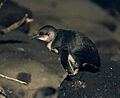
Little penguin at night at the St Kilda breakwater
-
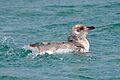
Swimming in Otago Harbour
-
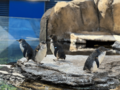
Little penguins at Birch Aquarium, La Jolla
.jpg)


See also
 In Spanish: Pingüino azul para niños
- Smallest organisms
- Penguin
