
Corynactis californica facts for kids
Quick facts for kids Corynactis californica |
|
|---|---|
 |
|
Scientific classification  |
|
| Kingdom: | Animalia |
| Phylum: | Cnidaria |
| Class: | Anthozoa |
| Order: | Corallimorpharia |
| Family: | Corallimorphidae |
| Genus: | Corynactis |
| Species: |
C. californica
|
| Binomial name | |
| Corynactis californica Carlgren, 1936
|
|
| Script error: The function "autoWithCaption" does not exist. | |
Script error: No such module "Check for conflicting parameters".
.jpg)
The Corynactis californica is a very colorful sea creature. It is often called the strawberry anemone because of its bright colors. It looks a lot like a sea anemone, but it's actually a type of animal called a corallimorph. This species is the only one of its kind found on the West Coast of North America.
You can find these amazing animals living deep in the ocean, sometimes as deep as 50 meters (about 164 feet). They like to attach themselves to vertical rock walls. They also live at the bottom of kelp forests. In some places, like Campbell River in British Columbia and Monterey Bay in California, they can cover large areas of the ocean floor.
Strawberry anemones are quite small, growing no bigger than 2.5 centimeters (about 1 inch). They come in many colors, including red, pink, purple, brown, yellow, or even pure white. They have tentacles that are white or clear. These tentacles have small, round tips. Unlike some corals, they don't have a hard, stony skeleton.
Contents
How Strawberry Anemones Reproduce
Strawberry anemones can make new anemones in two ways: sexually and asexually. Asexual reproduction helps them spread out and cover more space quickly.
- Sexual Reproduction: These anemones have separate male and female individuals. They release eggs and sperm into the water. This usually happens between August and November. The eggs and sperm meet in the water and form tiny embryos. These embryos then become small swimming larvae within a few days.
- Asexual Reproduction: This happens through processes like fission (splitting) or budding (growing a new part that breaks off). This allows a single anemone to create many copies of itself.
Strawberry Anemone Behavior
Strawberry anemones are known to be quite competitive. They will attack other types of sea anemones and corals if they are too close. They do this by touching their rivals with their tentacles for a long time.
When they attack, they release special thin white strings called mesenterial filaments. These strings contain enzymes and toxins. If they stay in contact long enough, these toxins can kill the other species. This allows the strawberry anemone to take over the empty space.
It's interesting that strawberry anemones do not attack other members of their own species. This is a special trait among anemones in their area. They also use these mesenterial filaments for other important things. They help the anemone eat larger prey. They also act as a way to defend themselves against predators, like the leather star.
Where Strawberry Anemones Live
Studies show that strawberry anemones grow best under the cover of large seaweeds, also known as macroalgae. They especially like to live under Macrocystis pyrifera (giant kelp) and Eisenia arborea.
These large seaweeds might help the anemones in a few ways. They could protect the tiny swimming larvae. They might also help direct food particles towards the anemone's polyps, making it easier for them to eat.
Images for kids
-
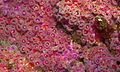
Strawberry anemones forming a large colony off Santa Cruz Island, California

