
Television facts for kids

Television (often called TV) is a popular way to send and receive moving images and sound. The word can refer to the technology used to send signals, the programs we watch, or the actual television set in our homes. TV is a type of mass media, which means it reaches a large audience. It is used for entertainment, news, sports, and education.
In the early days, television was experimental and used mechanical parts. By the late 1920s, electronic television was developed. After World War II, black-and-white TV became very popular in the United States and the United Kingdom. During the 1950s, television became the main way people influenced public opinion. Color TV became common in the 1960s.
Technology has changed how we watch TV. In the past, people used video tapes like VHS and DVDs to watch movies at home. Today, we often use cloud computing and streaming services like Netflix, Disney+, and YouTube. Since the early 2010s, smart TVs have allowed us to connect directly to the Internet to stream our favorite shows and movies.
Contents
Etymology
The word television comes from two different languages. Tele is Greek for "far," and visio is Latin for "sight." So, television literally means "far sight." The word was first used in 1900 by a Russian scientist named Constantin Perskyi at a big event in Paris called the International World Fair.
People often use short names for television. The abbreviation "TV" has been used since 1948. In the United Kingdom, it is often called the "telly." An older slang term is "the tube," which refers to the glass tubes used in old TV sets.
History of Television
Mechanical Television

Before modern electronic TVs, inventors created mechanical televisions. In 1884, a German student named Paul Nipkow invented the Nipkow disk. This was a spinning disk with holes in a spiral pattern. As the disk spun, it scanned an image line by line.
In the 1920s, a Scottish inventor named John Logie Baird used this disk to build a working TV system. On March 25, 1925, Baird showed the first moving silhouette images at a store in London. Later, in 1926, he demonstrated the first transmission of a face in motion. His system had only 30 lines of resolution, which made the picture look a bit blurry, but it was a huge breakthrough.
Electronic Television

Mechanical systems were eventually replaced by electronic ones. This technology relied on the cathode-ray tube (CRT), invented by Ferdinand Braun in 1897. The CRT was a glass tube that could display images using electron beams.
Two key inventors helped create electronic TV:
- Philo Farnsworth: An American inventor who demonstrated the first all-electronic television system in 1927. He transmitted a simple straight line as his first image.
- Vladimir Zworykin: A Russian-American inventor who developed the iconoscope, a type of camera tube, for RCA.
Electronic television was much better than mechanical TV because it had no moving parts and could show clearer pictures. By the late 1930s, electronic broadcasting began in countries like the UK, Germany, and the USA. The 1936 Summer Olympic Games in Berlin were broadcast live to public places, which was a major event for early TV.
Color Television

Early TV was only in black and white. Inventors wanted to add color almost immediately. John Logie Baird demonstrated the first color transmission in 1928. However, it took many years to make a system that worked well for everyone.
In the United States, a color system was approved in the early 1950s. The first national color broadcast happened in 1954. However, color TV sets were very expensive, so most people still watched in black and white for a long time. It wasn't until the mid-1960s and early 1970s that color TVs became common in homes.
Digital and Smart Television
In the late 1990s and 2000s, television technology changed from analog signals to digital signals. Digital TV (DTV) allows for much clearer pictures and better sound. It also lets broadcasters send more data, which enabled High-Definition TV (HDTV).
Following the digital revolution, Smart TVs became popular. These TVs have built-in computers and connect to the Internet. They allow users to use apps, browse the web, and stream videos without needing a separate box. By the late 2010s, most new TVs sold were Smart TVs.
How Television Works
Television signals can be sent to your home in several different ways.
Terrestrial Television

This is the traditional way to receive TV. Broadcasters send radio waves through the air from tall towers. To watch these channels, you need an antenna (sometimes called "rabbit ears" or a roof aerial) connected to your TV. This service is often free, which is why it is called "free-to-air."
Cable Television

Cable TV sends signals through cables that run underground or on telephone poles directly to your house. This started in the 1940s to help people in mountains or remote areas get better reception. Later, cable companies began offering hundreds of channels for a monthly fee.
Satellite Television

Satellite TV uses communication satellites orbiting the Earth. Broadcasters send the signal up to the satellite, which bounces it back down to Earth. Viewers use a satellite dish to catch the signal. This is very useful for people living in rural areas where cable wires do not reach.
Internet Television
Internet television, or streaming, uses the Internet to deliver video. Services like Netflix, Hulu, Amazon Prime Video, and YouTube allow you to watch what you want, when you want. This is often called "Video on Demand." Since the 2010s, many people have become "cord cutters," meaning they cancel their cable subscriptions to use streaming services instead.
Television Sets

A television set (or TV receiver) is the device we use to watch programs. It has a tuner to receive signals, a screen to show images, and speakers for sound.
Display Technologies
Over the years, the screens on our TVs have changed a lot.
CRT (Cathode-Ray Tube)

For a long time, TVs were big, heavy, and boxy. They used a large glass tube called a cathode-ray tube. Inside, an electron gun shot beams at the front of the screen, which was coated with special chemicals that lit up to create the picture. These TVs are rarely made today.
Flat-Panel Displays

Modern TVs are thin and light. They use different technologies:
- LCD (Liquid Crystal Display): These use liquid crystals that open and close to let light through.
- LED (Light Emitting Diode): These are LCD screens that use LED lights for backlighting. They are energy-efficient and bright.
- OLED (Organic Light Emitting Diode): These screens use organic compounds that light up on their own. They do not need a backlight, so they can be extremely thin and show perfect black colors.
Screen Resolution

Resolution refers to how clear the picture is. It is measured in pixels (tiny dots that make up the image).
- SD (Standard Definition): The old format used by analog TVs. It had about 480 lines of resolution.
- HD (High Definition): Offers much sharper images. Common formats are 720p and 1080p (Full HD).
- UHD (Ultra High Definition): Also known as 4K, this has four times the detail of Full HD. There is also 8K, which is even sharper.
Television Content
Television programs are made to entertain, inform, and educate.
Genres
There are many different types of TV shows, called genres:
- Drama: Serious stories with actors, like police shows or medical shows.
- Comedy: Funny shows, often called "sitcoms" (situation comedies).
- News: Programs that report on current events and weather.
- Sports: Live broadcasts of games like football, soccer, and basketball.
- Reality TV: Shows that film real people in unscripted situations.
- Documentaries: Educational programs about history, nature, or science.
- Animation: Cartoons for kids and adults.
Funding
TV stations need money to operate. They get this money in a few ways:
- Advertising: Companies pay the TV station to show commercials for their products.
- Subscriptions: Viewers pay a monthly fee to watch channels (like cable or Netflix).
- Public Funding: Some channels, like the BBC in the UK or PBS in the USA, receive money from the government or viewer donations to provide educational content without many commercials.
Social Aspects

Television is a big part of modern life. It can be a great tool for learning. Educational shows can teach science, history, and languages. News programs help people understand what is happening in the world.
However, watching too much TV can have downsides. Sitting for long periods is not healthy for the body. It is important to balance screen time with physical activity and other hobbies. Parents often monitor what children watch to ensure the content is safe and age-appropriate.
Safety
Modern flat-screen TVs are light but can be top-heavy. It is important to secure them properly so they do not tip over, especially in homes with small children or pets.
Images for kids
-
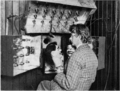
John Logie Baird with his early mechanical TV equipment and a dummy named "Stooky Bill"
-

Map showing the number of television sets per 1000 people around the world


See also
 In Spanish: Televisión para niños
- B-television
- Broadcast-safe
- Broadcast television systems
- Content discovery platform
- Information-action ratio
- List of countries by number of television broadcast stations
- List of television manufacturers
- List of years in television
- Lists of television channels
- Media psychology
- MicroLED
- Sign language on television
- Telephilia
- Television addiction
- Television studies
- Test card
- TV accessory
