
History of the Jews in Manchester facts for kids
The city of Manchester, England, grew very quickly in the late 1700s. During this time, a small Jewish community started to form there. Some members of this community opened businesses, and they also had a place where they could worship. The story of Manchester's Jewish community is told at the Manchester Jewish Museum in Cheetham. The Jewish community in Manchester is the second largest in Britain, after the one in Greater London.
Contents
Early Jewish Settlers in Manchester
In the 1750s, Jewish people in England did not have many political rights. For example, they were not allowed to buy property. Many Jewish people worked as traveling sellers, called pedlars or hawkers. They would travel to different towns to sell their goods. Small groups of Jewish people would gather in friendly lodging houses. Here, they would organize temporary prayer groups called minyanim to observe the Shabbat, their day of rest.
Liverpool was a main city for the first Jewish settlers in the North West of England. But Manchester was growing fast. By 1758, one Jewish family in Manchester became wealthy enough to own a private carriage. Manchester became a very important market. Jewish hawkers from Liverpool often worked in Manchester during the week and returned to Liverpool for Shabbat.
Challenges Faced by Early Settlers
Newspapers in Manchester at the time sometimes showed unfair prejudice against Jewish people. Jewish people traditionally traded in items like used clothes, jewelry, and calligraphy. They also worked as pawnbrokers, watchmakers, and engravers. These jobs were profitable. However, there was a fear in Manchester that traveling people might share secrets of the cotton industry with other countries. They worried this would harm England's trade.
Prescott's Manchester Journal warned in 1774:
- Several JEWS and OTHER FOREIGNERS have for some months past visited the town for different reasons. Some of them have gotten spinning machines, looms, and other tools used to make cotton goods. ... And many attempts have been made to convince workers to go to foreign countries outside the King's lands... This will destroy the trade of this country, unless stopped in time.
No Jewish person was ever found guilty of these specific charges. Despite this, wealthy Jewish traders were noticed. By 1788, a jeweler named Simon Solomon and a flower dealer named Hamilton Levi opened shops in Long Millgate and Shudehill.
Establishing a Community in Manchester
Around 1786, about fourteen Jewish families settled in Manchester. Their first synagogue was a rented room at Ainsworth Court. By 1796, they were worshipping in a room on Garden Street. They also leased a burial ground in 1794. Aaron Jacob was their reader and shochet (a person who prepares kosher meat), and Jacob Nathan was the overseer. Jewish families settled in the streets near the synagogue.
Wars against the French caused problems for them. The Aliens Act 1793 limited their movement. In 1800, Wolf Polack, a pawnbroker, was sent away for breaking this Act. Wheeler's Manchester Chronicle supported the Act and encouraged readers to report on foreigners. Despite these challenges, the community was generally stable.
Samuel Solomon, who bought a plot in the burial ground, sold a special medicine called Balm of Gilead. He also sold "Solomon's Drops" for skin problems. He bought a large house in Kensington, Liverpool, which he called Gilead House. He also bought land on Mossley Hill for a family burial place.
Nathan Meyer Rothschild came to Manchester from Frankfurt in August 1800. His father sent him to learn about English business. He arrived with a lot of money, about £20,000. He opened offices to buy English textiles directly at the lowest prices. He focused on raw materials, dyeing, and manufacturing. He traded dye and cotton for finished products, which were sent to Hamburg. The war made this harder. Rothschild lived in a nice suburb called Ardwick. Many German merchants moved to Manchester between 1800 and 1806, and eight of them were Jewish. Rothschild was the only one who regularly attended the synagogue. His money likely helped get a Rabbi and build a wall around the burial ground. By 1805, he spent less time in Manchester as his family's business moved more towards banking. He left Manchester in 1811.
Growth After the Napoleonic Wars
After the Napoleonic Wars, Manchester grew very quickly. There were also demands for political rights, like the large gathering at Peterloo in 1819. The Jewish community supported the existing government. Jacob Nathan signed a letter promising to help keep public peace. The Manchester Guardian, started in 1821, strongly supported the rights of all religious groups.
The fifteen most important Jewish families at this time had become well-integrated into society. Most were shop owners, with a few wealthy merchants and manufacturers. Their jobs included clothes dealers, jewelers, dentists, and silk manufacturers. Their businesses were mainly in the old town. Some families lived in nicer areas like Chorlton-on-Medlock and Salford. These wealthy families were the main leaders of the synagogue. Manchester had the fourth-largest Jewish community outside London.
Abraham Franklin (born 1784) became a leader of the Halliwell Street Synagogue. He started as a hawker and later owned a shop. He was very traditional in his religious beliefs. He also wanted the Jewish community to be respected in English society. He did not like the new Jewish immigrants who spoke broken English and seemed to have different business values. He believed they harmed the reputation of the settled Jewish traders. He wanted a larger synagogue, sermons in English, a choir, and groups to help with education and charity.
When the cholera sickness spread in 1832, wealthy people moved out of the city to suburbs like Broughton and Cheetham Hill. Franklin called his new home Gesunde House.
In 1826, Alexander Jacob, with Franklin's help, started the Manchester Hebrew Philanthropic Society. This group helped the elderly and poor Jewish people. They could not use the regular poor relief because of their special dietary rules. People gave money voluntarily to this society. Before the 1832 Reform Act, Manchester did not have its own Member of Parliament. The synagogue had to help poor immigrants who were not used to English ways and struggled to find work. These immigrants challenged the respectability the community had worked hard to gain.
Another change was in tailoring. Around 1830, retail businesses started taking orders from customers and then giving the work to people who worked from home or in small, often crowded, workshops. Benjamin Hyam was a very important retail middleman. He created modern mass-market tailoring, where he made money by selling many suits at lower prices, not just a few at high prices. He claimed to make a full suit in six hours in workshops connected to his shop. He advertised in the Manchester Guardian and offered money back if customers were not happy. He likely had over 100 workers. Hyam was very traditional in his faith, and his shop closed at sunset on Friday. His influence was so strong that by 1836, seven other synagogue members became tailors like him. The difficult conditions they put on their workers led to strikes in 1833 and 1834, but these strikes were not successful. Soon, ready-made clothing became common.
Wealthy Families in the Suburbs

The years 1834–1836 were very good for the cotton industry. Wealthy business owners traveled by carriage from their homes in the suburbs. Foremen and clerks came by bus from areas like Upper Brook Street and Cheetham Hill. The city center became a place of large warehouses. Meanwhile, areas like Newton, Ancoats, and Little Ireland had crowded, poor housing for workers. Franklin, Simmons, Hyam, the Jacob brothers, and Simon Joseph were all rich shop owners.
From 1834, many merchants came to Manchester and set up businesses. By 1837, there were 101 foreign export companies, and 75 of them were German. Thirteen new companies were run by Jewish people who were mostly young and brought a lot of money to invest. These newcomers were different from the older Jewish merchants who were becoming less connected to the synagogue. Only one of the newcomers stopped practicing their faith, as they felt proud of their Jewish identity. Even though 1837–43 were difficult years for the economy, 28 more Jewish merchants moved from the Netherlands and Northern Germany. Samual Hadida from Gibraltar and Abraham Nissim Levy from Constantinople also bought a warehouse on Mosley Street. The 1841 census showed that at least 76 Jewish people worked in the cotton trade in Manchester.

The Behrens Warehouse was built around 1860 for Louis Behrens & Sons. The Behrens family was very important in the banking and social life of Manchester's German community. Louis Behrens was the first chairman of the Schiller Anstalt, a German cultural society. Famous people like Charles Hallé and Karl Marx were members of this group.
Mid-19th Century Changes
The Reform Synagogue
In the mid-1800s, political events in Germany led to changes. Jewish and non-Jewish German liberals in Manchester came together to support German nationalist movements. The 1851 census showed that about 1,000 people born in Germany lived in Manchester, and 292 of them were Jewish. The leaders of the new synagogue were becoming more successful. David Hesse, for example, had bought a factory.
The Manchester Reform Synagogue was started in 1857. It was called the "Manchester Congregation of British Jews" and was mainly founded by German-Jewish immigrants. This synagogue was damaged by bombs during wartime in 1941. A new building was built in 1952.
Loss of a Rabbi
In 1859, the Sephardic Jewish community in Manchester, who came from Aleppo, Syria, asked Rabbi Yeshaya Attia to be their leader. However, he disappeared. Years later, a record was found showing that he was on a ship traveling from Alexandria, Egypt, to Liverpool, England. Sadly, he was lost in a storm at night in the Bay of Biscay on June 26–27, 1859.
Images for kids
-
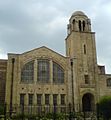
The former South Manchester Synagogue, Wilbraham Road, Fallowfield
-
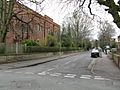
A synagogue in Queenston Road, West Didsbury


