
Jeddah Tower facts for kids
Quick facts for kids Jeddah Tower |
|
|---|---|
|
برج جدة
|
|

Jeddah Tower as of May 2026, after construction had reached the 100th floor
|
|
| General information | |
| Status | Under construction |
| Type | Mixed-use |
| Architectural style | Neo-futurism |
| Location | Jeddah, Mecca Province, Saudi Arabia |
| Coordinates | 21°44′02.4″N 39°04′58.5″E / 21.734000°N 39.082917°E |
| Construction started | 1 April 2013 |
| Estimated completion | August 2028 |
| Cost | US$1.2 billion |
| Owner | Kingdom Holding Company |
| Management | CBRE Group |
| Height | |
| Architectural | At least 1,008 m (3,307 ft) |
| Roof | At least 1,008 m (3,307 ft) |
| Top floor | 638 m (2,093 ft) |
| Observatory | 630 and 638 m (2,067 and 2,093 ft) (sky terrace at 630 m (2,067 ft)) |
| Technical details | |
| Structural system | Reinforced concrete and steel, all-glass facade |
| Floor count | 167 floors; 252 levels |
| Floor area | 243,866 m2 (2,624,950 sq ft) |
| Lifts/elevators | 57 (50 single-decked, 7 double-decked) made by Kone + 1 workmen's lift |
| Design and construction | |
| Architect | Adrian Smith |
| Architecture firm | Adrian Smith + Gordon Gill Architecture |
| Developer | Jeddah Economic Company |
| Engineer | Langan International (sub-grade and transportation planning) |
| Structural engineer | Thornton Tomasetti |
| Main contractor | Saudi Binladin Group |
The Jeddah Tower is a super-tall skyscraper being built in Jeddah, Saudi Arabia. It is located in the northern part of the city. This amazing building is the main part of the Jeddah Economic City project. The Jeddah Tower is planned to be the first building ever to reach one kilometer (about 0.6 miles) in height. Once finished, it will be the tallest building in the world. It will stand at least 180 meters (about 590 feet) taller than the famous Burj Khalifa.
Contents
Building the World's Tallest Tower
The Jeddah Tower was designed by American architect Adrian Smith. He also designed the Burj Khalifa, another very tall building. The project leader is Saudi Arabian prince Al-Waleed bin Talal. His company, Kingdom Holding Company (KHC), is a partner in the Jeddah Economic Company (JEC). JEC was created in 2009 to build the Jeddah Tower and the surrounding city.
Construction on the tower paused in January 2018. At that time, about one-third of the building was complete. The work stopped due to some challenges with the construction team and later the COVID-19 pandemic. In September 2023, new plans were made to finish the project. After almost five years, building work started again in 2023. Construction officially restarted in January 2025. By April 14, 2026, the tower's construction had passed the 100th floor. The building is expected to be finished by 2028.
The Tower's Location and Purpose
The Jeddah Tower stands on a large plot of land, about 50 hectares (124 acres) in size. This area is part of the bigger Jeddah Economic City project. This project is being built on a huge piece of undeveloped land near the waterfront. It is about 20 kilometers (12 miles) north of the city of Jeddah. The Jeddah Economic City was designed by HOK Architects. It is a massive project that will cost billions of dollars.
The goal is for this area to become a brand new part of Jeddah. The Jeddah Tower itself will be home to many things. It will have a Four Seasons hotel, fancy apartments, modern offices, and luxury homes. It will also feature the world's highest observation deck, where visitors can enjoy amazing views. The location was chosen because it offers a lot of space for this huge new city to grow.
How the Tower Was Built
Early Plans and Design
Planning for the Jeddah Tower began many years ago. In 2008, there were some questions about whether the ground could support such a tall building. The first ideas for the tower were even taller, possibly a mile high! But the plans were later adjusted.
In March 2010, Adrian Smith and his firm, Adrian Smith + Gordon Gill Architecture, were chosen to design the tower. Adrian Smith is famous for designing other very tall buildings around the world. These include the Zifeng Tower in China and the Trump International Hotel & Tower in Chicago.
Starting Construction
By August 2011, the designs for the tower's foundation were ready. The foundation needed to be very strong to support the massive weight of the building. It is similar to the foundation of the Burj Khalifa, but even larger. It uses many deep piles and a thick concrete base. This design helps the building settle evenly into the ground.
In August 2011, the Saudi Binladin Group was chosen as the main construction company. They signed a contract worth about US$1.23 billion. Construction officially began on April 1, 2013. The deep pilings for the foundation were finished by December of that year. This allowed the above-ground construction to start in September 2014.

Pauses and Restarting Work
In late 2017, there were some changes with the owners and main contractors of the project. This led to a pause in structural concrete work in January 2018. The tower was about one-third complete at that time. Work was stalled again in 2020 because of the COVID-19 pandemic. These events caused several years of delays.
However, the project did not stop for good! In September 2023, plans were made to restart construction. Many construction companies were asked to submit bids to finish the tower. Construction officially resumed in January 2025. Workers made good progress, and by April 26, 2026, the tower had reached its 100th floor. A new crane was added to help speed up the building process.

Who is Building the Tower?
The main designer of the Jeddah Tower is Adrian Smith. His company, Adrian Smith + Gordon Gill Architecture, is based in Chicago. Adrian Smith also designed the Burj Khalifa. The company managing the tower's development is Emaar Properties.
Thornton Tomasetti is the company responsible for the structural engineering. This means they make sure the building is strong and safe. Environmental Systems Design, Inc. (ESD) helps with the building's systems like plumbing, electricity, and fire safety. The main construction company is the Saudi Binladin Group. They are known for their experience in building large projects.
The Jeddah Economic Company (JEC) was created in 2009 to manage the finances for the Jeddah Tower and the surrounding city. Several important companies and individuals are part of JEC. These include Kingdom Holding Company, which is an investment company owned by Al-Waleed bin Talal.
How the Tower is Designed
The Jeddah Tower is designed to be at least 1,008.2 meters (about 3,308 feet) tall. Its exact height is kept a secret during construction, just like the Burj Khalifa. This height will make it the tallest building in the world.
Strong Structure and Foundation
The tower uses a special concrete structure that is very strong. It has a central core shaped like a triangle with three wings. These wings help the building stand firm against strong winds. The design is an improved version of what was used for the Burj Khalifa.
The tower sits on a deep foundation system. This system uses 270 strong concrete piles, which are like giant stilts. These piles go deep into the ground, some as far as 105 meters (344 feet). They are connected by a thick concrete slab. This special foundation helps the tower stay stable on the ground near the Red Sea.
Keeping the Tower Steady
To help control how the tower moves in strong winds, especially at the very top, it has a special system. This system uses large weights called "tuned mass dampers." These dampers are placed high up in the spire. They help reduce the swaying caused by wind, making the building more comfortable and safe.
Building Systems and Elevators
The tower has advanced systems for plumbing, electricity, and fire safety. Orange Group is in charge of all the communication technology inside the building.
Getting around such a tall building needs a very smart elevator system. The Jeddah Tower will have 57 elevators and 8 escalators, all made by the company Kone. These elevators are organized into sections, with "sky lobbies" where people can switch elevators to go higher. This makes travel faster and more efficient.
The elevators going to the highest observation deck are super-fast. They can travel up to 10 meters (33 feet) per second! To make this possible, they use a special carbon-fiber rope called KONE UltraRope. This rope is much lighter than traditional steel cables. It allows elevators to travel much longer distances without the rope becoming too heavy.
A "Vertical City"
The Jeddah Tower is designed to be like a "vertical city". It will have shops, hotels, and homes all in one place. The cost to build it is estimated at US$1.23 billion. This is less than the Burj Khalifa, partly because of lower labor costs.
The area around the tower will also be developed. It will include public spaces, a shopping mall, and other buildings. This whole area is called the Jeddah Tower Water Front District. The tower is meant to be a symbol that helps increase the value of the surrounding land.
The Tower's Impact
Saudi Arabia's real estate market has seen a lot of growth. The Jeddah Tower is a big part of this growth. The Saudi government is also investing billions of dollars in new homes and other projects across the country. This is to meet the needs of its growing population.
The Jeddah Tower is a key part of the larger Jeddah Economic City development. Many other big projects are happening in Saudi Arabia too. For example, the King Abdulaziz International Airport is being expanded. These projects show how much Saudi Arabia is investing in its future. The Jeddah Tower and its surrounding city are also designed to be environmentally friendly, using modern technology to reduce their impact on the planet.
Floor Plan
The Jeddah Tower is expected to have 167 floors. The total number of levels will reach 252. Many of these levels are not full floors but smaller sections for different uses.
| Floor | Purpose |
|---|---|
| Levels 240–252 (Spire) | Steel top Spire |
| Level 250 (Spire) | Building Maintenance Unit (BMU) |
| Level 206–218 (Spire) | Tuned mass dampers (870 + 260 Tons) |
| Level 204 (Spire) | BMU |
| Level 186 (Spire) | BMU |
| Level 168 (Spire) | BMU |
| Level 167 (Spire) | Sky Raft (Four-meter-thick Spire Transfer Slab) |
| Levels 161–166 | Mechanical, Electrical and Plumbing (MEP) / BMU / Medium Voltage (MV) electrical equipment / Water Tanks Floors |
| Levels 157–159 | Observatory & Sky Terrace (630 m) |
| Level 155 | MEP / BMU Floors |
| Level 154 | Refuge Floor |
| Levels 126–153 | Void Space with Electric / Mechanical Rooms / Future Flexible Space |
| Level 124 (double height) | Refuge Floor |
| Levels 121–123 | MEP / BMU Floors |
| Levels 106–120 | Residential Group 4 Apartments (37 Units) |
| Level 104 (double height) | Refuge Floor |
| Levels 99–103 | Residential Group 4 Apartments (28 Units) |
| Levels 95–96 | MEP Floors |
| Levels 87–94 | Residential Group 3 Apartments (40 Units) |
| Level 86 | Refuge Floor |
| Level 84 (double height) | Residents Sky Lobbies Groups 3 & 4 |
| Levels 73–83 | Residential Group 2 Apartments (61 Units) |
| Level 71 (double height) | Refuge Floor |
| Levels 68–69 | MEP / BMU Floors |
| Levels 58–67 | Residential Group 1 Apartments (57 Units) |
| Level 56 (double height) | Refuge Floor |
| Levels 43–55 | Residential Group 1 Apartments (102 Units) |
| Levels 42–43 | Residents Sky lobbies Groups 1 & 2 |
| Levels 39–40 | MEP / BMU Floors |
| Level 38 | Refuge Floor |
| Levels 27–37 | Four Seasons Private Residences (97 Units) |
| Levels 20–26 | Four Seasons Hotel (182 Keys) |
| Level 18 | Refuge Floor |
| Levels 15–16 | MEP Floors |
| Levels 7–13 | Offices (sellable areas Core and Shell) |
| Level 4–6 (Podium) | Hotel Spa, Pools, Fitness ..... |
| Level 2 (Podium) | Residential group 2 Lobby, Hotel amenities |
| Level 1 (Podium) | Lobby and Drop-offs (Residential, Hotel and Offices) |
| Basement 1 Mezz (Podium) | Observatory Lobby, Security |
| Basement 1 (Podium) | Parking, Security, Hotel Administration |
| Basement 2 (Podium) | Ballroom, Restaurants, Parking, MEP, Back Of House (BOH), Facility Management (FM) service areas |
| Basement 3 (Podium) | Car Parking, Facilities Management, MEP |
| Below Podium | Pile raft foundation
Total number of 270 circular bored piles ranging from 45 to 105 meters depth and 1.5–1.8 m diameter. |
Images for kids
-
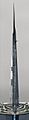
2011 rendering of the tower’s design
-
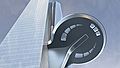
2nd proposed design of the sky terrace
-
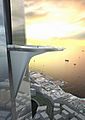
3rd proposed design of the sky terrace


See also
 In Spanish: Jeddah Tower para niños
- List of tallest buildings
- List of future tallest buildings
- List of tallest buildings in Saudi Arabia
- The Illinois
