
Krokolithes facts for kids
Quick facts for kids Krokolithes |
|
|---|---|
 |
|
| Holotype of K. dinophilus | |
Egg fossil classification  |
|
| Basic shell type: | †Crocodiloid |
| Oofamily: | †Krokolithidae |
| Oogenus: | †Krokolithes |
Imagine finding a fossilized egg! That's what Krokolithes is – a special type of fossil egg from ancient crocodiles. It's not a fossil of the crocodile itself, but of its egg.
Contents
What is Krokolithes?
When scientists find fossil eggs, it's often hard to know exactly which animal laid them. So, they give these eggs their own special name, called an oogenus (say: oh-OH-jee-nus). Krokolithes is an oogenus for crocodile eggs.
This means that if you find a fossil egg that looks like it came from an ancient crocodile, but you don't have the parent crocodile's bones nearby, you can call the egg Krokolithes. The most famous example is Krokolithes dinophilus, which you can see in the image here.
Why Study Fossil Eggs?
Fossil eggs are like tiny time capsules! They tell us amazing things about animals that lived millions of years ago. By studying these eggs, scientists can learn about:
- How big the parent crocodiles were.
- Where they nested, like on land or near water.
- What their babies might have looked like when they hatched.
- The environment and climate of the Earth long ago.
Learning from Eggshells
Even tiny pieces of eggshell can give clues! Scientists can study the structure of the shell under a microscope. This helps them understand how the egg was built and how it protected the growing baby crocodile inside.
When and Where Did These Crocodiles Live?
The crocodiles that laid Krokolithes eggs lived a very long time ago. Their fossils have been found in rocks from the Campanian age, which was about 83.5 to 70.6 million years ago. This was during the Cretaceous Period, a time when dinosaurs were still roaming the Earth!
Global Discoveries
Krokolithes eggs have been discovered in several parts of the world. Scientists have found them in:
These discoveries show that ancient crocodiles were widespread across different continents. They lived in various environments, from what is now Europe to North America.
Other Time Periods
While the main fossil range for Krokolithes is Campanian, similar crocodile egg fossils have been linked to other periods too. These include the Tithonian (even older), Barremian, Maastrichtian (the very end of the dinosaur age), and even the Oligocene (much later, after the dinosaurs were gone). This suggests that crocodiles and their egg-laying habits have a very long history on Earth.
Images for kids
-
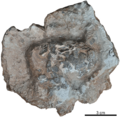
Holotype of K. dinophilus
