
President of Bulgaria facts for kids
Quick facts for kids President of the Republic of Bulgaria |
|
|---|---|
| Президент на България | |

|
|
.jpg) |
|
| Style | Her Excellency (diplomatic) Ms. President (informal, more widely used) |
| Residence | Sofia (office), Boyana (residential) |
| Appointer | Direct elections |
| Term length | 5 years renewable once |
| Constituting instrument | Constitution of Bulgaria (1991) |
| Precursor | State Council (1971-1990) Chairman (President) (1990-1992) |
| Inaugural holder | Zhelyu Zhelev Modern presidency; Petar Mladenov as inaugural Chairman (President) |
| Formation | 3 April 1990 (chairman (president) 22 January 1992 (modern presidency) |
| Deputy | Vice President |
| Salary | 7 199,38 € per month |
Script error: No such module "Check for conflicting parameters".
The President of the Republic of Bulgaria is the head of state for Bulgaria. This important role also makes them the commander-in-chief of the Bulgarian Army. The President's official home is the Boyana Residence, located in Sofia.
In Bulgaria, the President mainly serves as a symbolic leader. Their main job is to act as an 'arbitrator' or a fair judge between different government groups. They are not the head of government and are not part of the country's main executive power. However, if there is no prime minister, the President gets to choose a temporary government. This gives them a lot of power during those times. For example, Zhelyu Zhelev (1994-95), Petar Stoyanov (1997), Rosen Plevneliev (2013 and 2014), and Rumen Radev (2017, 2021, and 2022-2026) all appointed temporary governments. Sometimes, the President has even appointed the prime minister. A President serves for five years and can only be elected twice. Once someone has served two terms, they cannot be President again. Each year, on New Year's Eve, the President speaks to the nation on television.
Contents
- How Bulgarian Presidents Are Chosen
- Rules and Responsibilities of the President
- Leaders of Bulgaria: A Historical Look
- List of presidents of Bulgaria (1990–present)
- Living former presidents
- The Vice President's Role
- When a President's Term Ends
- Who Takes Over? The Line of Succession
- Images for kids
- See Also
How Bulgarian Presidents Are Chosen
Who Can Become President?
To become President of Bulgaria, a person must meet a few requirements:
- They must be a Bulgarian citizen from birth.
- They must be at least 40 years old.
- They must have lived in Bulgaria for the five years right before they run for office.
- They must also meet all the requirements to be a representative in Bulgaria's National Assembly.
The Voting Process
The people of Bulgaria directly elect their President. They use a special voting method called a two-round majoritarian election. In the first round, if a candidate gets more than half of all votes, and at least 50% of people voted, that candidate wins. If no one wins in the first round, or if not enough people voted, then the two candidates with the most votes go to a second round. In this second round, the candidate who gets more votes wins the election.
Rules and Responsibilities of the President
What the President Cannot Do
The President cannot also be a member of the National Assembly. They also cannot hold any other government, public, or private jobs while they are President. The Constitution also says the President cannot lead a political party during their term. Even though many candidates come from political parties, people in Bulgaria expect the President to be fair and not take sides in politics. Because of this, a President-elect usually leaves their political party.
Important Powers of the President
The President of Bulgaria has several important jobs and powers, which are explained in the 1991 Constitution of Bulgaria. The President is chosen by a popular vote for a five-year term, and they can be re-elected once.
Here are some of the President's powers:
- They can grant, restore, or take away Bulgarian citizenship. They can also grant refugee status.
- They appoint and remove important government officials.
- They can pardon people who have been found guilty of crimes. They can also forgive certain debts owed to the government.
- They can change the names of villages, towns, cities, and important national places.
- They are the Supreme commander-in-chief of the Bulgarian Armed Forces.
- They represent Bulgaria both inside the country and to other nations.
- They set the dates for national and local elections, following the law.
- They can stop a bill from becoming law by refusing to sign it after the National Assembly has passed it. This is called a veto.
- They can declare war, martial law, or other states of emergency. They do this with help from the Consultative Council on National Security.
- They give out awards and honors to people.
Presidential Protection and Impeachment
The President is protected by legal immunity while in office. This means they are not held responsible for actions taken during their duties. However, this protection does not apply if they commit treason or break the Bulgarian Constitution. The President's authority can only be taken away through a process called impeachment. They cannot be arrested or charged with a crime while in office.
Leaders of Bulgaria: A Historical Look
List of presidents of Bulgaria (1990–present)
| No. | Portrait | Name (Birth–Death) |
Term | Party | Endorsing parties | Election | Vice President | |
|---|---|---|---|---|---|---|---|---|
| 1 |  |
Zhelyu Zhelev (1935–2015) |
August 1, 1990 – January 22, 1997 |
SDS | DPS | 1990 | Atanas Semerdzhiev | |
| 1992 | Blaga Dimitrova | |||||||
| Vacant: July 6, 1993 – January 22, 1997 |
||||||||
| 2 | .png) |
Petar Stoyanov (1952–) |
January 22, 1997 – January 22, 2002 |
SDS | DPS BZNS DP (as ODS) |
1996 | Todor Kavaldzhiev | |
| 3 |  |
Georgi Parvanov (1957–) |
January 22, 2002 – January 22, 2012 |
BSP | DPS | 2001 | Angel Marin | |
| DPS NDSV |
2006 | |||||||
| 4 |  |
Rosen Plevneliev (1964–) |
January 22, 2012 – January 22, 2017 |
GERB | – | 2011 | Margarita Popova | |
| 5 |  |
Rumen Radev (1963–) |
January 22, 2017 – January 23, 2026 |
Independent | BSP | 2016 | Iliana Iotova | |
| BSP ITN IBG-NI PP |
2021 | |||||||
| 6 | |
Iliana Iotova
(1964–) |
January 23, 2026 – Present |
BSP | ITN IBG-NI PP |
N/A | Vacant | |
Living former presidents
| Name | Mandate | Date of birth |
|---|---|---|
| Petar Stoyanov | 1997 – 2002 | May 25, 1952 |
| Georgi Parvanov | 2002 – 2012 | June 28, 1957 |
| Rosen Plevneliev | 2012 – 2017 | May 14, 1964 |
| Rumen Radev | 2017 – 2026 | June 18, 1963 |
The Vice President's Role
The President gets help with their duties from the Vice President. The Vice President takes over if the President is away. If the President dies, resigns, is removed from office, or cannot do their job due to illness, the Vice President takes on the President's powers and duties until a new election is held. The Constitution allows the President to let the Vice President appoint and remove certain officials, grant pardons, and handle citizenship or refugee requests. However, the President cannot give away any of their other powers. The Vice President has the same legal protection as the President and can only be removed from office in the same way.
When a President's Term Ends
According to the Constitution, a President's term ends when:
- Their five-year term is over.
- They resign before the Constitutional Court.
- They become permanently unable to do their job due to serious illness.
- They pass away while in office.
- They are impeached.
How a President Can Be Removed
Impeachment can only start if the President has committed treason or has broken the Constitution of Bulgaria. At least one-quarter of the members of the National Assembly must first present a formal accusation. This accusation must then be approved by a large majority (two-thirds) of all elected representatives. If approved, the case goes to the Constitutional Court of Bulgaria. This court must decide within one month if the President is guilty of the accused crime. If the court finds the President guilty of treason or breaking the Constitution, then the President is successfully impeached and loses their authority.
Who Takes Over? The Line of Succession
If the President cannot serve, here is the order of who takes over:
- 1. Vice President of Bulgaria
- 2. Chairman of the National Assembly
- 3. Prime Minister of Bulgaria
Images for kids
-
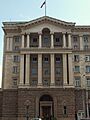
The Bulgarian President's Office

See Also
- Government of Bulgaria
- History of Bulgaria
- Politics of Bulgaria
- List of heads of state of Bulgaria
- List of presidents of Bulgaria (1990-present)
- Prime Minister of Bulgaria
