
Lower Moselle facts for kids
The Lower Moselle is a special part of the Moselle river in Germany. It stretches for about 100 kilometers, from the village of Pünderich all the way to where the Moselle joins the Rhine river in Koblenz. This area is also called the Terrassenmosel because of its unique terraced vineyards.
The landscape here is different from other parts of the Moselle. It's a narrower valley with tall, steep hillsides. On the sunny slopes that face south and west, you'll find vineyards. These vineyards are often on tiny, stepped pieces of land, like giant stairs, built on the very steep hills. In the 1960s, the Moselle was made deeper for big ships. This changed how the river looked, turning parts of it into a canal with artificial walls.
Contents
Where is the Lower Moselle?
The Lower Moselle starts in the wine village of Pünderich and ends in the city of Koblenz. Here, the Moselle flows into the Rhine river at a famous spot called the Deutsches Eck (which means "German Corner").
This part of the river separates two mountain ranges, the Eifel and the Hunsrück. It flows through two areas called counties: Cochem-Zell and Mayen-Koblenz. These are both in the northern part of the state of Rhineland-Palatinate. Most of the places along the valley are small villages. Some towns, like Zell (with about 4,200 people in 2009) and Cochem (with about 4,900 people in 2009), are bigger centers. Tourism and making wine are very important for the economy here.
Long ago, the border between two Roman provinces, Germania superior and Gallia Belgica, crossed the river between what are now Traben-Trarbach and Zell. This line later divided parts of the Electorate of Trier in the Middle Ages. It also marks the 50° latitude line, which was once thought to be the northern limit for growing wine. Today, the Lower Moselle is known as the Burg Cochem Wine Area.
-
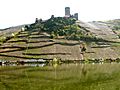
3. Old terraces below a medieval castle: the ruins of Metternich with the Beilsteiner Schlossberg hillside
-
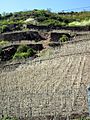
4. Traditional post planting on the lower slope. The upper terraces have been left fallow. Kardener Dechantsberg
-
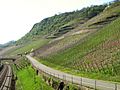
5. New vineyards with trellis wire fences after the old terraces were cleared in Hatzenporter Kirchberg
-
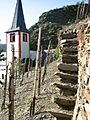
6. Terraces in the old part of the Alkener Burgberg
-
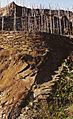
7. Old, rounded dry stone wall on rock base: Koberner Schlossberg below the Late Romanesque chapel


How the Moselle Valley Formed


The hillsides of the Lower Moselle show how the Earth changed here over millions of years. About 390 million years ago, during the Early Devonian period, this area was a shallow sea. Over time, mud and sand washed into this sea, forming thick layers of rock. These layers were later squeezed and heated, turning into the different types of rock we see today. This happened about 350 million years ago, when the Rhenish Massif mountains were pushed up.
The Moselle valley we see now started to form much later, during the Tertiary period. At first, the Moselle flowed through a wide, flat valley. But in the last 500,000 years, as the Rhenish Massif continued to rise, the Moselle cut deep into the rock, creating the steep valley.
Until the mid-1900s, the small villages and terraced vineyards in this area changed slowly. Today, many old orchards are empty, or have been used for new buildings and roads. Also, some old terraced vineyards have been flattened to make farming easier with machines. This means that the historic terraced landscape is becoming rarer.
However, some efforts are being made to save these old terraces. People are clearing overgrown areas to keep the beautiful look of the landscape and to protect the special plants and animals that live on these sunny terraces. It's also important to remove old, unused grapevines to stop plant diseases like grape black rot from spreading.
Many vineyards on steep slopes have been left empty. This is because small wine businesses often close due to money problems or because no one wants to take over the farm. It's also easier to farm on flatter land with machines than on steep slopes by hand.
From 1999 to 2009, the area of steep vineyards used for winegrowing went down from 998 hectares to 764 hectares. But some older, valuable sites are being replanted. Instead of single grapevines, new vines are often grown on wires, spaced further apart. In the Moselweisser Hamm area near Koblenz, new terraces are being built with grassy slopes instead of stone walls.
Some villages with many vineyards include:
- In Cochem-Zell county: Pünderich, Briedel, Kaimt, Merl, St. Aldegund, Neef, Bremm, Eller, Ediger, Senheim, Bruttig-Fankel, Ellenz-Poltersdorf, Ernst, Valwig, Klotten, Pommern, Treis-Karden, Müden and Moselkern.
- In Mayen-Koblenz county: Hatzenport, Alken, Lehmen, Niederfell, Kobern-Gondorf and Winningen. Lay, Moselweiss and Güls are part of Koblenz city.
The Calmont vineyard in Bremm and Eller is the steepest vineyard in Europe! Other very steep terraced vineyards include the Valwiger Herrenberg and the Kobern-Winninger Uhlen. Some vineyards, like Marienburg and Nonnenberg in Pünderich, Kirchberg and Stolzenberg in Hatzenport, and Uhlen and Röttgen in Winningen, are considered "First Class" by a special wine association.
The most popular grape grown in the Lower Moselle is Riesling, making up almost 60% of all grapes. Pinot Blanc and Pinot Noir are also grown, and their numbers are increasing.
Since the late 1900s, this area has been called the Terrassenmosel (meaning "Terrace Moselle") by the wine and tourism industries. This name was suggested by a winemaker from Winningen, Reinhard Löwenstein. It highlights the unique, very steep terraced vineyards, which are special even compared to other wine regions.
-
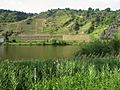
10. Managed terraces next to fallow ones in especially steep and small plots: Hatzenporter Stolzenberg
-
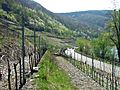
11. New terraces and diagonally running planting on espalier wires: Moselweisser Hamm
-
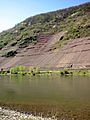
12. New plantings on the old steep hillside: Valwiger Herrenberg
-
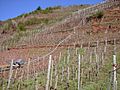
13. Without the monorack railway the old steep locations would not have been recultivated: Ediger Elzhofberg
-
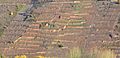
13a. Several monorack railways on steep slopes near Ediger-Eller.
-
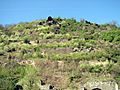
14. Abandoned since the mid-20th century: Gondorfer Fuchshöhle in a side valley of the Moselle near Kobern-Gondorf.


Building Terraces on the Lower Moselle

Archaeologists found signs of possible Roman terraces on the Moselle hills in the late 1970s. When new farm tracks were built, they uncovered foundations of ancient Celtic houses. This suggests that Romans might have built terraces here in the 3rd century AD.
Later, in the late 500s AD, a writer named Venantius Fortunatus wrote about winegrowing on steep hillsides along the Moselle. He described how "leafy vineyards soar up to bare hill tops" and how grapes were picked "even on the rocky slope."
Even after the Roman Empire ended, winegrowing on the Lower Moselle continued. Laws from the Frankish kings protected winemakers. People in some areas even spoke a special Moselle Roman language instead of Frankish until the Middle Ages. The local word for a vineyard terrace, Chur or Kuur, comes from a Latin word meaning "care."
From the 800s onwards, there are many records of winegrowing in almost all villages on the Lower Moselle. Many vineyards were probably on flatter land or lower hillsides at first. But in the High Middle Ages, workers started building strong terrace walls. They used skills learned from building castles on rocky cliffs. These walls were likely built without mortar, just by carefully stacking stones, because mortar was very expensive.


As the population grew in the Middle Ages, and more wine was needed in cities like Cologne and in Belgium and the Netherlands, vineyards expanded. This meant more terraces were built. Some vineyards that are still used today might have been terraced as early as the 1100s. An old saying from the 1300s was: "steep slopes produce better wine."
By the late 1800s, terracing along the Lower Moselle reached its peak, sometimes going almost to the top of the hills. Terraces were even built in side valleys and less ideal spots to produce more wine. Around 1880, the Koblenz area had about 2,500 hectares of vineyards, mostly on steep hills.
However, from the mid-1900s, farming on these steep terraced vineyards became harder. Many areas that were difficult to reach by hand became overgrown, and walls collapsed. In the 1960s and 1970s, smaller, less steep vineyards were combined into larger ones. This allowed farmers to use machines, saving time and money. But it also meant many old terraces and walls were removed, which changed the look of the countryside and affected local wildlife.
Today, money from the government and Europe, along with special monorack railways (like small trains for steep slopes), are helping to prevent some vineyards from being abandoned. These railways make it easier to transport people and materials.
Why Terraces are Important


Terraces help increase the amount of land that can be farmed on a slope. Ancient Roman farming books even talked about the benefits of terracing.
Building a terrace involves digging out the hillside and using the broken rocks to build walls. One terrace is built above another until the whole area is covered. High terrace walls are often built with mortar to make them stronger. Today, new walls are built using local stone. They are designed to be very stable, sometimes with a concrete base or by angling the stones. About two tons of stone are needed for every cubic meter of wall!
Terraces are not just for farming; they are also important for history and culture. Their careful design shows amazing building skills from the Middle Ages. The small, stepped plots also protect against plant diseases and create homes for many plants and animals that love warmth. The Apollo butterfly, the green lizard, the wallflower, and the rock bunting are just a few examples of the special creatures and plants that live in the Terraced Moselle ecosystem.
Beautiful Terrace Walls
Some very well-built and strong walls are called "beautiful murals." Today, building vineyard walls is often done by expert stonemasons, especially for larger wineries. But until the mid-1900s, when most Lower Moselle wine farms were small family businesses, every winemaker had to know how to build and repair walls themselves.
-
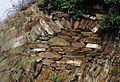
20. Built in a circle for greater terrace stability. Niederfeller Kahllay
-
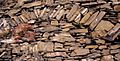
21. Very old curved section in a dry stone wall. Koberner Weissenberg
-
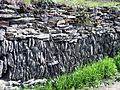
22. Vertical! Stone section in a terrace of the old vineyard In der Mark. Trimbs in the Nette valley
-
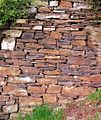
23. Ideal example of a dry stone wall. Built with stone broken on the spot. Hatzenporter Burg Bischofsteiner
-
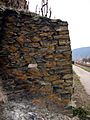
24. Solidly built wing wall. Lehmener Ausoniusstein


Changes in Terraced Vineyards
The Hatzenporter Kirchberg is a good example of how winegrowing on steep slopes has changed. In the mid-1900s, many winemakers farmed the hillsides of this village. But by the end of the century, fewer winemakers were left, and they tended fewer plots. Combining plots and building new tracks across the hillside made it possible to farm more easily with machines. This also led to some smaller, higher terraces being left unused.
-
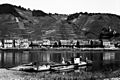
30. In the 1950s: planted terraces over the entire hillside. Hatzenporter Kirchberg
-
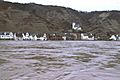
31. Around 1990: The Kirchberg with many abandoned terraces
-
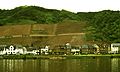
32. Around 1995: a new and double width track facilitates vehicles and the use of technical machines
-
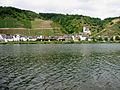
33. Since 2003 the Kirchberg has been classified as "first class"


Images for kids
-
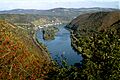
1. Lower Moselle countryside near Hatzenport in October
-
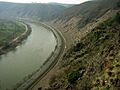
2. Terraced vineyards on the steep hillsides of the Koberner Uhlen (behind) and Winninger Uhlen in March


