
Shale facts for kids
| Sedimentary rock | |

Shale
|
|
| Composition | |
|---|---|
| Clay minerals and quartz |
Shale is a common type of sedimentary rock. It forms from tiny bits of mud that settle in calm water. This mud is mostly made of clay minerals and small pieces of other minerals, like quartz. A special thing about shale is that it often splits easily into thin, flat layers. This ability to split is called fissility. Shale is actually the most common sedimentary rock found on Earth! Sometimes, people use the word "shale" to mean any rock made of mud, but usually, it refers to mudrock that can split into layers.
Contents
How Does Shale Look and Feel?
Shale has a special texture because it can split into thin sheets. Imagine a stack of very thin pancakes; that's a bit like how shale breaks apart. This happens because the tiny clay minerals inside shale are lined up in parallel layers. When you find shale, it often breaks along these layers.
If a rock looks like shale but doesn't split easily, it might be called a mudstone or claystone. These rocks are also made of mud, but their particles aren't lined up in the same way. Rocks with more sandy bits and less clay are called siltstones.

What is Shale Made Of?
Shale is mostly made of tiny clay minerals and small grains of quartz. These are the main ingredients.

Why Does Shale Have Different Colors?
Most shale is grey. But it can also be red, brown, green, or even black! The color depends on what other tiny bits are mixed in.
- Red and Brown Shale: These colors often come from iron minerals, like hematite, which is a type of rust.
- Green Shale: Green colors can also come from iron, but in a different chemical form, or from other green minerals.
- Black Shale: If shale is black, it means it has a lot of carbon from ancient plants and animals. This usually happens when the mud settled in water with very little oxygen.
- Blue Shale: Pale blue or blue-green shales often contain carbonate minerals.
Clay minerals are the most important part of shale. Over long periods, some types of clay minerals can change into others deep underground. This process releases other elements that can form new tiny minerals within the shale. Shale also holds most of the ancient organic matter found in all sedimentary rocks, even though it's usually less than one percent of the rock's total weight.
Most shale forms in the ocean. The water trapped inside shale layers can sometimes be very salty.
How Does Shale Form?
Shale forms from very tiny particles of mud. These particles are so small that they can stay floating in water for a long time. They only settle down in very calm places.
Where Does Mud Turn into Shale?
You can find shale forming in places where water moves slowly. This includes:
- Lakes
- River deltas
- Floodplains (flat areas next to rivers)
- Deep parts of the ocean, far from strong waves
Over millions of years, thick layers of mud can build up in these quiet areas. For example, many black shales formed in the Cretaceous period (about 145 to 66 million years ago). They formed in parts of the Atlantic Ocean when it was first opening up. These areas had very little oxygen in the water, which helped preserve organic matter.
From Mud to Rock: The Journey of Shale
When tiny clay particles settle in salty seawater, they often clump together. These clumps then sink faster. As more and more mud piles up, the layers at the bottom get squeezed. This squeezing is called compaction.
As the mud gets buried deeper, the pressure from the layers above pushes the water out. The tiny mud particles get pressed closer and closer together. This is when shale starts to develop its ability to split into thin layers (fissility). The flat clay particles line up like pages in a book.
Over even longer periods, and with more heat from deep inside the Earth, the mud particles get cemented together. This process is called lithification, which means "turning into rock." The mud slowly becomes solid shale. Sometimes, the clay minerals themselves change into different types of clay minerals due to the heat and pressure.
What Are Black Shales?
Black shales are a special type of shale that are very dark. This dark color comes from a lot of carbon that was not broken down by oxygen. They formed in places where the water had very little or no oxygen, like deep, stagnant pools or parts of ancient oceans. These conditions helped preserve the remains of tiny plants and animals. Some black shales can also contain small amounts of metals like molybdenum or uranium. Scientists are still studying exactly how these metals ended up in the shale.
Ancient Life in Shale: Fossils!
Shale is a great rock for preserving signs of ancient life. You can sometimes find fossils of plants and animals in shale. Even tracks or burrows made by creatures, and impressions of raindrops, can be found on shale surfaces. Shale may also contain hard, rounded lumps called concretions, made of minerals like pyrite or calcite.
Shale's Transformation: From Shale to Slate
When shale is put under intense heat and pressure deep within the Earth, it can change into a new type of rock. This process is called metamorphism. Shale first transforms into a harder, more layered metamorphic rock called slate. If the heat and pressure continue to increase, slate can then change into phyllite, then schist, and finally gneiss.
Shale and Energy: A Hidden Resource
Shale is very important because it can be a "source rock" for hydrocarbons, which are natural gas and petroleum (oil). The calm waters where shale forms help preserve organic matter from ancient life. This organic matter, over millions of years and with heat and pressure, slowly changes into a substance called kerogen. With even more heat and pressure, this kerogen can turn into oil and natural gas. About 95% of all organic matter in sedimentary rocks is found in shales and other mudrocks.
Old Names for Shale
Long ago, before the mid-1800s, people didn't always distinguish clearly between slate, shale, and schist. In coal mining, shale was often called "slate" even into the 20th century. Dark shale found near coal seams was sometimes called "black metal."
Images for kids
-
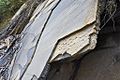
Shale layers visible in Potokgraben, a valley in the Karawanks mountains, Austria.
-
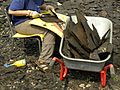
A person splitting Messel oil shale with a large knife to reveal ancient fossils inside.
-
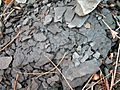
Weathering (breaking down) shale at a road cut in southeastern Kentucky, showing how it can crumble over time.


See Also
 In Spanish: Shale para niños
- Bakken Formation
- Barnett Shale
- Bearpaw Formation
- Burgess Shale
- Emu Bay Shale
- Marcellus Formation
- Mazon Creek fossil beds
- Oil shale
- Shale gas
- Wheeler Shale
- Bringelly Shale
- Ashfield Shale
