
Mount Higgins facts for kids
Quick facts for kids Mount Higgins |
|
|---|---|

Mount Higgins seen from Darrington
|
|
| Highest point | |
| Elevation | 5,176 ft (1,578 m) |
| Prominence | 896 ft (273 m) |
| Isolation | 0.95 mi (1.53 km) |
| Parent peak | Round Mountain (5,340 ft) |
| Geography | |

 Mount Higgins
Location in Washington (state)

Mount Higgins
Location in the United States
|
|
| Location | Skagit County, Washington, U.S. |
| Parent range | Cascade Range |
| Topo map | USGS Mount Higgins |
| Climbing | |
| Easiest route | Scramble |
Mount Higgins is a mountain in Washington state, standing 5,176 feet (about 1,578 meters) tall. It's located on the western edge of the North Cascades mountain range in Skagit County.
Mount Higgins has two smaller peaks nearby. One is called Skadulgwas Peak, which is 4,986 feet tall and looks like a fin. The other is the Mount Higgins Lookout Site, a western peak that is 4,849 feet tall. The land around Mount Higgins is managed by the Mount Baker-Snoqualmie National Forest, which is a protected area.
You can find Mount Higgins along the north side of Washington State Route 530. It's about halfway between the towns of Darrington and Oso. The closest taller mountain is Round Mountain, which is less than a mile away to the north-northeast. Rain and melting snow from Mount Higgins flow into streams that eventually join the Stillaguamish River.
Weather Around Mount Higgins
Mount Higgins is in a special weather area called the marine west coast climate zone. This means it gets a lot of moisture from the nearby Pacific Ocean. Most weather systems start over the Pacific Ocean and move northeast towards the Cascade Range.
When these weather systems hit the tall peaks of the Cascades, they are forced to rise. As the air goes higher, it cools down and drops its moisture as rain or snow. This process is called orographic lift. Because of this, the western side of the North Cascades gets a lot of rain and especially heavy snowfall in winter.
During the winter, it's often cloudy. But in the summer, high-pressure systems over the Pacific Ocean usually bring clear skies and sunshine.
How Mount Higgins Was Formed
The North Cascades mountains, where Mount Higgins is located, have a very rugged landscape. You'll see sharp peaks, long ridges, and deep valleys carved by glaciers. These amazing shapes and big changes in elevation were created by geological events that happened millions of years ago. These events also led to different climates and types of plants in the area.
The Cascade Mountains began to form millions of years ago, during a time called the late Eocene Epoch. This happened because the North American Plate (a huge section of the Earth's crust) was slowly moving over the Pacific Plate. This movement caused a lot of volcanic activity, creating many igneous rocks.
Also, smaller pieces of the Earth's crust, called terranes, crashed into North America. These collisions helped build the North Cascades about 50 million years ago.
Later, during the Pleistocene period (which started over two million years ago), huge sheets of ice called glaciers moved across the land. These glaciers advanced and then melted back many times, scraping away the landscape and leaving behind piles of rock. The "U"-shaped valleys you see today were carved by these glaciers. The combination of the land being pushed up (called uplift) and cracks forming in the Earth's crust (called faulting), along with the glaciers, created the tall peaks and deep valleys of the North Cascades.
Images for kids
-
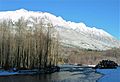
Mt. Higgins in winter
-
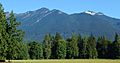
Mt. Higgins (left). Top of Round Mountain visible to right


