
Mount Pershing facts for kids
Quick facts for kids Mount Pershing |
|
|---|---|

Mount Pershing seen from West Seattle
|
|
| Highest point | |
| Elevation | 6,154 ft (1,876 m) |
| Prominence | 1,114 ft (340 m) |
| Geography | |

 Mount Pershing
Location in Washington (state)

Mount Pershing
Location in the United States
|
|
| Location | Mason County, Washington, US |
| Parent range | Olympic Mountains |
| Topo map | USGS Mount Skokomish |
| Geology | |
| Age of rock | Eocene |
| Type of rock | pillow basalt |
| Climbing | |
| First ascent | 1939 by Don Dooley, Robert Henderson, Walt Ingalls, and Bob Mandelhorn |
| Easiest route | Scrambling |
Mount Pershing is a tall mountain, 6,154 feet (about 1,876 meters) high, found in the beautiful Olympic Mountains. It's located in Mason County, within the state of Washington. This mountain is part of the Mount Skokomish Wilderness, which is managed by the Olympic National Forest.
Mount Pershing was named after a very important military leader, John J. Pershing, who was a General of the Armies. The closest taller mountain is Mount Washington, which is about 1.45 miles (2.33 km) away to the south-southeast. All the rain and snow that falls on Mount Pershing eventually flows into the Hamma Hamma River.
Contents
How the Olympic Mountains Formed
The Olympic Mountains are made mostly of rock that was pushed up from the ocean floor. This rock includes sandstone, a type of rock made from sand, and basalt, a dark, fine-grained volcanic rock. These rocks formed during a time called the Eocene epoch, which was about 56 to 34 million years ago.
Shaping the Mountains
The mountains got their shape during the Pleistocene Ice Age. This was a time when huge sheets of ice, called glaciers, covered much of the Earth. These glaciers moved slowly, carving out valleys and peaks as they advanced and then melted away many times. This process of erosion by ice and water gave the Olympic Mountains their unique look.
Understanding the Climate

Mount Pershing is in a special climate zone called the marine west coast climate. This means it gets a lot of moisture from the Pacific Ocean. Most of the weather systems, like big clouds and storms, start over the Pacific Ocean and move towards the Olympic Mountains.
Rain and Snow in the Olympics
When these weather systems hit the tall Olympic Range, they are forced to rise. As the air goes higher, it cools down and drops its moisture as rain or snow. This is called Orographic lift. Because of this, the Olympic Mountains get a lot of rain and snow, especially in the winter.
During the winter, it's often cloudy. But in the summer, big areas of high pressure over the Pacific Ocean usually bring clear skies. The snow here tends to be wet and heavy because of the ocean's influence. This can sometimes lead to a higher risk of avalanches.
Images for kids
-
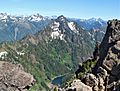
South aspect, from Mt. Ellinor
-
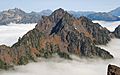
South aspect
-
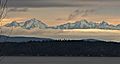
Left to rightː Mt. Ellinor, Mt. Washington, Mt. Pershing, Jefferson Peak. View from Seattle.


