
Mount Vesuvius facts for kids
Quick facts for kids Mount Vesuvius |
|
|---|---|

 Mount Vesuvius
Location in Italy
|
|
| Highest point | |
| Elevation | 1,281 m (4,203 ft) |
| Prominence | 1,232 m (4,042 ft) |
| Listing | Ribu |
| Geography | |
| Location | Campania, Italy |
| Geology | |
| Age of rock | 25,000 years before present to 1944; age of volcano = c. 17,000 years to present |
| Mountain type | Somma–stratovolcano |
| Volcanic arc | Campanian volcanic arc |
| Last eruption | 17–23 March 1944 |
| Climbing | |
| Easiest route | Walk |
Mount Vesuvius is a famous volcano in Italy. It stands near the beautiful Gulf of Naples in Campania. Vesuvius is about 9 kilometers (5.6 miles) east of the city of Naples. It is a special type of volcano called a somma-stratovolcano. This means it has a large cone inside an older, collapsed crater.
Vesuvius is known for its powerful eruption in 79 AD. This event buried the ancient Roman cities of Pompeii and Herculaneum. It also covered other towns like Oplontis and Stabiae. The eruption sent a huge cloud of ash, stones, and gases high into the sky. Many people lost their lives during this disaster. We know about it thanks to letters written by Pliny the Younger.
This volcano has erupted many times throughout history. It is the only volcano on mainland Europe that has erupted in the last 100 years. Vesuvius is considered one of the most dangerous volcanoes globally. This is because millions of people live close to it. Its eruptions are often very strong and explosive.
Contents
What's in a Name?
The name Vesuvius was used by ancient Roman writers. Some people think the name might come from old Greek words meaning "unquenchable" or "hurling violence." Others believe it comes from an ancient word for "hearth" or "burn."
The Romans believed Mount Vesuvius was connected to the hero Hercules. An old story says that Hercules passed through the area. He found a fiery plain near a mountain that "spouted forth a huge fire." This mountain was called Vesuvius. The nearby city of Herculaneum might even be named after him.
Ancient Stories and Beliefs
Mount Vesuvius has a rich history in ancient stories. In 79 AD, people thought of Vesuvius as a kind of god. It was sometimes shown as a serpent in paintings found in homes in Pompeii. These paintings were in special household shrines. Some writings also suggest it was worshipped as a powerful form of Jupiter, the king of the Roman gods.
What Vesuvius Looks Like

Vesuvius has a unique "humpbacked" shape. It has a large main cone, called the Gran Cono. This cone is partly surrounded by the edge of an older, collapsed crater. This older crater is known as Mount Somma. The Gran Cono formed during the famous 79 AD eruption. Because of this, the volcano is sometimes called Somma-Vesuvius.
The older crater, or caldera, began to form about 17,000 to 18,000 years ago. It grew larger with many powerful eruptions over time. The 79 AD eruption was the last one to make it bigger. This type of volcano, with an old crater surrounding a new cone, is now called a "somma volcano".
The highest point of the main cone is 1,281 meters (4,203 feet) above sea level. The volcano's sides show marks from old lava flows. Other parts are covered with plants, like forests and vineyards.
How Vesuvius Was Born
_-_n._1167_-_Napoli_-_Panorama_(2).jpg)
Vesuvius is a stratovolcano. It formed because two huge pieces of the Earth's crust, called tectonic plates, crashed into each other. The African plate slid underneath the Eurasian plate. As it went deeper, the rocks melted into hot liquid called magma. This magma then rose to the surface through cracks, creating the volcano.
Vesuvius is part of a group of volcanoes called the Campanian volcanic arc. Other volcanoes in this area include Campi Flegrei and the island of Ischia. Vesuvius is special because it's the only one in this group that has erupted in the last 100 years.
Vesuvius' Many Eruptions

Mount Vesuvius has erupted many times throughout its long history. Before the famous 79 AD event, there were at least three much larger eruptions. One of these was the Avellino eruption about 3,800 years ago. It covered several ancient villages from the Bronze Age.
Since 79 AD, the volcano has erupted around three dozen more times. These eruptions vary in how strong they are. They are often very explosive, a type called "Plinian" eruptions. This name comes from Pliny the Younger, who wrote about the 79 AD event. Sometimes, Vesuvius's ash clouds have reached far across Europe. For example, in 472 and 1631, ash fell on Constantinople (modern-day Istanbul), over 1,200 kilometers (760 miles) away!
Vesuvius is still an active volcano today. It mostly releases sulfur-rich steam from its crater.
Before the Big One: 79 AD
Scientists have learned about Vesuvius's past by studying rock samples. The area has had volcanic activity for at least 400,000 years. Vesuvius itself started forming about 25,000 years ago. It grew through many lava flows and smaller explosions.
Around 19,000 years ago, the eruptions became much more explosive. These created large craters called calderas. The 79 AD eruption was the most recent of these powerful events.
One important discovery was made in 2001 near Nola. Archaeologists found a Bronze Age village buried by the Avellino eruption. It was preserved much like Pompeii. They even found thousands of human footprints pointing away from the volcano. This shows people tried to escape the eruption.
Before 79 AD, Vesuvius was quiet for a long time. Roman writers described its slopes as covered with gardens and vineyards. Only the very top was rocky. Some ancient writers, like Strabo and Vitruvius, knew it was a volcano. They described its barren summit and suggested it once had "craters of fire."
The Famous Eruption of 79 AD
In 79 AD, Vesuvius erupted in one of the most destructive events ever recorded. This eruption destroyed the cities of Pompeii and Herculaneum. It buried their ruins under many meters of ash and rock.
Warning Signs
The 79 AD eruption had some warning signs. A strong earthquake hit the area in 62 AD. It caused a lot of damage in Pompeii. Many repairs were still unfinished when Vesuvius erupted. Smaller earthquakes also started happening four days before the eruption. They became more frequent, but people did not realize what they meant. The Roman writer Pliny the Younger noted that small tremors were common in the region.
Pliny's Account
The only eyewitness account we have is from two letters by Pliny the Younger. He wrote to the historian Tacitus. Pliny described the last days of his uncle, Pliny the Elder. His uncle was a Roman commander. He saw the first signs of the eruption from Misenum, about 35 kilometers (22 miles) away.
Pliny the Elder decided to investigate and help people. He sailed towards the volcano. His nephew, Pliny the Younger, stayed behind. The younger Pliny later described seeing a huge, dense cloud rising from the volcano. It looked like a pine tree.
As the eruption continued, ash began to fall. The sky grew dark, even in the morning. Pliny the Younger and his mother had to shake off the ash to avoid being buried. They eventually fled the area.
Pliny the Elder sailed closer to the danger. He tried to rescue a friend and other people. He faced hot cinders and pumice falling from the sky. He eventually reached Stabiae, a town near Pompeii. There, he became unwell and passed away. His companions were able to escape later.
The Impact

The eruption caused widespread destruction. Many people lost their lives in Pompeii and Herculaneum. In Pompeii, many were buried by falling ash and collapsing roofs. In Herculaneum, which was closer to the crater, people were overcome by extremely hot gases and volcanic flows.
Archaeologists have found many remains and casts of victims. These discoveries help us understand the sudden and powerful nature of the eruption. The ash preserved the shapes of people and objects, giving us a unique look into ancient Roman life.
Later Eruptions: 3rd to 19th Centuries
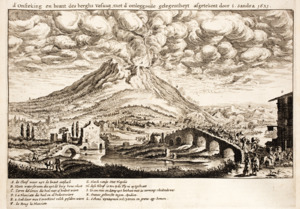

After 79 AD, Vesuvius erupted about three dozen more times.
- In 203 AD, it erupted during the lifetime of the historian Cassius Dio.
- In 472 AD, it sent out so much ash that it reached Constantinople, over 1,220 kilometers (760 miles) away.
- The eruptions in 512 AD were so strong that people living on Vesuvius's slopes were excused from paying taxes.
The volcano became quiet at the end of the 13th century. For many years, its slopes were again covered with gardens and vineyards. Even the inside of the crater had shrubs.
- Vesuvius became active again in December 1631. A major eruption buried many villages under lava flows. It also created mudslides called lahars. Around 3,000 people lost their lives.
- After 1631, eruptions happened almost constantly. Significant eruptions occurred in 1660, 1682, 1694, 1698, 1707, 1737, 1760, 1767, 1779, 1794, 1822, 1834, 1839, 1850, 1855, 1861, 1868, and 1872.
Eruptions in the 20th Century
,_Brooklyn_Museum_Archives.jpg)

- The eruption on April 5, 1906, caused over 100 deaths. It also released the most lava ever recorded from Vesuvius. Italy had planned to host the 1908 Summer Olympics. However, funds were redirected to rebuild Naples after the eruption. The Games were then moved to London.
- Vesuvius was active from 1913 until 1944. Lava filled the crater, and small amounts of lava flowed out sometimes.
- This period ended with a major eruption in March 1944. It destroyed the villages of San Sebastiano al Vesuvio, Massa di Somma, and Ottaviano. Part of San Giorgio a Cremano was also damaged. Lava flows destroyed nearby villages between March 19 and March 22. On March 24, an explosive eruption created an ash cloud.
In March 1944, the United States Army Air Forces (USAAF) had a base near the volcano. The ash and hot cinders from the eruption damaged many of their North American B-25 Mitchell bombers. Between 78 and 88 aircraft were destroyed.

People in Naples could see the eruption. USAAF photographers and other staff recorded the damage to local villages.
What About the Future?
Large eruptions of Vesuvius, like the one that buried Pompeii, happen after thousands of years of quiet. Smaller, but still powerful, eruptions (like in 472 and 1631) have occurred every few hundred years. From 1631 to 1944, there were smaller eruptions every few years.
When magma stays underground for a long time, gases like sulfur dioxide and carbon dioxide build up. This makes future eruptions more violent. The Italian government has an emergency plan for a future eruption. They expect a scenario similar to the 1631 eruption.
In this plan, areas up to 7 kilometers (4.3 miles) from the volcano could be hit by fast-moving pyroclastic flows. Many surrounding areas could be covered by falling ash. Towns south and east of the volcano are most at risk. If ash builds up too much, roofs could collapse.
The plan aims to evacuate 600,000 people from the "red zone." This is the area at highest risk. The evacuation would take about seven days. People would be sent to other parts of Italy for several months. Deciding when to start this huge evacuation is a challenge. Starting too late could be dangerous. Starting too early might be a false alarm.
.jpg)
The government is working to reduce the number of people living in the red zone. They are tearing down illegally built homes. They also created a national park around the volcano. This helps prevent new construction. They offer money to people who move away. The goal is to reduce the evacuation time to just two or three days in the next 20 to 30 years.
Vesuvius is constantly watched by the Osservatorio Vesuvio. They use special equipment to measure ground movement and gas emissions. This helps them track magma rising inside the volcano. As of July 2024, Mount Vesuvius is at a Green Alert Level. This means it has low volcanic activity.
Vesuvius National Park

The area around Vesuvius became a national park on June 5, 1995. Visitors can hike to the summit of Vesuvius. There are paths around the volcano maintained by the park. You can drive close to the top, but the last 200 meters (656 feet) must be walked. A spiral walkway leads from the road to the crater.
The Vesuvius Funicular
Mount Vesuvius had its first funicular in 1880. A funicular is a type of cable car that moves up and down a steep slope. This funicular was destroyed by the 1944 eruption.
The famous Neapolitan song "Funiculì, Funiculà" was written to celebrate the opening of this first funicular on Mount Vesuvius.
Related pages
See also
 In Spanish: Monte Vesubio para niños
- Battle of Mount Vesuvius
- List of volcanic eruptions by death toll
- List of volcanoes in Italy
- List of stratovolcanoes
