
Nubian bustard facts for kids
Quick facts for kids Nubian bustard |
|
|---|---|
 |
|
| Conservation status | |
Scientific classification  |
|
| Kingdom: | Animalia |
| Phylum: | Chordata |
| Class: | Aves |
| Order: | Otidiformes |
| Family: | Otididae |
| Genus: | Neotis |
| Species: |
N. nuba
|
| Binomial name | |
| Neotis nuba (Cretzschmar, 1826)
|
|
| Script error: The function "autoWithCaption" does not exist. | |
Script error: No such module "Check for conflicting parameters".
The Nubian bustard (Neotis nuba) is a special kind of bird that belongs to the bustard family. These medium-sized birds live in the dry areas between the southern edge of the Sahara desert and the northern part of the Sahel region. You can find them in countries like Burkina Faso, Cameroon, Chad, Mali, Mauritania, Niger, Nigeria, and Sudan. They prefer dry savanna and shrubland where plants are spread out.
What Does the Nubian Bustard Look Like?
Male Nubian bustards are quite large. They usually weigh between 5–7 kg (11–15 lb) (about 11 to 15 pounds). They are around 80 cm (31 in) (31 inches) long. Their wings can spread out to about 180 cm (71 in) (71 inches) wide.
Female Nubian bustards are much smaller than males. They weigh around 3 kg (6.6 lb) (about 6.6 pounds). They are about 60 cm (24 in) (24 inches) long. Their wingspan is around 150 cm (59 in) (59 inches).
The Nubian bustard is smaller than the Arabian bustard, which lives in the same areas. The Nubian bustard also has more reddish-brown feathers. It has a more rounded body shape. Its neck is quite long and thin, and its head is rounded.
Reproduction and Life Cycle
Scientists have observed Nubian bustards breeding from July to October. This happens across all the areas where these birds live.
Young birds and eggs can be in danger from many different animals. These include meat-eating mammals and reptiles.
Protecting the Nubian Bustard
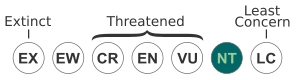
The Nubian bustard is listed as "Near-Threatened" by the IUCN. This means it could become endangered in the future. The biggest danger to these birds is habitat loss. This happens when their natural homes are destroyed or changed.
