
Walleye facts for kids
Quick facts for kids Walleye |
|
|---|---|
_(1).jpg) |
|
| Conservation status | |
Scientific classification  |
|
| Kingdom: | Animalia |
| Phylum: | Chordata |
| Class: | Actinopterygii |
| Order: | Perciformes |
| Family: | Percidae |
| Genus: | Sander |
| Species: |
S. vitreus
|
| Binomial name | |
| Sander vitreus (Mitchill, 1818)
|
|
| Script error: The function "autoWithCaption" does not exist. | |
| Synonyms | |
|
List
|
|

Script error: No such module "Check for conflicting parameters".
The walleye (scientific name: Sander vitreus) is a popular freshwater fish. It lives in many parts of Canada and the Northern United States. People sometimes call it the walleyed pike or yellow pikeperch. It's a close relative of the European zander. The walleye is known for its unique eyes and delicious taste.
There was once a color variation called the blue walleye. It was found in southern Ontario and Quebec. Scientists now believe the blue walleye was just a different look of the yellow walleye. They are considered the same species.
Contents
Discover the Walleye Fish
What's in a Name?

The name "walleye" comes from its special eyes. They have a reflective layer called a tapetum lucidum. This layer helps the fish see very well in dim light. It also makes their eyes look shiny and opaque.
Because of their excellent night vision, walleyes often hunt when it's dark. They also do well in cloudy or rough waters. This gives them an advantage over their prey. Many anglers like to fish for walleyes at night.
Walleye's Family Tree
The walleye belongs to a group of fish called Sander. Its closest North American relative is the sauger (S. canadensis). The walleye was first officially described by Samuel Latham Mitchill in 1818. He found it near Cayuga Lake in New York.
What Does a Walleye Look Like?
_-_51780343419_(cropped).jpg)
Walleyes are usually olive green and gold. Their back is olive, fading to gold on their sides. They have five darker stripes across their upper body. Their belly is white.
Walleyes have a large mouth with many sharp teeth. They have spiny fins on their back and belly. You can tell a walleye apart from a sauger by its tail fin. Walleyes have a white patch on the lower part of their tail. Saugers do not have this white patch. Also, saugers have clear black dots on their back and tail fins. Walleyes usually don't have these dots.
Size and Growth
.jpg)
Walleyes can grow quite large. They can reach about 80 centimeters (31 inches) long. They can weigh up to 9 kilograms (20 pounds). The biggest walleye ever recorded was 107 centimeters (42 inches) long. It weighed 13 kilograms (29 pounds).
Female walleyes usually grow larger than males. Walleyes can live for many years, sometimes up to 29 years. However, in places where many are caught, most walleyes are younger than six years old. When caught by anglers, they are typically 30 to 50 centimeters (12 to 20 inches) long.
The Walleye Life Cycle
.jpg)
Male walleyes are ready to have babies when they are about three or four years old. Females usually mature about a year later. In late winter or early spring, adult walleyes travel to streams. They lay their eggs over gravel and rocks. Some walleyes also lay eggs in open water on reefs.
A large female can lay up to 500,000 eggs! The parents do not care for the eggs or young fish. The eggs are a bit sticky and fall between rocks. The eggs hatch in about 12 to 30 days. This depends on the water temperature. After hatching, the tiny walleye larvae absorb food from a small yolk sac.
Once the yolk is gone, they start eating tiny water creatures. After about 40 to 60 days, young walleyes begin to eat other fish. Adult walleyes mostly eat other fish, like yellow perch. They also eat crayfish, minnows, and leeches.
Walleye as Food and Fun

Many people think walleye is a very tasty freshwater fish. Because of this, people catch them for fun and for selling. Since walleyes feed at night, they are often caught after dark. Anglers use live minnows or lures that look like small fish.
Many commercial walleye fisheries are in the Canadian Great Lakes. Fried walleye is a popular dish in Canada. In Minnesota, walleye is often caught in the late afternoon on windy days. A walleye sandwich is a common meal in Minnesota pubs. Fried walleye is a favorite in both Canada and Minnesota.
Fishing for Walleye
Walleyes are very popular with people who love to fish. Because of this, fishing for walleyes is carefully managed. Rules like catch limits and size limits help make sure there are enough fish for the future. For example, in Michigan, you cannot keep walleyes shorter than 38 centimeters (15 inches).
Walleyes see very well in low light. So, they tend to feed most actively at dawn and dusk. They also feed on cloudy days or when the water is choppy. This is because these conditions make it harder for their prey to see. In dark or cloudy waters, walleyes might even feed all day.
In spring and fall, walleyes are found in shallower areas. This is often near their spawning grounds. They also like shallower, oxygen-rich water when it's windy. On calm spring days, they might be in deeper water, around 3 meters (10 feet) or more.
Ice fishing is a popular winter activity in Canada and the northern United States. Walleyes are often caught this way. "Walleye chop" is a term fishermen use for rough water. It usually means winds of 10 to 25 kilometers per hour (6 to 16 mph). This is a good sign for walleye fishing. It means the walleyes are more active. Night fishing with live bait is also very effective.
The world record for a walleye was caught by Mabry Harper. He caught an 11.34 kilogram (25 pound) walleye in Old Hickory Lake, Tennessee, on August 2, 1960.
Walleye in Culture

The walleye is an important fish in the Upper Midwest region of the United States. It's very popular in Minnesota. The Minnesota Legislature made the walleye the official state fish in 1965. Three towns claim to be the "Walleye Capital of the World." These are Garrison, Minnesota, Baudette, Minnesota, and Garrison, North Dakota. Each town has a large statue of the fish. In 2012, walleye pike became the official "state warm water fish" of Vermont.
South Dakota also chose the walleye as its official state fish in 1982. The fish lives naturally in the Missouri River and eastern lakes of the state. It became very popular there in the 1970s and 1980s. This was thanks to fishing tournaments that promoted the fish.
The walleye is also the official provincial fish of Manitoba, Canada. In Winnipeg, Manitoba, walleye (called "pickerel" there) is considered a very important local fish. It is also the provincial fish of Saskatchewan. Saskatchewan declared it their official fish in 2015 after a contest. Walleye is the most popular fish for sport fishing in Saskatchewan. You can catch them in many rivers, reservoirs, and lakes.
Images for kids
-
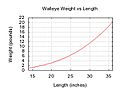
Graph showing walleye weight and length

See also
 In Spanish: Sander vitreus para niños
