
Shield volcano facts for kids

A shield volcano is a giant, gently sloping volcano. It gets its name because it looks like a warrior's shield lying flat on the ground. Unlike steep, cone-shaped volcanoes, shield volcanoes are very wide and have gentle slopes.
These volcanoes are built by runny lava with low thickness. Because the molten rock is so runny, it travels far before chilling into stone. Layer after layer of cool rock slowly builds up these enormous, rounded mountains.
Contents
How Shield Volcanoes Form and Behave

Shield volcanoes are very different from tall stratovolcano peaks, bumpy lava domes, or crumbly cinder cone hills. Most volcanoes blast out thick magma and clouds of rock fragments in an explosive eruption. Shield volcanoes usually have gentle, flowing eruptions.
The molten rock inside is basaltic lava that has very little silica. This makes the lava flow smoothly like warm syrup. Because it flows easily, it forms thin, flat sheets of rock rather than steep piles. Over hundreds of thousands of years, these sheets build huge, low mountains.
Types of Hawaiian Lava Flows

Scientists study shield volcanoes on Hawaiʻi Island to see a calm Hawaiian eruption up close. During these events, lava shoots up in a glowing lava fountain. Geologists classify the flows into two main types based on their surface texture:
- Pāhoehoe: This lava has a smooth, shiny surface that cools into ropy, twisting shapes. It moves forward in glowing, creeping toes of melted rock.
- ʻAʻā: This lava is rough, chunky, and sharp. It moves like a tumbling wall of hot, jagged clinkers pushed by molten liquid inside.
Strange Lava Tubes and Fire Fountains
Shield volcanoes have amazing underground features called lava tubes. These are natural stone caves formed when the top crust of a river of molten rock cools and hardens. Underneath the crust, the hidden liquid lava stays super hot because the rock roof works as insulation. When the eruption ends, the empty cave remains behind like a subway tunnel.
Sometimes, fountains of lava blast into the air and land while still gooey, creating a steep spatter cone. At other times, the ground cracks open in long fissures, spraying giant curtains of fire across the land. Over long periods, the peak can collapse into an enormous bowl called a caldera, which sometimes holds a churning lava lake.
Where Shield Volcanoes Are Found on Earth

Shield volcanoes can form in different places across the globe. Many form over a deep volcanic hotspot, while others form where tectonic plates pull apart at a rift.
The Hawaiian Islands
The Hawaiian–Emperor seamount chain is the most famous group of shield volcanoes on Earth. It is fueled by the Hawaii hotspot. As the giant Pacific Plate moves over this hot zone, new volcanic islands grow.
The largest mountain on Earth is Mauna Loa. From its base on the sea floor to its high summit, it measures over 17,000 m (56,000 ft) in total height! Nearby sits Kīlauea, which is famous for its long-lasting eruptions and active vents like Puʻu ʻŌʻō.
The Galápagos Islands and Iceland
The Galápagos Islands sit out in the Pacific Ocean west of South America. Famous scientist Charles Darwin explored these islands in 1835. Six volcanoes joined together to build the largest island, Isabela.
Shield volcanoes also appear along the Mid-Atlantic Ridge in Iceland, where plates pull apart at a divergent boundary. In East Africa, volcanoes like Nyamuragira and Erta Ale sit along the massive East African Rift.
Giant Shield Volcanoes in Outer Space

Shield volcanoes are not found only on planet Earth. Astronomers have discovered huge shield mountains on Mars, Venus, and even on Jupiter's fiery moon, Io.
The biggest volcano in the entire solar system is on Mars. It is named Olympus Mons. This red planet monster is 14 mi (23 km) high and 370 mi (595 km) across. It grew so huge because Mars does not have moving tectonic plates. The volcano sat over the same hot zone for millions of years, growing bigger and bigger with every lava flow!
Images for kids
-
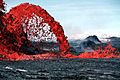
A pāhoehoe lava fountain on Kīlauea erupts
-
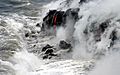
Pāhoehoe flows enter the Pacific Ocean on Hawaiʻi island
-
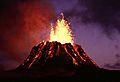
Puʻu ʻŌʻō, a parasitic cinder cone on Kīlauea, lava fountaining at dusk in June 1983, near the start of its eruptive cycle
-
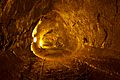
Nāhuku, a lava tube on Hawaiʻi island, now a tourist attraction in the Hawaiʻi Volcanoes National Park


See also
 In Spanish: Volcán en escudo para niños