
Snow Tent, California facts for kids
Quick facts for kids
Snow Tent
|
|
|---|---|
|
Former settlement
|
|

 Snow Tent
Location in California
|
|
| Country |  United States United States |
| State |  California California |
| County | Nevada County |
| Elevation | 4,583 ft (1,397 m) |
| Population
(1880)
|
|
| • Total | 25 |
| Time zone | UTC-8 (Pacific (PST)) |
| • Summer (DST) | UTC-7 (PDT) |
Snow Tent was a historic settlement in Nevada County, California. It was once a busy place where people looked for gold and cut down trees for wood. The name "Snow Tent" came from a tent set up by the first person to live there in 1850. This tent got snowed in during winter! Snow Tent grew into a center for mining and lumbering, but it disappeared sometime after 1880.
Today, the area where Snow Tent once stood is part of the Tahoe National Forest. It's located on the San Juan Ridge, about halfway between North Bloomfield and Graniteville. This is about 16 miles northeast of Nevada City. Snow Tent was an important stop on one of the main routes through Henness Pass. It even appeared on maps as late as 1902.
Contents
Gold Mining in Snow Tent
Snow Tent was built on a rich area filled with gold-bearing gravel. This gravel stretched from the San Juan Ridge all the way to other places like Hunt's Hill and Dutch Flat. People in Snow Tent used two main ways to get gold: hydraulic mining and hard rock mining.
Hydraulic Mining Methods
Hydraulic mining used powerful jets of water to wash away hillsides and find gold. It's not clear how much hydraulic mining happened in Snow Tent itself. This was because there might not have been a water ditch bringing enough water directly to the settlement.
A big change for hydraulic mining in the area happened in 1884. A court decision, called the Sawyer decision, made it illegal to dump mining waste into the Yuba River. This decision greatly reduced hydraulic mining.
Hard Rock Gold Mining
Hard rock mining, also known as quartz mining, involved digging tunnels into mountains to find gold veins. This type of mining started in the 1850s and continued for a long time in the Snow Tent area. Miners would sometimes find new gold deposits, which kept the mining going.
Lumbering and Sawmills
Mining needed a lot of wood for buildings, tools, and fuel. Snow Tent was surrounded by thick pine forests, making it a perfect spot for cutting timber.
Churchill's Sawmill Story
The main sawmill in Snow Tent belonged to James Churchill. He built it in the early 1850s. Sadly, it burned down in 1857. People thought someone set it on fire. Mr. Churchill rebuilt the mill, but it burned down again. He rebuilt it a third time, and it finally burned down for good in 1875, again possibly set on fire. Later, in the early 1900s, the Landsburgh brothers also ran a sawmill in the area.
Snow Tent as a Stage Stop
Snow Tent was a very important stop for travelers and goods. It was on the route connecting Marysville, Nevada City, and the territory that would later become the state of Nevada.
The Snow Tent Hotel
As early as 1851, stagecoaches and freight wagons regularly traveled this route. Snow Tent's most famous building was its hotel, sometimes called Snow Tent House. Mr. L. A. Sackett ran it for several years. He even put it up for sale in 1864 with an advertisement.
-
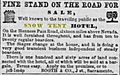
Snow Tent Hotel Advertisement

Unfortunately, the hotel burned down in 1866. This fire was caused by an accident, starting from the chimney.
Daily Life in Snow Tent
Snow Tent began in the spring of 1850 when Michael Angelo Singleton, who was from Louisiana, set up a canvas tent. From this tent, he sold goods and also mined for gold.
Businesses and Community
Starting in 1851, Snow Tent had a general store run by Furman, McIntyre & Co. There was also a livery stable connected to the hotel, where people could keep their horses. However, it seems Snow Tent did not have a school, a church, or a post office. These were common in other mining camps nearby. By 1880, the population of Snow Tent had shrunk to only 25 people.
Challenges in the Camp
Life in Snow Tent could be tough. Besides the fires at the sawmill and hotel, there were also reports of thefts and killings. North of Snow Tent, there's a stream still called Bloody Run. It got this name because many bodies were found there long ago.
