
Gold facts for kids
 |
|||||||||||||||
| Gold | |||||||||||||||
|---|---|---|---|---|---|---|---|---|---|---|---|---|---|---|---|
| Appearance | Metallic yellow | ||||||||||||||
| Standard atomic weight Ar, std(Au) | 196.966570(4) | ||||||||||||||
| Gold in the periodic table | |||||||||||||||
|
|||||||||||||||
| Atomic number (Z) | 79 | ||||||||||||||
| Group | group 11 | ||||||||||||||
| Period | period 6 | ||||||||||||||
| Block | d | ||||||||||||||
| Electron configuration | [Xe] 4f14 5d10 6s1 | ||||||||||||||
| Electrons per shell | 2, 8, 18, 32, 18, 1 | ||||||||||||||
| Physical properties | |||||||||||||||
| Phase at STP | solid | ||||||||||||||
| Melting point | 1337.33 K (1064.18 °C, 1947.52 °F) | ||||||||||||||
| Boiling point | 3243 K (2970 °C, 5378 °F) | ||||||||||||||
| Density when liquid (at m.p.) | 17.31 g/cm3 | ||||||||||||||
| Heat of fusion | 12.55 kJ/mol | ||||||||||||||
| Heat of vaporization | 342 kJ/mol | ||||||||||||||
| Molar heat capacity | 25.418 J/(mol·K) | ||||||||||||||
Vapor pressure
|
|||||||||||||||
| Atomic properties | |||||||||||||||
| Oxidation states | −3, −2, −1, +1, +2, +3 +5 (an amphoteric oxide) | ||||||||||||||
| Electronegativity | Pauling scale: 2.54 | ||||||||||||||
| Ionization energies |
|
||||||||||||||
| Atomic radius | empirical: 144 pm | ||||||||||||||
| Covalent radius | 136±6 pm | ||||||||||||||
| Van der Waals radius | 166 pm | ||||||||||||||
 |
|||||||||||||||
| Other properties | |||||||||||||||
| Natural occurrence | primordial | ||||||||||||||
| Crystal structure | face-centered cubic (fcc)
 |
||||||||||||||
| Speed of sound thin rod | 2030 m/s (at r.t.) | ||||||||||||||
| Thermal conductivity | 318 W/(m⋅K) | ||||||||||||||
| Electrical resistivity | 22.14 nΩ⋅m (at 20 °C) | ||||||||||||||
| Magnetic ordering | diamagnetic | ||||||||||||||
| Molar magnetic susceptibility | −28.0×10⁻⁶ cm3/mol (at 296 K) | ||||||||||||||
| Tensile strength | 120 MPa | ||||||||||||||
| Young's modulus | 79 GPa | ||||||||||||||
| Shear modulus | 27 GPa | ||||||||||||||
| Bulk modulus | 180 GPa | ||||||||||||||
| Poisson ratio | 0.4 | ||||||||||||||
| Mohs hardness | 2.5 | ||||||||||||||
| Vickers hardness | 188–216 MPa | ||||||||||||||
| Brinell hardness | 188–245 MPa | ||||||||||||||
| CAS Number | 7440-57-5 | ||||||||||||||
| History | |||||||||||||||
| Naming | from a Proto-Indo-European root meaning 'yellow' | ||||||||||||||
| Discovery | In the Middle East (before 6000 BCE) | ||||||||||||||
| Symbol | "Au": from Latin aurum | ||||||||||||||
|
|||||||||||||||
Gold is a special chemical element with the symbol Au. This comes from the Latin word aurum, meaning gold. Its atomic number is 79. In its pure form, gold is a shiny, metallic yellow metal. It is very dense, soft, and can be easily shaped. This means it is both malleable (can be hammered into thin sheets) and ductile (can be pulled into thin wires).
Gold is a transition metal and one of the noble metals. It is known for being one of the least reactive elements. This means it doesn't easily combine with other chemicals. Only platinum is less reactive than gold. Gold is a solid at normal temperatures and pressures.
You often find gold in its natural, pure state. It appears as nuggets or tiny grains in rocks, veins, and alluvial deposits (places where water has carried and dropped sediment). Sometimes, gold mixes with silver to form a natural alloy called electrum. It can also mix with other metals like copper, platinum, and palladium. Rarely, gold is found in compounds with other elements, most often with tellurium.
Gold resists most acids. However, it dissolves in a strong mixture called aqua regia. This mix of nitric acid and hydrochloric acid creates a soluble gold compound. Gold does not dissolve in nitric acid alone. This property has been used for a long time to test if a metal is truly gold. Gold also dissolves in alkaline solutions of cyanide, which is used in mining and electroplating. It also dissolves in mercury, forming an amalgam. This is not a chemical change, but more like gold simply mixing into the mercury.
Gold is a relatively rare element, though it is much more common than platinum. It is a precious metal that people have used for coins, jewelry, and works of art for thousands of years. In the past, many countries used a gold standard for their money. Most gold coins stopped being used as everyday money in the 1930s. The world moved away from the gold standard after 1971.
Gold is great for electrical connectors in computers. This is because it is very malleable, ductile, resists rust, and conducts electricity well. Gold is also used in infrared shields, colored glass, gold leafing, and tooth fillings. Some medicines, like Auranofin, contain gold to treat conditions like rheumatoid arthritis.
Contents
What is Gold?
Gold is a shiny, yellow metal that is also a chemical element. It has the symbol Au, which comes from the Latin word aurum. Gold is known for being very special because it doesn't rust or tarnish easily. It is also very soft and can be shaped into many forms. People have valued gold for its beauty and rarity for thousands of years.
Where Does Gold Get Its Name?
The word "gold" comes from old Germanic languages. It is related to words that mean "to shine" or "to be yellow."

The chemical symbol for gold, Au, comes from the Latin word aurum. This word also means "gold." Some people think aurum is linked to words meaning "glow" or "dawn." This is because gold has a bright, shining appearance like the morning sun.
Amazing Qualities of Gold
Gold has many unique properties that make it useful and valuable. It is the most malleable metal. This means you can hammer it into incredibly thin sheets without it breaking.

A single gram of gold can be flattened into a sheet one square meter (about 11 square feet) in size. Gold leaf can be so thin that it becomes see-through. Light passing through it looks greenish-blue. This is because gold reflects yellow and red light very strongly. These thin sheets also reflect infrared light, which is why they are used in spacesuit visors to protect astronauts from heat. Gold is also a great conductor of heat and electricity.
Gold is very dense, meaning a small amount of it is quite heavy. Its density is 19.3 grams per cubic centimeter. This is almost the same as tungsten. Because of this, some people have tried to make fake gold bars by plating tungsten with gold.
Gold's Unique Color
Most metals are gray or silvery-white. But gold has a slightly reddish-yellow color. This special color is due to how its electrons behave at a very tiny level.


You can change gold's color by mixing it with other metals. For example, adding copper creates a beautiful rose gold. Mixing gold with palladium or nickel makes white gold. If you mix gold with silver, it can look greenish-yellow, which is sometimes called green gold. You can even make blue gold by adding iron or purple gold by adding aluminium.
Gold's Tiny Particles: Isotopes
Gold has only one stable type of atom, called an isotope, which is the only one found naturally. Scientists have also made many other types of gold atoms in labs. These are called radioisotopes because they are unstable and change over time.
How Gold Formed in Space
Gold in the universe comes from amazing events in space. It was already present in the dust cloud that formed our Solar System. Scientists have found three main ways gold is made in space: exploding stars, colliding neutron stars, and giant flares from magnetars.
All these events involve a process called the "r-process." This process creates elements heavier than iron. For a long time, scientists thought exploding stars were the main source of gold. But more recently, we learned that neutron star collisions also create a lot of gold.
In 2017, scientists actually saw the signs of heavy elements, including gold, during a neutron star collision event. This proved that these collisions make gold. Just one such event can create as much gold as 3 to 13 Earth masses! This suggests that most of the gold in the universe might come from these collisions.
However, neutron star collisions happen later in the life of galaxies and are not very frequent. This made it hard to explain why gold is found in very old stars. In 2025, researchers found that giant flares from magnetars (super magnetic neutron stars) also create gold. These flares produce heavy elements through the same r-process. Magnetars existed earlier in the universe and flare more often. This helps explain gold's presence in older stars.
Gold from Asteroids and Earth's Inside
When Earth first formed, it was molten. Most of the gold likely sank to the planet's center. One idea is that most of the gold in Earth's outer layers came from asteroid impacts. These impacts happened about 4 billion years ago during a time called the Late Heavy Bombardment.

For example, the asteroid that formed the Vredefort impact structure in South Africa is often linked to the rich gold deposits there. However, the gold-rich rocks were already in place long before this asteroid hit. The impact did help by pushing these gold-bearing rocks closer to the surface. This made them easier for people to find. The discovery of this gold in 1886 led to the Witwatersrand Gold Rush. About 22% of all the gold ever found on Earth has come from these rocks.
Another idea is that much of Earth's gold has been here since the planet began. It may have come from deep inside the Earth, from the mantle. Scientists in 2017 found evidence that gold came to the surface from these deep regions.
Where We Find Gold on Earth
On Earth, gold is found in rocks that formed billions of years ago. It usually appears as a pure metal. Often, it is mixed with silver, forming a natural alloy. If it has more than 20% silver, it's called electrum or "white gold."
_4_(16848647509).jpg)

Pure gold is found as tiny particles in rock, often with quartz or other minerals like pyrite. These are called "lode" deposits. Gold is also found as free flakes or larger nuggets in placer deposits. These form when gold erodes from rocks and washes into streams and rivers. Over time, water action can even weld these pieces together to form bigger nuggets.
Sometimes, gold combines with tellurium to form minerals like calaverite. Rarely, it forms alloys with copper, lead, or mercury. Scientists have also found that tiny living things, like microbes, can help form gold deposits. They can move and gather gold to create grains and nuggets.
A 2013 study suggested that during an earthquake, water in faults can turn into steam. This process can deposit gold onto nearby rock surfaces. This happens because the water, under high pressure and heat, carries dissolved gold. When the fault opens, the sudden drop in pressure makes the water vaporize, leaving the gold behind.
Gold in Seawater
The world's oceans contain gold, but in very tiny amounts. The concentration is about 10 to 30 parts per quadrillion. This means there are about 10 to 30 grams of gold in every cubic kilometer of seawater. Even though the oceans are huge, this amount is too small to collect easily.
Many people have tried to find ways to get gold from seawater. However, these attempts have either been mistakes or tricks. For example, Fritz Haber, a famous scientist, researched this after World War I. He hoped to help Germany pay its war debts. But after testing thousands of water samples, he found too little gold to make it worthwhile.
Gold Through History
Gold is one of the first metals humans ever used. Small pieces of natural gold have been found in Spanish caves from about 40,000 BC.

The oldest gold objects in the world come from Bulgaria, dating back to about 5,000 BC. Gold items also appeared in Ancient Egypt and Mesopotamia around 4,000 BC. In Central Europe, golden hats and the Nebra disk were made during the Bronze Age.
Gold is mentioned often in ancient texts, including the Old Testament and New Testament. The legend of the golden fleece might refer to an old method of using sheep fleeces to catch gold dust in rivers. Around 610 BC, the kingdom of Lydia created some of the world's first gold coins.
The Roman Empire developed new ways to mine gold on a large scale. They used hydraulic mining methods, especially in Spain and Dacia. One of their biggest mines was at Las Medulas. The Roman writer Pliny the Elder described these mining methods in his book Naturalis Historia.
In 1324, Mansa Musa, the ruler of the Mali Empire, traveled to Mecca. He brought so much gold with him that he gave away large amounts in Cairo. This caused the price of gold in Egypt to drop for over ten years.

When Europeans explored the Americas, they were amazed by the gold ornaments worn by Native Americans. The Aztecs valued gold highly. Much of this gold was later sent to Spain. However, many Native American groups valued other minerals like obsidian more than gold, seeing them as more useful.
European exploration of West Africa was also driven by reports of gold. This region became known as the "Gold Coast." The Ashanti Empire controlled much of the gold trade there. Later, British desires for gold led to conflicts and the annexation of the Ashanti Empire.
Today, the top prize at the Olympic Games and many other sports events is the gold medal.
Long ago, alchemists tried to turn other substances, like lead, into gold. They believed in a mythical substance called the philosopher's stone. While they never succeeded in making gold this way, their experiments laid the groundwork for modern chemistry. Today, scientists can create gold using nuclear transmutation, but it is far too expensive to be practical. The alchemists' symbol for gold was a circle with a dot in the center (☉), which also represented the Sun.
Ancient kings and queens wore crowns made of gold.
How We Get Gold Today
Mining for Gold
.jpg)

For many years, South Africa was the world's largest source of gold. In 1970, it produced 79% of the world's supply. However, in 2007, China became the top producer, a position South Africa had held since 1905.
In 2023, the leading gold-mining countries were China, Russia, Australia, Canada, the United States, and Ghana.

Some gold mining happens in very deep mines. The Savuka Mine and TauTona mines in South Africa are among the deepest on Earth, reaching almost 4,000 meters (2.5 miles) underground. These mines are in the Witwatersrand basin, which holds some of the richest gold deposits ever found.
During the 19th century, many "gold rushes" happened when large gold deposits were discovered. Famous gold rushes took place in California, Colorado, the Black Hills, New Zealand, Australia, and the Klondike in Canada.
Recycling Gold
Recycling is an important way to get gold. In 1997, recycled gold made up about 20% of the gold supplied to the market. Companies like Dell even recycle gold from old electronics.
Recycling gold is also much better for the environment. Mining one kilogram of gold creates about 16 tonnes of carbon dioxide. Recycling the same amount of gold creates only 53 kilograms of carbon dioxide. As of 2020, about 30% of the world's gold supply comes from recycling.
Who Uses the Most Gold?
The world uses new gold in three main ways: about 50% for jewelry, 40% for investments, and 10% for industry. In 2013, China became the world's largest consumer of gold, using more than any other country.
Gold as Money and Value

Gold has been used as money for a very long time. People used it for trading and to store their wealth. Mints create standardized gold bullion coins and bars with a fixed weight and purity.
In the 19th century, many industrial countries used a gold standard. This meant their paper money could be exchanged for a certain amount of gold.
After World War II, a new system called the Bretton Woods system linked currencies to the US dollar, which was then linked to gold. However, in 1971, the United States stopped allowing dollars to be exchanged for gold. Since then, most countries use fiat currency, which is money not backed by a physical commodity like gold. Switzerland was the last country to link its currency to gold, ending this in 1999.

Central banks around the world still keep some of their money in gold. This is a way to protect against economic problems. Even though the amount of gold mined each year is small, very little gold is ever truly lost. The gold already above ground could meet industrial and artistic needs for many decades.
The purity of gold is measured in karats (k). Pure gold is 24 karat (24k). Lower karat numbers mean the gold is mixed with other metals. For example, 18k gold is 75% pure gold.
How Gold Prices Change

Like other precious metals, gold is measured by troy weight and by grams. The price of gold is set by trading in markets around the world. The "Gold Fixing" in London provides a daily benchmark price for the industry.
Historically, the US government set the value of the US dollar to gold. For example, in 1934, one troy ounce of gold was worth $35.00. However, after August 15, 1971, the price of gold began to increase greatly.
The price of gold has changed a lot over time. It reached a high of $850 per troy ounce in 1980. Then it dropped to a low of $252.90 in 1999. Prices started to rise quickly after 2001. In 2008, it reached a new high of $865.35. By 2011, it hit $1,913.50 due to global events. In August 2020, the gold price reached $2,060 per ounce.
Other Cool Uses for Gold
Gold in Jewelry

Pure (24k) gold is often mixed with other metals to make jewelry. This makes it harder, changes its melting point, and can create different colors. For example, 22k, 18k, 14k, or 10k gold have more copper, silver, or other metals. Some white gold alloys use palladium or nickel. Gold solder is used to join pieces of gold jewelry. Gold can also be made into gold thread for embroidery.
Gold in Electronics
About 10% of new gold goes to industry. The most important industrial use is for making rust-free electrical connectors in computers and other devices. For example, a typical cell phone might have 50 milligrams of gold. This gold helps ensure a good connection.
Gold is a great conductor of electricity and resists rust. This makes it perfect for thin coatings on electrical connectors. You might see gold connectors on expensive audio, video, and USB cables. Gold is also used in important electronic sliding contacts in places with high humidity or where failure would be very costly, like in spacecraft or jet aircraft engines. Thin gold wires are used to connect tiny semiconductor devices inside electronic chips.
Gold in Medicine
Only two gold compounds are used as medicines today: sodium aurothiomalate and auranofin. They help treat rheumatoid arthritis because they reduce swelling.

Historically, people believed gold had healing powers. In medieval times, it was thought to be good for health because it was so rare and beautiful. In the 19th century, gold was used to treat nervous problems and other conditions.
Pure metallic gold does not react inside the body. So, only gold compounds or special radioactive gold are useful in medicine.
Gold alloys are used in restorative dentistry, especially for crowns and permanent bridges. Gold alloys are slightly malleable, which helps them fit perfectly with other teeth.
Colloidal gold is made of tiny gold nanoparticles suspended in water. These solutions are often red. Colloidal gold is used in medical research. For example, it can help scientists see tiny parts of cells using powerful microscopes.
The isotope gold-198 (which has a half-life of 2.7 days) is used in nuclear medicine for some cancer treatments and other diseases.
Gold in Food and Art
.jpg)
Gold can be used in food as a decoration. It has the E number 175. You might see gold leaf, flakes, or dust on fancy sweets and drinks. In medieval Europe, rich people used gold flakes to decorate their food. Some alcoholic drinks, like Goldwasser, even contain tiny flakes of gold leaf. Since metallic gold doesn't react in the body, it has no taste and provides no nutrition.
- Gold creates a deep red color when used in cranberry glass.
- In photography, gold toners can change the color of black-and-white prints.
- Some high-quality CDs use gold as a reflective layer.
- McLaren cars use gold foil in their engine compartments for heat shielding.
- Gold, when in tiny nanoparticles, can help speed up chemical reactions as a catalyst.
Is Gold Safe?
Pure metallic gold is not harmful if you eat it. It is sometimes used as a food decoration. It is approved as a food additive in the EU. This is because metallic gold does not react with chemicals in the human body. It passes through without changing.
However, soluble gold compounds, called gold salts, can be harmful to the liver and kidneys. For example, potassium gold cyanide, used in gold electroplating, is toxic. In rare cases, it can cause serious poisoning.
Gold metal was named "Allergen of the Year" in 2001. Gold allergies mostly affect women. However, gold is not as strong an allergen as metals like nickel.
Interesting facts about Gold
- As of 2016, about 5.7 billion troy ounces of gold have been found. About 85% of this gold is still in use today.
- Gold can be made so thin that it is semi-transparent. It is used in some aircraft windows for de-icing by heating it with electricity.
- The autism rights movement uses gold as a symbol of pride, linking its chemical symbol "Au" to "autism."
- Gold is a good reflector of infrared and visible light, and radio waves. It is used for protective coatings on satellites and in astronauts' helmets.
- The first known gold coins were made in Lydia, Asia Minor, around 600 BC.
- As of 2023, China was the world's biggest gold producer. Russia and Australia followed.
- By 2020, about 201,296 tonnes of gold existed above ground. If all this gold were a single cube, each side would be about 21.7 meters (71 feet) long.
- About half of new gold goes into jewelry. About 40% is for investments, and 10% is for industry.
Images for kids
-
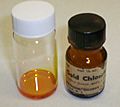
Gold(III) chloride solution in water
_chloride_solution.jpg)
See Also
 In Spanish: Oro para niños
- Bulk leach extractable gold, for sampling ores
- Chrysiasis (dermatological condition)
- Digital gold currency, form of electronic currency
- GFMS business consultancy
- Gold (color), a range of colors
- Gold fingerprinting, use impurities to identify an alloy
- Gold standard in banking
- List of countries by gold production
- Tumbaga, alloy of gold and copper
- Iron pyrite, fool's gold
- Nordic gold, non-gold copper alloy
