
Palme d'Or facts for kids
Quick facts for kids Palme d'Or |
|
|---|---|
 |
|
| Presented by | Cannes Film Festival |
| Location | Cannes |
| Country | France |
| First awarded | Marty (1955) |
| Currently held by | Fjord (2026) |
The Palme d'Or (which means Golden Palm in English) is the most important award given to the best film director at the Cannes Film Festival. This famous festival takes place every year in Cannes, France. The Palme d'Or was first introduced in 1955. Before that, from 1939 to 1954, the top prize was called the Grand Prix. The Palme d'Or was briefly replaced by the Grand Prix again from 1964 to 1974, but it came back in 1975. Today, it is known as one of the most respected awards in the film industry around the world.
Contents
The Story of the Golden Palm Award

In 1954, the festival organizers decided to create a special award that would be given out every year. They wanted a unique design for this top prize. They asked different jewelers to create a design that featured a palm tree. This was a nod to the city of Cannes's own coat of arms, which also has a palm. It also reminded people of the legend of Saint Honorat and the beautiful palm trees along the famous Promenade de la Croisette in Cannes.
A Parisian jeweler named Lucienne Lazon came up with the winning design. Her idea was inspired by a drawing from the director Jean Cocteau. The original award had a special base made of terracotta by an artist named Sébastien.
In 1955, the very first Palme d'Or was given to Delbert Mann for his film Marty. For a while, from 1964 to 1974, the festival went back to giving out the Grand Prix instead. But in 1975, the Palme d'Or returned and has been the festival's main symbol ever since. The award is presented in a beautiful case made of pure red Morocco leather with a soft white suede lining.

How the Palme d'Or Design Changed
Since it came back, the award has been updated a few times. In the early 1980s, the round base of the palm became more pyramid-shaped. In 1992, Thierry de Bourqueney redesigned the palm and its base using hand-cut crystal. Then, in 1997, Caroline Scheufele gave the statuette a new look. Since then, it has been made by the Swiss jewelry company Chopard. The palm itself is crafted from about 4.16 ounces (118 grams) of 18-carat yellow gold. The base of the palm branch forms a small heart. A single piece of cut crystal holds the palm, which is carefully made using a wax mold. Today, it comes in a blue Morocco leather case. In 1998, Theo Angelopoulos was the first director to win this modern version of the Palme d'Or for his film Eternity and a Day.
Memorable Moments and Changes
In 2013, the film Blue Is the Warmest Color won the Palme d'Or. The jury, led by Steven Spielberg, decided to give the award not only to the director, Abdellatif Kechiche, but also to the film's actresses, Adèle Exarchopoulos and Léa Seydoux. This was a very rare event, as it was the only time multiple Palme d'Or trophies were given for one film. The jury wanted to recognize the amazing performances of the actresses. A festival rule meant the winning film couldn't receive any other awards, so they found a way to honor everyone involved. Spielberg explained that the film wouldn't have been as powerful without their excellent acting.
The 2014 award went to Winter Sleep, a Turkish film by Nuri Bilge Ceylan. This happened during the 100th anniversary of Turkish cinema. When he accepted the award, Ceylan dedicated it to young people and workers in Turkey who were facing challenges in their country. In 2017, the award was redesigned again for the festival's 70th anniversary. The diamonds used were from a supplier that follows ethical practices.
The 2020 Cannes Film Festival was canceled because of the COVID-19 pandemic. Even though 56 films were chosen for the festival, no awards were given out that year. This was the first time this happened since 1968.
Since 2026, films that win the Palme d'Or and are not in English are also automatically considered for the Academy Award for Best International Feature Film.
As of 2026, Jane Campion, Julia Ducournau, and Justine Triet are the only female directors who have won the main prize. Jane Campion won for The Piano, Julia Ducournau for Titane, and Justine Triet for Anatomy of a Fall. However, Bodil Ipsen also won the Grand Prix (an earlier version of the top award) in 1946 for The Red Meadows, sharing it with Lau Lauritzen Jr..

Famous Winners of the Palme d'Or
Many talented directors from all over the world have been honored with the Palme d'Or. This award celebrates the best in filmmaking and has recognized some of the most important movies in history.
Special Palme d'Or
Sometimes, the jury gives a "Special Palme d'Or." This is different from the main competition award. It's given to honor a director's amazing career or a film that stands out in a unique way. In 2018, a Special Palme d'Or was given to Jean-Luc Godard for his film The Image Book, celebrating his long and influential work in cinema.
Countries with the Most Wins
The Palme d'Or has been won by films from many different countries. Here's a look at which countries have received the most awards:
| Country | Number of wins |
|---|---|
 France France |
29 |
 United States United States |
22 |
 Italy Italy |
13 |
 United Kingdom United Kingdom |
|
 Germany Germany |
10 |
 Denmark Denmark |
5 |
 Japan Japan |
|
 Sweden Sweden |
|
 Belgium Belgium |
4 |
 Soviet Union Soviet Union |
2 |
 Brazil Brazil |
|
 Yugoslavia Yugoslavia |
|
 Poland Poland |
|
 Austria Austria |
|
 Spain Spain |
|
 Turkey Turkey |
|
 Iran Iran |
|
 Romania Romania |
|
 Czechoslovakia Czechoslovakia |
1 |
 India India |
|
 Mexico Mexico |
|
 Switzerland Switzerland |
|
 Morocco Morocco |
|
 Algeria Algeria |
|
 Australia Australia |
|
 Hong Kong Hong Kong |
|
 New Zealand New Zealand |
|
 Greece Greece |
|
 Ireland Ireland |
|
 South Korea South Korea |
|
 Thailand Thailand |
|
 Luxembourg Luxembourg |
Directors Who Won More Than Once
Some directors are so talented that they have won the Palme d'Or more than once! Ten directors or directing teams have achieved this amazing feat. Three of them even won for films released one after the other.
| Number of wins | Directors | Nationality | Films |
|---|---|---|---|
| 2 | Alf Sjöberg | Sweden | Torment (1946), Miss Julie (1951) |
| Francis Ford Coppola | United States | The Conversation (1974), Apocalypse Now (1979) | |
Bille August  |
Denmark | Pelle the Conqueror (1988), The Best Intentions (1992) | |
| Emir Kusturica | Yugoslavia | When Father Was Away on Business (1985), Underground (1995) | |
| Shōhei Imamura | Japan | The Ballad of Narayama (1983), The Eel (1997) | |
| Jean-Pierre & Luc Dardenne | Belgium | Rosetta (1999), L'Enfant (2005) | |
| Michael Haneke |
Austria | The White Ribbon (2009), Amour (2012) | |
| Ken Loach | United Kingdom | The Wind That Shakes the Barley (2006), I, Daniel Blake (2016) | |
| Ruben Östlund |
Sweden | The Square (2017), Triangle of Sadness (2022) | |
| Cristian Mungiu | Romania | 4 Months, 3 Weeks and 2 Days (2007), Fjord (2026) |
Honorary Palme d'Or
The Honorary Palme d'Or is a special award given to people who have had a huge impact on cinema throughout their careers. It's for those who have created many wonderful films but might not have won the main competitive Palme d'Or. In 1997, on the festival's 50th anniversary, a special "Palme des Palmes" was given to the Swedish filmmaker Ingmar Bergman. Since 2002, this award has been given more regularly. In 2024, Studio Ghibli became the first and only film studio to receive this honor.
Images for kids
-

Orson Welles won in 1952.
-
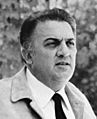
Federico Fellini won in 1960.
-

Robert Altman won in 1970.
-
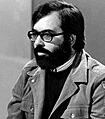
Francis Ford Coppola won twice in 1974 and 1979.
-
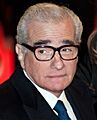
Martin Scorsese won in 1976.
-

Akira Kurosawa won in 1980.
-

Emir Kusturica won twice in 1985 and 1995.
-

David Lynch won in 1990.
-

Joel Coen won in 1991.
-

Jane Campion won in 1993, becoming the first woman to win it.
-

Quentin Tarantino won in 1994.
-

Abbas Kiarostami won in 1997.
-
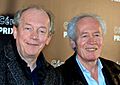
Dardenne brothers won twice in 1999 and 2005.
-

Ken Loach won twice in 2006 and 2016.
-
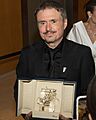
Cristian Mungiu won twice in 2007 and 2026.
-

Michael Haneke won twice in 2009 and 2012.
-

Ruben Östlund won in 2017 and 2022.
-

Bong Joon Ho won in 2019.
-

Julia Ducournau won in 2021, becoming the first woman to win it solo.
-

Sean Baker won in 2024.
-

Jafar Panahi won in 2025.


.jpg)
.jpg)


.jpg)
_(cropped).jpg)
.jpg)
.jpg)
.jpg)


.jpg)
.jpg)

See also
 In Spanish: Palma de Oro para niños
- List of actors who have appeared in multiple Palme d'Or winners
- Golden Bear, the highest prize awarded at the Berlin International Film Festival
- Golden Lion, the highest prize awarded at the Venice Film Festival
- Short Film Palme d'Or
