
Sphaerichthys vaillanti facts for kids
Quick facts for kids Sphaerichthys vaillanti |
|
|---|---|
 |
|
| Female (front); Male (back); | |
| Conservation status | |
Scientific classification  |
|
| Kingdom: | Animalia |
| Phylum: | Chordata |
| Class: | Actinopterygii |
| Order: | Anabantiformes |
| Family: | Osphronemidae |
| Genus: | Sphaerichthys |
| Species: |
S. vaillanti
|
| Binomial name | |
| Sphaerichthys vaillanti Pellegrin, 1930
|
|
| Script error: The function "autoWithCaption" does not exist. | |

Script error: No such module "Check for conflicting parameters".
The Sphaerichthys vaillanti, also known as Vaillant's chocolate gourami, Samurai gourami, or Samurai zebra gourami, is a special type of gourami fish. It lives in Asia, mainly in the Kapuas River area in Borneo, Indonesia. You can often find these fish in pairs in small streams. They like places with lots of wood and plant bits. This fish is super good at mimicking dead leaves. This helps them camouflage and hide from danger. They grow to be about 6 cm (2.5 inches) long. They can also breathe air if they need to!
Contents
What Kind of Fish Is It?
This fish is part of a big group called ray-finned fishes. It belongs to the order Anabantiformes. It's a type of anabantoid fish. These are all part of the Osphronemidae family, which includes all gouramis. So, the Vaillant's chocolate gourami is a specific kind of gourami.
Discovery and History
A person named Léon Vaillant first found this fish. He thought it was a different kind of gourami at first. Later, Jacques Pellegrin realized it was a new species. He then named it after Leon Vaillant to honor his discovery. This happened in the year 1832.
Life Cycle
These fish have a unique way of raising their babies! Unlike many other fish, the female gourami starts the courting behavior. She will stand upright for many hours during this time. The female then lays about 10 to 40 eggs. The male fish carefully gathers all the eggs into his mouth. He then hides to protect them. The female stays nearby to guard the area. This is called mouthbrooding.
What Does It Look Like?
Male and female Vaillant's chocolate gouramis look very different! This is called sexual dimorphism. Females are bright red with strong green and dark stripes. Males are much plainer. They are a dull reddish-brown with a few white lines. Young fish are brown with clear tails and white marks. All their colors help them blend in. They look like the dead leaves and plant bits in their natural home.
Threats to This Fish
This gourami faces several dangers. It only lives in Borneo, which means it's an endemic species. People really want this fish for aquariums. This makes it vulnerable to being collected too much. Its home is also being destroyed. Illegal gold mining causes pollution in the rivers. Scientists think that many of these fish were already lost because of human actions. This happened even before they started trying to protect them.
Who Lives With It?
Many other cool creatures live in the rivers of Borneo. The plant Bucephalandra grows there. Some types, like B. brownie sp., live with the Vaillant's gourami in the Kapuas River. Other fish friends include Clown loaches and Tiger barbs. You might also find Shelford’s loach and half-banded loaches. Different kinds of bagrid catfish also share the river. Even a special snake, the Kapuas mud snake, lives there!
Keeping Them in an Aquarium
It's rare to find this fish in pet stores. You usually get them from special breeders. If you do find one, it needs a tank that is at least 10 gallons. The water should be soft and a bit acidic. It needs a PH between 3.5 and 6.8. The tank should have wood, plants, and sand on the bottom. The water should also look a bit brown from tannins. This makes it look like their natural home. They like water with very little flow.

These fish eat both plants and small creatures. They are omnivores. They like small things like daphnia and worms. Baby fish can eat tiny plant bits that decay. These fish are sensitive to bad stuff in the water, like ammonia and nitrites. In their natural home, constant rain keeps the water clean. But they like stable water, so only change 10-15% of their water at a time. They are also sensitive to bacteria. Using peat in the filter can help. The tannins from plants in the water also help keep it clean.
It's best to keep a group of 6 or more of these fish. They are smart and peaceful. They like to explore their surroundings. You must feed them live foods at first. They often refuse processed foods. Once they get used to live food, you can slowly try to get them to eat processed food. Still, give them live food every few days to keep them healthy. These fish can get sick easily, so good care is important.
Gallery
-

Aerial view of the Kapuas River.
-
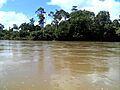
The Kapuas River.
-

The Samurai Gourami using its camouflage in its habitat.
-

A picture of the riverbed where S. Vaillanti lives.
-
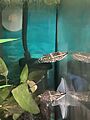
A pair of Samurai gouramis near a cryptocoryne plant.
-
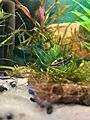
A specimen hiding behind Java moss.
-
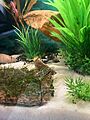
A Samurai gourami in an aquarium.
-
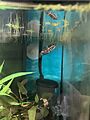
A specimen near the corner surface of an aquarium.
-
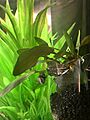
A pair of Samurai gouramis underneath a cryptocoryne plant.

.jpg)


