
St Andrew's Church, Buckland facts for kids
Quick facts for kids St Andrew's Church, Buckland |
|
|---|---|

St Andrew's Church, Buckland, from the south-west
|
|
| Lua error in Module:Location_map at line 420: attempt to index field 'wikibase' (a nil value). | |
| OS grid reference | TL 359 339 |
| Location | Buckland, Hertfordshire |
| Country | England |
| Denomination | Anglican |
| Website | Churches Conservation Trust |
| History | |
| Dedication | Saint Andrew |
| Architecture | |
| Functional status | Redundant |
| Heritage designation | Grade II* |
| Designated | 22 February 1967 |
| Architectural type | Church |
| Style | Gothic |
| Groundbreaking | c. 1348 |
| Specifications | |
| Materials | Flint with stone dressings Tiled roofs |
St Andrew's Church is an old and beautiful church located in the village of Buckland, Hertfordshire, England. It's a special building that has been officially recognized as a Grade II* listed building. This means it's very important historically and architecturally. Today, the Churches Conservation Trust takes care of it, making sure it stays preserved for everyone to see. You can find this church on the highest point in the village, near the A10 road, between the towns of Royston and Buntingford.
Contents
History of the Church
The main parts of St Andrew's Church, like the nave (the central area where people sit) and the chancel (the area near the altar), were built a very long time ago, around the year 1348. The tall tower was added later, around 1400. The south aisle (a side section) and the south porch (the entrance area) were built in the late 1400s.
The church has been repaired and updated several times over the years. Major repairs happened in 1848 and again in 1875. Around 1880, a vestry (a room for clergy) and an organ chamber were added. The outside walls of the nave and aisle were also repaired in 1893.
Church Design and Features
Outside the Church
St Andrew's Church is built mostly from flint stones, with special stone pieces used for details. The roofs are made of red tiles. The church has a narrow nave with a wide south aisle and a south porch. It also has a chancel with a vestry and organ chamber on its north side, and a large tower on the west side.
The tower has three main sections, separated by decorative stone bands. It has strong corner supports called buttresses and a battlemented top, which looks like the top of a castle wall. At the very top of the tower is a pyramid-shaped spire. The tower has a main doorway with a pointed arch and windows above it. The bell openings at the top also have two lights (sections).
On the north side of the nave, there are three windows from the 1300s. There's also a doorway from the 1400s that is now blocked up. The large east window in the chancel has three sections and was added in the 1800s, but it looks like it's from the 1400s. The south aisle has windows from the 1400s, with two on the south wall and one on each of the east and west walls. The south porch has corner buttresses and windows on each side. Above the entrance arch, there's a small carved space called a niche.
Inside the Church
Both the nave and the chancel have curved wooden ceilings, called waggon roofs, which were added in the 1800s. Between the nave and the south aisle, there's a row of arches called an arcade. The aisle has a nearly flat wooden roof from the 1400s, decorated with carved designs called bosses. In the aisle, you can also find a piscina, which is a small basin used for washing sacred vessels.
The floor of the chancel is covered with colorful encaustic tiles. The arch on the north side of the chancel has beautiful carvings of angels playing music. The font, used for baptisms, is made from Barnack stone with a base of clunch stone. The wooden pulpit, where sermons are given, is from the 1800s.
On the north wall of the nave, there are four boards from the 1800s with the Lord's Prayer, the Ten Commandments, and the Creed written on them. Behind the altar, there are three groups of brasses (engraved metal plates) from the late 1400s. In the south wall of the aisle, there's a white alabaster monument from 1634. The tower also has two monuments from the 1700s.
You can see a marble tablet in the arcade from 1861, designed in a Neoclassical style. In the southwest part of the chancel, there's another marble tablet from 1819, created by a famous sculptor named Chantrey. Some of the windows in the nave still have medieval stained glass, which is very old and colorful. The organ, which has one keyboard, was built in 1870 by Henry Jones and Son.
Images for kids
-
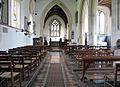
St Andrew's, Buckland - Nave, looking east
-
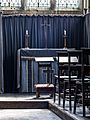
St Andrew's, Buckland - South aisle altar
-
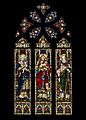
St Andrew's, Buckland - East window by Alexander Gibbs & Co, 1883
-
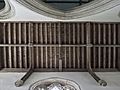
St Andrew's, Buckland - South aisle roof
-
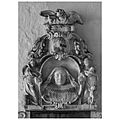
St Andrew's, Buckland - Memorial to Susan Clerke, south aisle


See also
- The Churches Conservation Trust: St Andrew's Church, Buckland
