
St Paul's Anglican Church, Ipswich facts for kids
Quick facts for kids St Paul's Anglican Church, Ipswich |
|
|---|---|

St Paul's Anglican Church, 2020
|
|
| Location | 124 Brisbane Street, Ipswich, City of Ipswich, Queensland, Australia |
| Design period | 1840s–1860s (mid-19th century) |
| Built | 1855–1929 |
| Official name: St Pauls Anglican Church and Rectory | |
| Type | state heritage (landscape, built) |
| Designated | 21 October 1992 |
| Reference no. | 600591 |
| Significant period | 1850s–1860s (historical) 1850s–1920s (fabric) |
| Significant components | fence/wall – perimeter, wall/s, residential accommodation – rectory, chapel, bell – church, stained glass window/s, views to, roof lantern / lantern light, furniture/fittings, memorial – tablet, memorial – cross, chimney/chimney stack, stalls – choir, terracing, pipe organ, church, roof/ridge ventilator/s / fleche/s |
| Lua error in Module:Location_map at line 420: attempt to index field 'wikibase' (a nil value). | |
St Paul's Anglican Church is a very old and important church building in Ipswich, Queensland, Australia. It is located at 124 Brisbane Street. This beautiful church was built over many years, starting in 1855 and finishing in 1929. Because of its history and special design, it was added to the Queensland Heritage Register on 21 October 1992.
Contents
The Church's Story

St Paul's Anglican Church is a brick church built in the Gothic Revival style. This means it looks like old churches from the Gothic period in Europe. The main part of the church was finished in 1859. William Wakeling oversaw the building work, but the design was likely by Edmund Blacket.
Later, more parts were added to the church. In 1888 and 1889, side aisles were built, designed by architect F.D.G. Stanley. Then, in 1929, the western parts were extended by architect George Brockwell Gill.
Early Church Buildings
Before the current St Paul's Church was built, the first Church of England services in Ipswich were held in a timber building. Later, in 1850, a brick church was built across the street from where St Paul's stands today. This first brick church was only meant to be temporary. It was used as a Sunday School and a day school before being taken down in 1877.
Building the Main Church
The first stone for St Paul's Church was laid in 1855. However, the church took several years to complete, finally opening in June 1859. Many people believe Edmund Blacket was the architect. He designed similar churches in other places like West Maitland and Newcastle.
An architect named William Wakeling, who had studied with Blacket, came to Ipswich in 1856. He helped supervise the building of St Paul's and was in charge of how the inside of the church was set up.
The church was built to a very high standard. This was because Ipswich was a busy and successful town at the time. There was also a friendly competition between Ipswich and Brisbane. The church leaders hoped that the new bishop would choose St Paul's as his main church, making Ipswich an important cathedral town.
Special Features and Additions
In 1860, a pipe organ was brought all the way from England and installed. This was the very first pipe organ in the colony of Queensland! This organ is still there today, though it has been fixed up and moved around over the years.
- In 1882, a gallery was built inside the church.
- Two special windows were added to the eastern wall.
- A cast iron porch was also put on the church.
In 1888, more additions were made. The north and south aisles were added. These were designed by F.D.G. Stanley and built by Robert Wilson and Co.
Later, in 1926, the old cast iron porch was replaced with the one you see today. The bell in this new porch actually came from the very first church built in the 1850s!
In 1929, George Brockwell Gill, a local Ipswich architect and church member, designed and oversaw more extensions. These included making the chancel (the area around the altar) larger and adding an organ chamber, sacristy, chapel, and vestry. In 1992, major work was done to protect and restore the church.
Inside the Church
The church has beautiful stained glass windows. It also has many special memorials, which are marble tablets honoring important people from Queensland's past. These include George Thorn and Thomas de Lacy Moffat.
In the north-east part of the church is the Martyrs Chapel. This chapel honors the Martyrs of New Guinea, including a medical missionary named Mavis Parkinson. She was killed during World War II. The chapel has a small bamboo cross in a glass case, given by the Bishop of South Tokyo. There is also a cross found in an old German mission. Outside the church, near the entrance, a Celtic cross made of grey stone also honors Mavis Parkinson.
The church also has a memorial tablet for John Panton, who was an early settler, businessman, and politician in Ipswich.
In 1966, a special baptismal font bowl and plaque were added. These honored Anna MacArthur, who was the daughter of Philip Gidley King.
Church Hall and Rectory
A church hall was built in 1908. However, it was taken down in 1962, along with a timber belltower. A new brick and steel building, called the parish centre, was built in its place. This new centre was dedicated as a war memorial and was designed by Conrad and Gargett Architects.
The rectory, which is the house where the church's rector (or minister) lived, was built in 1895–1896. It was designed by George Brockwell Gill. It replaced an older house that was falling apart. The rectory has not changed much since it was built. Around 1990, it stopped being used as the rector's home and is now used for church offices.
Church Grounds
The church grounds are very pretty and help make the church look even more impressive. They include a limestone wall around the outside, much of which was built before 1876. The part of the wall along Brisbane Street has long been a popular spot for people in Ipswich to sit and watch parades.
The limestone terraces were made longer along Nicholas and Limestone Streets in the 1930s. A bus shelter in Nicholas Street was also built in 1932.
What the Church Looks Like
St Paul's Church takes up a whole block in the middle of Ipswich city. The area includes the church building, the church hall, the rectory, gardens, and the limestone walls around the property. All these parts together make it a very noticeable landmark in the city.
Church Building Details
The church itself is built in the Gothic Revival style. It has a Latin cross shape, with the main altar area (called the sanctuary) at the western end. The outside walls are made of brick. There are five arched windows with beautiful stained glass and small vents that can open.
The roof is very steep and covered with flat metal sheets. It has dormer window ventilators that stick out. Inside, the roof has special wooden beams called hammer beam trusses. These cross over each other in the middle, holding up a raised lantern roof ventilator.
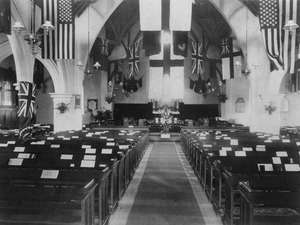
The main entrance porch is at the eastern end. It leads into a foyer area. Above this foyer is the upper choir loft, which has a timber screen, decorative cast iron railings, and a cast iron spiral stair to get up to it. The church floor is made of clear-finished hoop pine wood, and the walls are painted plaster. The church pews (benches) look like they are the original ones.
The northern transept (one of the arms of the cross shape) used to hold the organ and choir stalls. However, the organ has been fixed up and moved to the southern transept. The southern transept is also larger to fit two vestries (rooms for clergy).
Side aisles run along both sides of the nave (the main part of the church). These aisles end in small chapels at the western end. The inside of the church has beautiful wooden details, including screens around the sanctuary, a communion rail, and wood panels made of cedar and pine.
There are also many marble tablets and memorials inside, along with a pulpit (where sermons are given), a baptismal font (for baptisms), and a lectern (for reading lessons). The chapel in the north-eastern corner of the nave honors Mavis Parkinson. It has an altar covered with New Guinea tapa cloth and a small bamboo cross in a glass case.
Rectory Details
The rectory is a timber building that sits low to the ground. It has verandahs (porches) on all sides. A nice entrance porch with a pediment (a triangular shape above the door) faces east, looking over the town centre. The walls are made of chamferboard (a type of wooden siding), and the hipped roof is covered with corrugated galvanised iron. The roof has special metal ventilators and brick chimneys with terracotta chimney pots.
The inside of the rectory is mostly the same as when it was built. Only small changes have been made to create church offices, meeting rooms, and storage. Most of the cedar wood details, except for one fireplace, are still there. A modern car parking area has been built at the back, and a ramp for people with disabilities is next to the northern verandah.
Grounds and Walls
The church grounds are higher than the surrounding footpaths. They are surrounded on all sides by old limestone retaining walls with sloped concrete tops. These walls once had a small picket fence on top. At the main north-east entrance, there are two round, crenellated (like castle battlements) gate pillars. These are made of rough limestone that matches the nearby walls. The garden has some old trees and a beautiful Celtic cross memorial. It sits on three steps and has an inscription and traditional Celtic designs carved into it.
Why This Place Is Important
St Paul's Anglican Church and Rectory were listed on the Queensland Heritage Register on 21 October 1992 for several important reasons:
- Shows Queensland's History: This place helps us understand how Queensland's history unfolded. It shows the hopeful spirit of Ipswich before Queensland became a separate colony. People wanted to build impressive community buildings that showed how important they thought their town was.
- Rare and Special: The church was finished in 1859, making it a rare example of a church built before Queensland separated from New South Wales. It is the oldest Anglican Church in Queensland. It also has the oldest pipe organ in Queensland, which is very special.
- Beautiful Design: The main church is a wonderful example of Gothic Revival architecture. It was built over a long time, from 1855 to 1929. With its central location in the city and its well-kept grounds, including the lovely limestone wall and terraces, it is a major landmark in Ipswich.
- Important to the Community: The church has been a very important part of the spiritual and social life of the Ipswich community since the 1850s.
- Connected to Important People: It is strongly connected to two important Queensland architects, F.D.G. Stanley and G.B. Gill. It is also linked to Edmund Blacket and William Wakeling. The church is also associated with Mavis Parkinson, an Anglican Church missionary who was killed in New Guinea during World War II. The rectory is a finely designed example of a late Victorian house and shows the good work of G.B. Gill.
