
The Negro Motorist Green Book facts for kids

Cover of the 1940 edition
|
|
|
|
|
| Author | Victor Hugo Green |
|---|---|
| Country | United States |
| Language | English |
| Genre | Guide book |
| Publisher | Victor Hugo Green |
| Published | 1936–1966 |
The Negro Motorist Green Book, often called the Green Book, was a special guidebook for Black people traveling by car. It was created by Victor Hugo Green, a postal worker from New York City. The book was published every year from 1936 to 1966. During this time, unfair laws called Jim Crow laws made it hard for Black people to travel freely. They often faced problems like being refused service at restaurants or hotels. Sometimes, they even faced serious dangers. The Green Book helped Black travelers find safe places to eat, sleep, and get gas. It made their journeys much easier and safer.
The Green Book: A Guide for Black Travelers
Traveling During a Time of Segregation
_in_1956.png)
Before the civil rights movement brought about big changes, traveling by car was very difficult and often risky for Black people. They sometimes faced unfair treatment from police. Some white people thought Black people should not own cars or travel freely. This meant Black travelers could face problems on the road.
Challenges on the Road
Many towns had unfair Jim Crow laws. These laws meant Black people were not allowed to stay in certain places after sunset. These were called "sundown towns." If Black travelers were caught in these towns after dark, they could face serious danger.
Even if they found a place to stay, hotels and restaurants often refused to serve Black customers. This was part of a system called "separate but equal." In reality, facilities for Black people were usually much worse and not equal at all. Black people were often limited to "colored sections" or could only use facilities at different times.
Writer W. E. B. Du Bois noted in 1917 that it was very hard for Black people to plan vacations. This problem grew as more Black Americans moved to cities and had more money and time for travel.
Why Cars Were Important
Cars became very important for Black Americans. They offered freedom from segregated public transportation, like the "Jim Crow cars" on trains, which were often uncomfortable. One writer in 1933 said that driving made them feel like "Vikings," free to go where they pleased.
However, even with cars, challenges remained. Many hotels and restaurants across the country would not serve Black customers. For example, in Salt Lake City in the 1920s, Black travelers might not find a hotel. In Albuquerque, only a few motels on U.S. Route 66 welcomed Black guests.
Black travelers often had to carry their own food and extra gasoline. They might also carry portable toilets because they were often not allowed to use bathrooms at gas stations or rest stops. Finding a safe place to sleep was a constant worry. Families sometimes spent hours looking for a place or had to sleep in their cars.

Civil rights leader John Lewis remembered his family's trips in 1951. They packed all their food and carefully planned their route. They knew which gas stations had "colored" bathrooms and which ones to avoid.
The danger was real. Rules about segregation changed from place to place. Even small mistakes could put travelers in danger. For instance, in some areas, Black drivers were not allowed to pass white drivers on unpaved roads. This was to prevent dust from covering white-owned cars.
Even important Black diplomats faced discrimination. In one famous event, Ghana's finance minister, Komla Agbeli Gbedemah, was refused service at a restaurant in Delaware in 1957. This caused an international incident.
How the Green Book Helped

Because of these challenges, guides were created to help Black travelers. The Negro Motorist Green Book was one of the most famous. Victor Hugo Green started it in 1936. His goal was to give Black travelers information to avoid problems and make their trips more enjoyable. He gathered information from his postal worker colleagues and asked readers for their experiences.
The Green Book had a motto on its cover: "Carry your Green Book with you – You may need it." It helped Black travelers find safe places to stay, eat, and get car service. It also helped money stay within the Black community by listing Black-owned businesses.
What Was Inside the Green Book?
The guide listed hotels, motels, tourist homes (private houses offering rooms), and restaurants. These were organized by state and city. Businesses could pay extra to have their listings in bold or marked with a star.
The Green Book also empowered Black women. It listed many businesses owned by women, like beauty salons and tourist homes. This created safe spaces and economic chances for Black women during segregation. Famous women like Annie Turnbo Malone and Madam C. J. Walker helped many Black women start their own businesses, and many of these were in the Green Book.
Many listed places were owned and run by Black Americans. Some were named after important Black history figures. For example, North Carolina had the Carver, Lincoln, and Booker T. Washington hotels.
The Green Book's Impact
The Green Book gained support from many businesses, including Black newspapers and Esso (now ExxonMobil) gas stations. Esso even had a Black marketing team that promoted the Green Book.
Many people praised the Green Book. William Smith of New Jersey called it a "credit to the Negro Race" in 1938. He said it was as important for Black travelers as the AAA guide was for white travelers.
Ernest Green, one of the Little Rock Nine, used the Green Book for long trips in the 1950s. He called it "one of the survival tools of segregated life." Civil rights leader Julian Bond said it told you "not where the best places were to eat, but where there was any place."
Victor Green hoped that one day the guide would not be needed. He wrote that it would be a "great day for us to suspend this publication for then we can go as we please, and without embarrassment."
The End of an Era
The Green Book started in New York City and grew to cover most of the United States, parts of Canada, Mexico, and Bermuda. It sold about 15,000 copies each year. These were sold by mail, churches, Black-owned businesses, and Esso gas stations.
After Victor Green passed away in 1960, his wife, Alma Green, and her team continued the publication.
By the early 1960s, the need for the Green Book began to lessen. The civil rights movement was making progress in ending segregation. More Black Americans started to wonder if the guide was accidentally supporting segregation by directing them to separate businesses.
The final edition was published in 1966–1967. It was renamed Travelers' Green Book: 1966–67 International Edition: For Vacation Without Aggravation. The Civil Rights Act of 1964 had made racial discrimination in public places illegal. This law made the Green Book no longer necessary, fulfilling Victor Green's hope.
Remembering the Green Book Today
In the 2000s, people became interested in the Green Book again. They wanted to learn more about Black travel during the Jim Crow era. Copies of the book are now valuable collector's items. A 1941 edition sold for $22,500 in 2015.
Exhibitions and Films
- The New York Public Library has digitized 21 issues of the Green Book. They also created an interactive map for people to explore the listed locations.
- The Smithsonian Institution's National Museum of American History included the Green Book in an exhibition called America on the Move in 2003.
- The National Museum of African American History and Culture displayed a 1941 copy of the book when it opened in 2016.
- Several films have been made about the Green Book, including the documentary The Green Book Chronicles (2016) and the 2018 movie Green Book (film), which won Best Picture at the 91st Academy Awards.
Protecting Important Places
Cities like Los Angeles have considered giving special historical protection to sites listed in the Green Book. This helps remember the important role these places played in keeping Black travelers safe.
Notable listings
A number of sites in the Green Book are listed on the National Register of Historic Places:
- Limerick-Frazier House, Austin, Texas
- Harriet Cornwell House, Columbia, South Carolina
- Latimore Tourist Home, Russellville, Arkansas
- Avalon Hotel, Rochester, Minnesota
- Cummings' Guest House, Old Orchard Beach, Maine
- Allen University, Columbia, South Carolina
- A.G. Gaston Motel, Birmingham, Alabama
- Rossonian Hotel, Denver, Colorado
- Hotel Theresa, New York, New York
- Leveey's Funeral Home, Columbia, South Carolina
- Ruth's Beauty Parlor, Columbia, South Carolina
- Ebony Guest House, Florence, South Carolina
- Harrison's Guest House, Las Vegas, Nevada
- Coronado Lodge, Pueblo, Colorado
- Winks Panorama, Pinecliffe, Colorado
- Manse Hotel and Annex, Cincinnati, Ohio
- Booker T. Motel, Humboldt, Tennessee
- Apollo Theater, New York, New York
- Liberty Hotel, Atlantic City, New Jersey
- Lorraine Motel, Memphis, Tennessee
- Holman's Barber Shop, Columbia, South Carolina
Images for kids
-
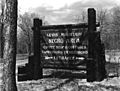
Separate but equal in practice: a separate "Negro Area" at Lewis Mountain in Shenandoah National Park
-
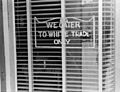
"We cater to white trade only"; many hotels and restaurants excluded African Americans, such as this one in Ohio, seen in 1938.
-
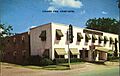
The College View Court-Hotel in Waco, Texas, advertised as "Waco's Finest for Negroes" in the 1950s
-
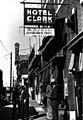
The "Colored only" Hotel Clark in Memphis, Tennessee, c. 1939
-
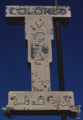
Sign in Statesboro, Georgia: "Colored Motel, 2 blocks", photographed in 1979


See also
- Black Travel Movement
- AAA racial discrimination
- Black-owned businesses
- List of African American hotels, motels, and boarding houses
- African American resorts
