
The Twelve Days of Christmas (song) facts for kids
Quick facts for kids "The Twelve Days of Christmas" |
|
|---|---|
 |
|
| Song | |
| Published | c. 1780 |
| Genre | Christmas carol, nursery rhyme (counting-out) |
| Composer(s) | Traditional with additions by Frederic Austin |
"The Twelve Days of Christmas" is a well-known English Christmas carol and nursery rhyme. It's a special kind of song called a cumulative song. This means each verse builds on the one before it. The song lists many gifts given by a "true love" over the twelve days of Christmas. These twelve days are the Christmas season, starting on Christmas Day. The words were first printed in England in the late 1700s. The most famous tune for the song comes from a 1909 arrangement by English composer Frederic Austin.
Contents
What is "The Twelve Days of Christmas"?
"The Twelve Days of Christmas" is a cumulative song. This means that each new verse adds a new gift and then repeats all the gifts from the verses before it. There are twelve verses in total. Each verse describes a gift given by "my true love" on one of the twelve days of Christmas.
There are some small differences in the words used over time. The lyrics we know best today come from Frederic Austin's 1909 publication. Here are the first three verses:
On the first day of Christmas my true love sent to me
A partridge in a pear tree
On the second day of Christmas my true love sent to me
Two turtle doves,
And a partridge in a pear tree.
On the third day of Christmas my true love sent to me
Three French hens,
Two turtle doves,
And a partridge in a pear tree.
Each verse after this follows the same pattern. A new gift is added for the next day of Christmastide. Then, all the gifts from earlier days are repeated. This makes each verse a little longer than the one before it.
Here are the other gifts mentioned in the song:
- four calling birds
- five gold rings
- six geese a-laying
- seven swans a-swimming
- eight maids a-milking
- nine ladies dancing
- ten lords a-leaping
- eleven pipers piping
- twelve drummers drumming
Different Ways to Sing It
The words to "The Twelve Days of Christmas" have changed a bit over many years. The first known printed versions were in a children's book called Mirth Without Mischief (around 1780) and on a paper called a broadsheet from Newcastle.
Changes Over Time

Many versions of the song exist. Here are some common changes:
- Early versions often skipped the word "on" at the start of each verse. For example, "The twelfth day of Christmas" instead of "On the twelfth day of Christmas." Frederic Austin added "on" in his 1909 version, and it became very popular.
- Some older versions said "my true love sent to me." A newer version, popular in North America, says "my true love gave to me."
- Sometimes, the gifts came from "my mother" instead of "my true love."
- The "pear tree" has sometimes been heard as "juniper tree" or "June apple tree." This was likely a misunderstanding of "partridge in a pear tree."
- The "four calling birds" were originally "four colly birds." "Colly" is an old word meaning "coal-black." Austin's 1909 version changed it to "calling birds," which is now the most common.
- "Five gold rings" often became "five golden rings." This helps the words fit the music better.
- The order of the last few gifts (pipers, drummers, ladies, lords) sometimes changed in different versions.
Versions from Other Countries
Similar counting songs exist in other parts of the world. They show how this type of song is popular in many cultures.
Scotland's "The Yule Days"
Scotland has a similar song called "The Yule Days." It has thirteen days instead of twelve. The number of gifts doesn't increase in the same way as "The Twelve Days of Christmas." One verse from 1842 mentions:
The king sent his lady on the thirteenth Yule day,
Three stalks o' merry corn,
Three maids a-merry dancing,
Three hinds a-merry hunting,
An Arabian baboon,
Three swans a-merry swimming,
Three ducks a-merry laying,
A bull that was brown,
Three goldspinks,
Three starlings,
A goose that was grey,
Three plovers,
Three partridges,
A pippin go aye;
Wha learns my carol and carries it away?
"Pippin go aye" is a Scots word for a peacock or parrot.
Faroe Islands' Counting Song

The Faroe Islands also have a similar Christmas counting song. Its gifts include: one feather, two geese, three sides of meat, four sheep, five cows, six oxen, seven dishes, eight ponies, nine banners, ten barrels, eleven goats, twelve men, thirteen hides, fourteen rounds of cheese, and fifteen deer. These gifts were shown on two special stamps in 1994.
Sweden's Similar Tune
In southern Sweden, a similar song was sung. It listed gifts like one hen, two barley seeds, three grey geese, four pounds of pork, and many more. It ended with twelve churches, each with twelve altars, priests, capes, coin-purses, and silver coins.
France's "The Twelve Months"
France has a cumulative song called "Les Douze Mois" ("The Twelve Months"). It is also known as "La Perdriole" ("The Partridge"). A verse from 1856 mentions:
|
Le douzièm' jour d'l'année, |
The twelfth day of the year |
The Song's History and Meaning
The exact beginnings and meaning of "The Twelve Days of Christmas" are not fully known. It likely started as a children's game where players had to remember and repeat things.
Where Did It Come From?
The twelve days in the song refer to the twelve days of Christmas. This period starts on Christmas Eve and ends the day before Epiphany, which is January 6th. Twelfth Night is January 5th. It traditionally marks the end of Christmas celebrations.

The most famous English version was first printed in a children's book. It was called Mirth without Mischief and came out in London around 1780. This book had many pictures.
Some clues suggest the carol might have come from northern England. Many old printed copies from the 1700s and 1800s were found near Newcastle upon Tyne. Also, the Red-legged partridge, which often perches in trees, was brought to England from France around 1770. This might suggest a French connection for the "partridge in a pear tree."
Playing the Game
Many old records show that "The Twelve Days of Christmas" was played as a memory game. It was also a "forfeits" game. In this game, one person would start by saying a verse. Then, the next person would repeat it and add the next part. If a player made a mistake, they had to pay a penalty. This could be giving a kiss or a sweet treat.
One writer in 1842 said that "Each child in succession repeats the gifts of the day, and forfeits for each mistake." Another person from Newcastle in 1855 said the song was "extremely popular as a schoolboy's Christmas chant."
In 1864, a writer named Thomas Hughes described a game of forfeits. He wrote about children repeating the verses. If someone made a mistake, it was noted down for a forfeit. This shows how much fun kids had playing this game.
What Do the Gifts Mean?
People have wondered about the meaning of each gift in the song. Some ideas have been shared over the years.
The Partridge and Pear Tree
Some people think "pear-tree" might have come from the French word perdrix, which means "partridge." This idea comes from how similar the words sound. It also makes sense because the partridge is a bird.
French Hens and Blackbirds
The "French" in "French hens" might just mean "foreign" or from another country. The "colly birds" (which became "calling birds") are actually blackbirds. "Colly" is an old word meaning "black," like coal.
The Gold Rings

Some people have guessed that the "five gold rings" might refer to ringed pheasants or even goldfinches. However, the first printed version of the song in 1780 shows a picture of actual jewelry rings. This suggests they are indeed gold rings to wear.
General Meanings and Theories
Some people have thought the gifts might represent food or sports for each month of the year. Others believed the weather on each of the twelve days could predict the weather for the next twelve months.
A popular idea, especially in the late 1900s, was that the song had a secret meaning. Some thought it was a way for a certain religious group to teach their beliefs during a time when it was difficult to practice their faith openly. However, experts who study old songs and stories have looked into this idea. They found no strong proof that the song was a secret code. The gifts mentioned in the song are things that many people would understand, not just one specific group.
The Music of the Carol
The earliest printed versions of the song did not include any music. People likely sang it to tunes they already knew.
The Famous Tune

The tune we usually hear today was made popular by an English musician named Frederic Austin. He arranged the music for a singer and piano. He started performing it in his concerts around 1905. People loved the "quaint folk-song."
Austin's arrangement was published in 1909. He wrote that the song and its tune were part of his family's traditions. He had not heard them anywhere else. He recorded them as best as he could remember.
Many people believe that Austin added the special melody for "five gold rings." The rest of the tune is thought to be from older folk music.
The song's rhythm changes a bit, which is common in folk songs. The parts like "On the [nth] day of Christmas, my true love gave to me" have a steady beat. But the lines listing the gifts often feel a little faster. This gives the song its unique, hurried sound.
.png)
Austin's choices for the lyrics also became very common. He added "On" at the start of each verse. He changed "colly birds" to "calling birds." He also set the order for the last few gifts.

Older Melodies
Many older tunes for the song have been found. Some were written down in the 1800s. Others were collected by people who studied folk music.
- Older Musical settings of "Twelve Days of Christmas"
-
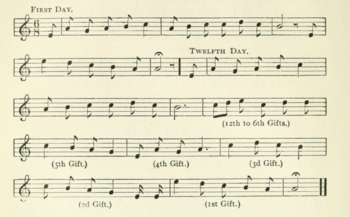
"[C]opied from a manuscript of 1790"
-
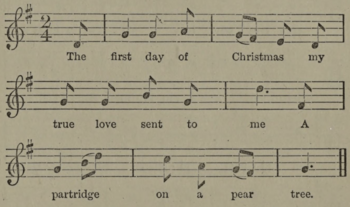
"[C]ollected by the late Mr. John Bell, of Gateshead, about eighty years ago" [i.e. around 1808]
-
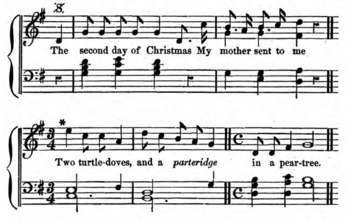
From Edward Rimbault's Nursery Rhymes, with the Tunes to which They Are Still Sung in the Nurseries of England (1846)
-
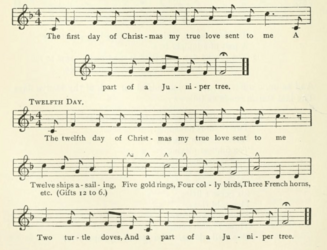
"[R]ecorded about 1875 by a lady of Providence, RI, from the singing of an aged man."
-
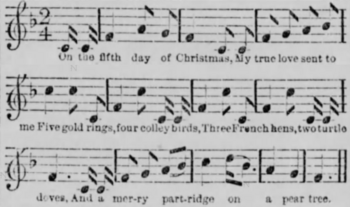
Current in "country villages in Wiltshire", according to an 1891 newspaper article
-
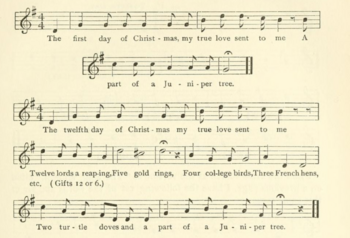
"[A]s sung by the Allens at the Homestead, Castle Hill, Medfield, Massachusetts, 1899"
-
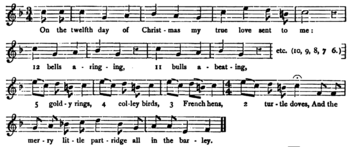
"[S]ung by Mr. George Wyatt, at West Harptree, Somerset, April 15th, 1904".
.png)


.png)
.png)
.png)
.png)
Folklorists, who study traditional stories and songs, have recorded many versions. These recordings show how the song was sung in different places. For example, the Copper family in England sang a unique version in 1955. Many versions were also recorded in New England in the United States.
Fun Parodies and Other Versions

"The Twelve Days of Christmas" is so popular that many artists have created their own fun versions.
- Bing Crosby and the Andrews Sisters recorded the traditional song in 1949.
- Allan Sherman released "The Twelve Gifts of Christmas" in 1963, a funny take on the carol.
- Alvin and the Chipmunks covered the song for their 1963 album.
- Frank Sinatra and his children sang their own version in 1968.
- The Muppets and John Denver performed it together in a 1979 TV special.
- Bob & Doug McKenzie released a Canadian-themed version in 1982.
- VeggieTales made a parody called "The 8 Polish Foods of Christmas" in 1996.
- Christian rock band Relient K recorded a version in 2007. It had a funny line: "What's a partridge? What's a pear tree? I don't know, so please don't ask me."
- A Māori / New Zealand version, "A Pukeko in a Ponga Tree", was released in 1981.
- In Hawaii, "The Twelve Days of Christmas, Hawaiian Style" is a popular version.
Counting All the Gifts
If you add up all the gifts mentioned in the song, including all the repetitions, the "true love" sends a total of 364 items by the twelfth day! That's almost one gift for every day of the year.
This idea of 364 gifts has been used in many funny stories and films:
- In 1955, a short film called On the Twelfth Day... showed a woman's house getting very crowded with all the gifts.
- A 1972 children's novel, The Thirteen Days of Christmas, tells how the gifts cause a lot of trouble for the person receiving them.
- In 1999, singer Natalie Cole's version of the song ended with her adding up all 364 gifts and deciding to move out of her crowded home.
- A 2016 animated short film showed a woman getting very stressed by all the gifts. She eventually broke up with her boyfriend!
The Christmas Price Index
Christmas Price Index Since 1984, a bank called PNC Bank has created something fun called the Christmas Price Index. It's a silly way to track the cost of all the gifts in the song. They calculate two costs:
- The Christmas Price Index: The cost of one set of each gift.
- The True Cost of Christmas: The total cost of all 364 gifts, including all the repetitions.
The people mentioned in the song (like maids, ladies, lords, pipers, and drummers) are counted as hired services, not items to buy. For 2023, the total cost for one set of gifts was about US$46,729.86. If you wanted to buy all 364 items, it would cost around US$201,972.18! The original cost in 1984 was much lower, at $12,623.10.
See also
 In Spanish: The Twelve Days of Christmas para niños
