
Tim Cook facts for kids
Quick facts for kids
Tim Cook
|
|
|---|---|
.jpg)
Tim Cook
|
|
| Born |
Timothy Donald Cook
November 1, 1960 Mobile, Alabama, U.S.
|
| Education | |
| Title |
|
| Predecessor | Steve Jobs |
| Successor | John Ternus |
| Signature | |
 |
|
Timothy Donald Cook (born November 1, 1960) is an American business leader and engineer. He served as the chief executive officer (CEO) of Apple from 2011 to 2026. Under his leadership, Apple became one of the most valuable technology companies in world history. In 2026, he transitioned to become Apple's executive chairman.
Before taking the top job at Apple, Cook worked closely with co-founder Steve Jobs. Cook managed the complex supply chains and global factories that build Apple devices. When Jobs stepped down due to illness in 2011, Cook took over as CEO. During his time leading the company, Cook introduced popular products like the Apple Watch, AirPods, and Apple Vision Pro. He also focused strongly on user privacy, renewable energy, and charitable giving.
Contents
- Early Life and Childhood in Alabama
- Early Business Career Before Apple
- Rising Through the Ranks at Apple
- Leading Apple as Chief Executive Officer
- Environmental and Social Initiatives
- Global Diplomacy and Government Relations
- Personal Life and Philanthropy
- Awards, Honors, and Legacy
- Tim Cook Quotes
- Images for kids
- See also
Early Life and Childhood in Alabama
Growing up in Robertsdale
Timothy Donald Cook was born on November 1, 1960, in Mobile, Alabama. He grew up in the small nearby town of Robertsdale. His father, Donald Cook, worked hard at a local shipyard. His mother, Geraldine Cook, worked at a local pharmacy.
Growing up in a close-knit Southern community shaped Cook's calm and steady personality. He attended Robertsdale High School, where he was an exceptional student. He graduated in 1978 with the second-highest grades in his class, earning the title of salutatorian.
College education and engineering studies
After high school, Cook chose to study how systems and manufacturing work. He attended Auburn University in Alabama. In 1982, he graduated with a Bachelor of Science degree in industrial engineering. Industrial engineers focus on making processes faster, cheaper, and more efficient.
Cook wanted to expand his knowledge into the world of business management. He enrolled at the Fuqua School of Business at Duke University. In 1988, he earned a Master of Business Administration (MBA) degree. He graduated near the top of his class and earned the honor of being named a Fuqua Scholar.
Early Business Career Before Apple
Twelve years at IBM
After completing his undergraduate degree in 1982, Cook joined IBM. At the time, IBM was the world's most dominant personal computer company. Cook spent twelve years working in IBM's personal computer manufacturing and logistics divisions.
Logistics involves planning the movement of parts, materials, and finished goods across the globe. Cook showed great talent in solving supply problems. He eventually became the director of North American fulfillment, ensuring computers reached customers on schedule.
Leadership at Intelligent Electronics and Compaq
Cook left IBM to gain executive experience at other technology companies. He became the chief operating officer of the reseller division at Intelligent Electronics.
In 1997, he joined Compaq, which was then the world's largest maker of personal computers. At Compaq, he served as the vice president for corporate materials. He seemed set for a long career at Compaq, but an unexpected meeting soon changed his life.
Rising Through the Ranks at Apple
Meeting Steve Jobs in 1998
In early 1998, Steve Jobs had returned to run Apple, which was struggling financially. Jobs was searching for a brilliant operations expert to reorganize Apple's manufacturing. Jobs arranged an interview with Cook.
Many business experts warned Cook not to leave Compaq for Apple. However, Cook later explained that his intuition told him to take the risk. Within five minutes of speaking with Jobs, Cook decided to join Apple. He was hired in March 1998 as senior vice president for worldwide operations.
Revolutionizing Apple's supply chain
When Cook arrived at Apple, the company had disorganized warehouses and months of unsold inventory. Cook acted swiftly to fix these problems.
- He closed Apple's expensive internal factories and warehouses around the world.
- He hired specialized contract manufacturing partners to build Apple hardware.
- He reduced the company's stored parts inventory from months down to just a few days.
- He made major advance investments in components like flash memory.
These moves secured components at low prices for products like the iPod, iPhone, and iPad. Cook's operational genius helped Apple save billions of dollars and return to massive profitability.
Becoming Chief Operating Officer
In 2005, Steve Jobs promoted Cook to chief operating officer (COO) of Apple. In this role, Cook managed all worldwide sales and operations. He led the Macintosh computer division and handled global customer support.
Cook's calm demeanor balanced Jobs' fiery creative style. When Jobs took medical leaves of absence in 2009 and 2011, Cook ran Apple's daily operations smoothly. The board of directors recognized Cook as the ideal leader to ensure Apple's future stability.
Leading Apple as Chief Executive Officer

Taking over from Steve Jobs in 2011
On August 24, 2011, Steve Jobs stepped down as CEO and recommended Cook as his successor. Cook officially became the chief executive officer of Apple. Sadly, Jobs died just six weeks later on October 5, 2011.
Taking over after such an iconic founder was an enormous challenge. Critics wondered if Apple could remain innovative without Jobs. Cook promised to protect Apple's creative spirit while building a more collaborative corporate culture.
Reshaping the executive team
In October 2012, Cook made major structural changes to Apple's leadership. He removed executive Scott Forstall after software issues during the launch of Apple Maps. Cook wanted to reduce internal rivalries and encourage teams to work together.
Cook divided key responsibilities among trusted leaders:
- Jony Ive took over software interface design in addition to hardware design.
- Craig Federighi led all software engineering for iOS and macOS.
- Eddy Cue assumed control of online services like Maps and Siri.
- Bob Mansfield led advanced technology and semiconductor research teams.
These adjustments created a unified leadership team that focused on long-term product roadmaps.
Launching major new product categories
Under Cook's leadership, Apple expanded far beyond computers and phones. Cook oversaw the development and launch of entirely new product lines that dominated global consumer electronics:
- Apple Watch (2015): Apple's first major new wearable device, focusing on fitness tracking and digital health monitoring.
- AirPods (2016): Wireless Bluetooth earbuds that changed how people listen to music and take calls.
- Apple Silicon (2020): Apple's custom-designed M-series computer chips, making Mac computers faster and more energy-efficient.
- AirTag (2021): Small tracking devices designed to help users locate personal items through the Find My network.
- Apple Vision Pro (2024): A spatial computing headset blending digital media with the real world.
Expanding subscription and digital services
Cook recognized that Apple could generate steady income by offering digital services to its billions of active devices. He invested heavily in cloud software, digital media, and financial tools.
Under his direction, Apple launched Apple Music, Apple TV+, Apple Arcade, Apple News+, Apple Fitness+, and Apple Pay. By diversifying into digital services, Cook transformed Apple from purely a hardware maker into an entertainment and software powerhouse.
Enormous business growth and financial success
Under Cook's stewardship, Apple grew into one of the most profitable companies in human history. When Cook became CEO in 2011, Apple was worth roughly $350 billion. By 2026, the company's total market value passed $4 trillion.
Cook managed Apple's massive global revenue, which reached hundreds of billions of dollars each year. He also returned hundreds of billions of dollars to investors through dividends and share buybacks.
Stepping down as CEO in 2026
In April 2026, Apple announced that Cook would step down as chief executive officer on September 1, 2026. This transition was part of a carefully planned leadership succession strategy.
Cook transitioned into the role of executive chairman of Apple's board of directors. John Ternus, who previously led Apple's hardware engineering division, took over as the new CEO.
Environmental and Social Initiatives
Commitment to green energy and recycling
Cook placed environmental protection at the center of Apple's business philosophy. In 2013, he hired Lisa P. Jackson, the former head of the U.S. Environmental Protection Agency, to oversee Apple's green initiatives.
Under Cook, Apple converted its corporate offices, retail stores, and data centers to run on 100 percent renewable energy, including solar and wind power. Cook also introduced custom disassembly robots, named Liam and Daisy, to recover valuable metals from recycled iPhones. Cook challenged other global corporations to match Apple's carbon reduction targets.
Championing digital privacy and cybersecurity
Cook has been a vocal defender of user privacy. He argued that personal data should belong solely to the user, not to technology companies.
Cook implemented features across Apple devices that let users block apps from tracking their online activity. At international technology conferences, Cook warned against companies stockpiling consumer information without clear consent.
Supporting education and community giving
Under Cook's direction, Apple expanded its educational programs. The company created the "Everyone Can Code" curriculum to teach computer programming in elementary, middle, and high schools worldwide.
Cook also established Apple's employee donation matching program, raising hundreds of millions of dollars for global charities, disaster relief, and educational non-profits.
Global Diplomacy and Government Relations

.jpg)
Managing international manufacturing
As the head of a massive global company, Cook frequently met with world leaders to discuss trade, manufacturing, and technology policy. Cook maintained complex supply chain operations in China while expanding Apple's manufacturing footprint into other countries like India and Vietnam.
Working with American leaders
Cook maintained professional relationships with multiple U.S. presidential administrations. He discussed tax policy, domestic manufacturing, and technology education with government leaders.
Cook advocated for policies supporting technical education, workforce training programs, and immigration protections for skilled workers. In August 2025, Cook announced expanded American investments to build advanced semiconductor facilities inside the United States.
Personal Life and Philanthropy
Daily routine and personal interests
Cook is known for his disciplined work ethic and private personal life. He typically wakes up before 4:00 AM every morning to read customer feedback emails and review operational reports.
He is an avid fitness enthusiast who enjoys cycling, hiking in national parks, and working out regularly. Cook lives a relatively modest lifestyle compared to other technology billionaires.
Charitable pledges
Cook is an active philanthropist. In March 2015, he announced his plan to donate the vast majority of his wealth to charitable causes during his lifetime.
His philanthropic donations focus on public education, human rights organizations, disease research, and environmental conservation projects.
Awards, Honors, and Legacy
.jpg)
Cook has received numerous international awards for his leadership in business and engineering:
- Financial Times Person of the Year (2014): Recognized for outstanding corporate management.
- Fortune World's Greatest Leader (2015): Named first on Fortune's annual global leadership list.
- Alabama Academy of Honor (2015): Inducted into the highest civilian honor society of his home state.
- Honorary Doctor of Science (2017): Awarded by the University of Glasgow in Scotland.
- National Academy of Engineering Member (2026): Elected for outstanding contributions to global manufacturing supply chains.
Tim Cook's legacy remains defined by his ability to guide Apple through immense growth, expand its global technology ecosystem, and champion environmental sustainability.
Tim Cook Quotes
- "The things we should be doing at Apple are things that others can’t."
- "Don’t just accept the world you inherit today. Don’t just accept the status quo. No big challenge has ever been solved, and no lasting improvement has ever been achieved, unless people dare to try something different. Dare to think different."
- "What I found is that even though I'm an engineer and an analytical person at heart the most important decisions I've made had nothing to do with any of that. They were always based on intuition."
Images for kids
-
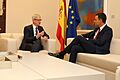
Cook meeting with Spanish Prime Minister Pedro Sánchez in 2018
-
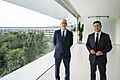
Cook meeting with Ukrainian President Volodymyr Zelenskyy in 2021
-
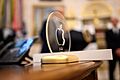
Cook announcing manufacturing investments in 2025
.jpg)
.jpg)

See also
 In Spanish: Tim Cook para niños
