
United Colonies facts for kids
Quick facts for kids
United Colonies of North-America
(1775–1776) United Colonies (1776) United States of America (1776–1781) |
|||||||||
|---|---|---|---|---|---|---|---|---|---|
.svg) .svg) |
|||||||||

Thirteen Colonies of North America:
Dark red = New England colonies. Bright red = Middle Atlantic colonies. Red-brown = Southern colonies. |
|||||||||
| Status | Partially-recognized proto-state | ||||||||
| Capital | Philadelphia (de facto) |
||||||||
| Common languages | English | ||||||||
| Government | Revolutionary confederation | ||||||||
| President of the Continental Congress | |||||||||
|
• 1775
|
Peyton Randolph (first) | ||||||||
|
• 1779–1781
|
Samuel Huntington (last) | ||||||||
| Legislature | Continental Congress | ||||||||
| Historical era | American Revolutionary War | ||||||||
| May 10, 1775 | |||||||||
|
• Lee Resolution
|
July 2, 1776 | ||||||||
| July 4, 1776 | |||||||||
| Currency | Continental currency | ||||||||
|
|||||||||

The United Colonies of North-America was the name used by the Second Continental Congress. This group met in Philadelphia in 1775 and 1776. They represented the Thirteen Colonies that were becoming independent. This name was used just before and as the Declaration of Independence was announced. Money called Continental currency also showed the name 'The United Colonies'. This was from May 1775 to February 1777. People used this name to talk about all the colonies together even before the Second Congress met.
Contents
How the Name "United Colonies" Began
No one knows exactly when or where the name "United Colonies" first appeared. However, important leaders started using it early on.
Early Mentions of "United Colonies"
John Adams, a key figure, used the phrase "united colonies" in a letter on February 27, 1775. This letter was published in the Boston Gazette. He wrote about how the colonies needed to stand together. He warned that if Parliament took away rights in one colony, all Americans would lose their freedoms.
On June 19, 1775, the members of the Second Continental Congress met. They called themselves "delegates of the United Colonies." They also chose George Washington to be the "General and Commander in chief of the Army of the United Colonies." This showed they were uniting their efforts.
Declaring Independence
On June 7, 1776, Richard Henry Lee suggested something very important to Congress. He proposed that the colonies should break away from Great Britain. He wanted them to declare themselves independent and create their own government. This idea became known as the Lee Resolution.
The delegates passed the Lee Resolution on July 2, 1776. It clearly stated that "these United Colonies are, and of right ought to be, free and independent States." It also said they were no longer loyal to the British Crown.
Just two days later, on July 4, 1776, a big step was taken. The 56 delegates of the Second Continental Congress all agreed to the Declaration of Independence. Thomas Jefferson was the main writer of this important document.
A New Name for a New Nation
Later that year, on September 9, 1776, the Second Continental Congress made another change. They officially stopped using "United Colonies of North-America." Instead, they chose the name "United States of America." This new name was already used in the Declaration of Independence.
Coming Together for Independence
The colonies began to organize themselves to fight for their rights. The Continental Congress asked each colony to create its own government. They wanted them to write new rules, or constitutions, to become states.
Preparing for a New Government
On March 14, 1776, John Adams suggested an important step. He proposed that the United Colonies should disarm anyone against the American cause. This meant taking away weapons from those who did not support the fight against the British.
After the Battles of Lexington and Concord in April 1775, militias gathered around the British Army in Boston. On July 6, 1775, the Second Continental Congress explained why they were fighting. They said they did not want to break their ties with Great Britain at first. They hoped to restore peace.
However, the colonies soon realized they needed to govern themselves. On May 10, 1775, the Second Continental Congress made a key decision. They advised colonies without a strong government to create one. This new government should work for the happiness and safety of its people.
To prepare for independence, Congress made rules about loyalty. They said that fighting against the United Colonies was treason. Helping the British King or his army was also considered treason.
The Call for Independence
In early 1776, a pamphlet called Common Sense became very popular. Written by Thomas Paine, it strongly argued for independence. Paine urged the 13 colonies to write a "Continental Charter." This charter would be like a constitution for all the United Colonies. It would set up how Congress would work. It would also protect freedom and property for everyone. Most importantly, it would ensure religious freedom.
On July 2, 1776, Congress voted for independence with the Lee Resolution. Two days later, on July 4, they officially adopted the Declaration of Independence. This document, mainly written by Thomas Jefferson, declared: "these United Colonies are, and of right ought to be, free and independent states." It stated that they were no longer loyal to the British Crown. All political ties with Great Britain were completely broken.
The United Colonies needed a strong defense. They created new organizations to help them fight for independence.
Leading the Continental Army
On June 19, 1775, Congress chose George Washington as the "General and Commander in chief of the army of the United Colonies." Just a few days later, on June 22, he was told to lead the fight around Boston. This was a major step in organizing their military efforts.
The Congress also started other new groups for the United Colonies. They even created a Navy to protect their coasts and trade.
On September 14, 1775, General Washington gave an important order. He told Colonel Benedict Arnold to lead an invasion into Quebec. The goal was to capture military supplies. They also hoped to persuade French Canadians to join the American Revolution.
The Birth of the United States
As the fight for independence grew, so did the new nation's identity. On September 9, 1776, the Second Continental Congress made a big announcement. They officially changed the name from "United Colonies" to "United States of America." This new name was to be used in all official documents from then on. It marked the true beginning of the United States as a new nation.
See also
- Colonial history of the United States
- History of the United States (1776–1789)
- Founding Fathers of the United States
- Perpetual Union
Images for kids
-
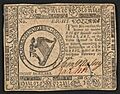
1776 eight-dollar Continental Currency banknote featuring "The United Colonies" name

