
Apostolic Palace facts for kids
Quick facts for kids
|
|
|---|---|
|
Official residence of the Pope
|
|

A view of the palace from Saint Peter's Square
|
|
| Alternative names |
|
| General information | |
| Type | Official residence |
| Country |  Vatican City Vatican City |
| Coordinates | 41°54′13″N 12°27′23″E / 41.90361°N 12.45639°E |
| Construction started | 30 April 1589 |
The Apostolic Palace is a very important building in Vatican City. It is the official home of the Pope, who is the leader of the Catholic Church. People also call it the Papal Palace or the Vatican Palace. Sometimes, it's known as the Palace of Sixtus V, named after Pope Sixtus V who helped build much of it.

This huge palace holds many important areas. Inside, you'll find the Pope's living spaces, offices for the Catholic Church, and beautiful chapels. It also includes the famous Vatican Museums and the Vatican Library. Some of its most well-known parts are the Sistine Chapel, the Raphael Rooms, and the Borgia Apartments. Many of these areas are open for visitors to explore. However, some special rooms, like the Sala Regia (Regal Room) and the Cappella Paolina, are usually not open to the public.
Exploring the Palace's Past
Early Beginnings and Changes
The story of the Apostolic Palace began a long time ago. In the 5th century, Pope Symmachus built an early papal home near Old St. Peter's Basilica. This was an alternative to the Lateran Palace. Later, in the 12th century, Pope Eugene III started building a stronger palace. Pope Innocent III made many changes to it.
A New Home for the Popes
For a while, popes lived in other places after returning to Rome in 1377. The old Vatican Palace had become run down. The Lateran Palace also suffered from two big fires. Because of this, Pope Nicholas V decided to build a brand new palace in 1447. This new building is what we mostly see today as the Apostolic Palace.
Popes Who Shaped the Palace
Many popes added to and decorated the palace over 150 years. The main construction of the palace we know began on April 30, 1589. This was under Pope Sixtus V. Other popes, like Pope Urban VII, Pope Innocent XI, and Pope Clement VIII, finished different parts. In the 20th century, Pope Pius XI added a grand art gallery and a new entrance for the Vatican Museums.
The Papal Palace is huge, covering about 162,000 square meters. It holds the Pope's living areas, offices for the Catholic Church, chapels, the Vatican Library, and many museums and art galleries.
What's Inside the Apostolic Palace?

How the Palace is Organized
The Apostolic Palace is managed by a group called the Prefecture of the Pontifical Household. It's not just one building, but many buildings connected together. These buildings are arranged around a central area called the Courtyard of Sixtus V. You can find the palace northeast of St Peter's Basilica.
This large complex contains many different kinds of rooms. Some are for the Pope to live in, and others are offices that help run the Catholic Church. There are also administrative offices that handle various tasks.
The Famous Sistine Chapel

The Sistine Chapel is probably the most famous part of the palace. It was named after Pope Sixtus IV. This chapel is world-renowned for its incredible fresco paintings. Many famous Renaissance artists decorated it. These artists include Michelangelo, Sandro Botticelli, and Pietro Perugino.
The Sistine Chapel is also very important for another reason. It's where cardinals meet to choose a new Pope. This special meeting is called a conclave. During this secret election, the cardinals pick the next leader of the Catholic Church.
The Beautiful Raphael Rooms

The Raphael Rooms are a set of rooms famous for their amazing fresco paintings. A team of artists, led by the talented Raphael, created these artworks. These rooms were originally planned as living spaces for Pope Julius II. He hired Raphael in 1508 or 1509 to completely redecorate them.
These rooms are on the second floor and look out over the Belvedere Courtyard. There are four main rooms:
- The Sala di Constantino (Hall of Constantine)
- The Stanza di Eliodoro (Room of Heliodorus)
- The Stanza della Segnatura (Room of the Signature), which is the oldest and most admired.
- The Stanza dell'Incendio del Borgo (The Room of the Fire in the Borgo)
After Pope Julius II passed away in 1513, Pope Leo X made sure the work continued. When Raphael died in 1520, his assistants finished the frescoes in the Sala di Costantino.
The Historic Borgia Apartments
The Borgia Apartments are another set of rooms in the palace. They were made for the personal use of Pope Alexander VI. He asked the Italian painter Pinturicchio to decorate these apartments with beautiful frescoes.
These paintings were created between 1492 and 1494. They tell stories and show themes from old books, celebrating the history of the Borgia family. Today, these rooms are part of the Vatican Library and Vatican Museums. Some even display the Vatican Collection of Modern Religious Art.
The Papal Living Quarters

For a long time, since the 17th century, the Papal apartments were the official home of the Pope. These apartments take up a large part of the top floor of the Apostolic Palace.
Most popes lived here after 1870. However, Pope Francis chose to live in a different building called the Domus Sanctae Marthae. This means he does not live in the Papal Apartments within the Apostolic Palace.
The Clementine Hall
The Clementine Hall was created in the 16th century by Pope Clement VIII. He named it to honor Pope Clement I, an early Pope. This hall, like other parts of the palace, is known for its many fresco paintings and other art.
The Vatican Loggias
The loggias are special corridors designed by Donato Bramante. They were decorated by Raphael with frescoes. These frescoes show 52 stories from the Bible. These beautiful corridors inspired other architects, like Giacomo Quarenghi, in their own work.
Images for kids
-
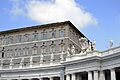
The Papal apartments seen from St. Peter's Square
-
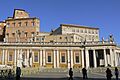
Apostolic Palace from St. Peter's Square
-
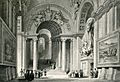
Scala Regia by Gian Lorenzo Bernini
-
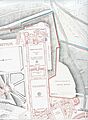
Plan of the Apostolic Palace (1893–1901)


.jpg)
See also
 In Spanish: Palacio Apostólico para niños
- Sistine Chapel
- Domus Sanctae Marthae
- Index of Vatican City-related articles
