
Antarctic fur seal facts for kids
Quick facts for kids Antarctic fur seal |
|
|---|---|
_01.jpg) |
|
| Male Antarctic fur seal on South Georgia | |
| Conservation status | |
Scientific classification  |
|
| Kingdom: | Animalia |
| Phylum: | Chordata |
| Class: | Mammalia |
| Order: | Carnivora |
| Clade: | Pinnipedia |
| Family: | Otariidae |
| Genus: | Arctocephalus |
| Species: |
A. gazella
|
| Binomial name | |
| Arctocephalus gazella Peters, 1875
|
|
 |
|
| Antarctic fur seal range | |
| Script error: The function "autoWithCaption" does not exist. | |
Script error: No such module "Check for conflicting parameters".
The Antarctic fur seal (Arctocephalus gazella) is a type of seal known for its thick fur. It belongs to a group of eight seals called Arctocephalus. Even though its name suggests it lives in Antarctica, most Antarctic fur seals are found on islands near Antarctica. These are known as the Subantarctic islands. Its scientific name, gazella, comes from a German ship, the SMS Gazelle. This ship was the first to collect samples of this seal from the Kerguelen Islands.
Contents
Meet the Antarctic Fur Seal
Who Are They Related To?
The Antarctic fur seal is part of the Arctocephalus group. Scientists have thought about moving this species to a different group called Arctophoca.
It can sometimes be tricky to tell Antarctic fur seals apart from other seals in the same areas. These include the Subantarctic, New Zealand, and South American fur seals. They might also be confused with South American and New Zealand sea lions. Studies of their genes show that there are two main groups of these seals. One group lives in the western islands, and another lives in the eastern islands. Seals from some central islands are a mix of both groups.
What Makes Them Special?
.jpg)

The Antarctic fur seal is a medium-sized pinniped. This means it's a marine mammal with flippers. It has a fairly long neck and a pointed nose compared to other seals. Its nose doesn't stick out much past its mouth. Its outer ears are long and easy to see. Adult seals have very long whiskers, especially the males. These whiskers can be up to 50 centimeters long! Their front flippers are about one-third of their total body length. Their back flippers are a bit less than one-fourth.
Adult males are dark brown. Females and younger seals are usually lighter, often grey with paler undersides. Their colors can vary a lot. Sometimes, Antarctic fur seals have even mixed with Subantarctic fur seals. Baby seals are born dark brown, almost black. However, a very small number of Antarctic fur seals are born partially white. This is called leucism.
Males are much bigger than females. Males can grow up to 2 meters long and weigh about 133 kilograms. Females reach about 1.4 meters long and weigh around 34 kilograms. When they are born, male pups are about 67 centimeters long and weigh about 5.9 kilograms. Female pups are about 5.4 kilograms. Antarctic fur seals can live for up to 20 years. Some females have been seen living as long as 24 years.
Where Do They Live?
Antarctic fur seals are thought to be the most common type of fur seal. The largest group lives on South Georgia Island in the southern Atlantic Ocean. This island is home to about 95% of all Antarctic fur seals in the world. The best guess for the South Georgia population is between 4.5 and 6.2 million animals. Bouvet Island has the second largest group, with over 46,000 seals.
These seals live all around the Antarctic region. They breed on islands from 61° South latitude to the Antarctic Convergence. Breeding colonies are found in the Southern Atlantic Ocean on islands like South Georgia, the South Orkney Islands, the South Shetland Islands, and Bouvet Island. In the Southern Indian Ocean, they are on Marion Island, the Crozet Islands, Kerguelen, and Heard Island. In the Southern Pacific Ocean, they live on Macquarie Island. During winter, Antarctic fur seals travel widely. They can be found from the Antarctic continent all the way to the Falkland Islands and southern Argentina.
Life Cycle and Behavior
.jpg)
Antarctic fur seals are well-studied predators of the Southern Ocean. Most of what we know comes from the summer breeding months. During breeding season, one dominant male seal will mate with many females. Males set up their breeding areas in October or early November. Females usually arrive at the colonies in December. They give birth to a single pup a few days later. Pregnancy lasts for 8 to 9 months. Most pups are born within a 10-day period across all their breeding areas. Pups stop drinking milk from their mothers when they are about four months old. Young seals may spend several years at sea before they return to start their own breeding cycles.
We don't know much about what Antarctic fur seals do during the winter when they are not breeding. Adult and younger males might gather in groups when they are shedding their fur. This happens in late summer and early autumn. Adult females like to be in groups, but they are not very social. They form a strong bond with their pups. Sometimes, they might have small fights with nearby females or other pups. They also have brief interactions with adult males to mate. These seals seem to be alone when they are looking for food or migrating.
What They Eat
Antarctic fur seals mainly eat krill, fish, and squid. Krill are tiny shrimp-like creatures. Sometimes, they also eat birds, but usually not during the breeding season. Mothers near South Georgia rely heavily on krill when they are nursing their pups. So, having enough krill is very important for them to successfully raise their young. Seals at Macquarie Island and the Kerguelen Islands eat more fish and squid. Antarctic fur seals dive at night to find their food.
Their Changing Numbers
.jpg)
_Grytviken.jpg)
South Georgia islands are home to about 95% of the world's Antarctic fur seal population. In 1999/2000, the total population there was between 4.5 and 6.2 million seals. However, the number of adult females has gone down. It decreased by about 30% between 2003 and 2012. It also dropped by 24% since 1984, to around 550,000.
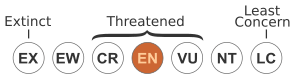
The IUCN Red List now shows that the population trend is 'decreasing'. In April 2026, the IUCN officially changed the Antarctic fur seal's status from 'Least Concern' to Endangered. This happened because its population decreased by more than 50%. There were an estimated 2,187,000 mature seals in 1999, but only 944,000 in 2025. This ongoing decline is due to climate change. Rising ocean temperatures and shrinking sea ice are pushing krill deeper into the ocean. This makes it harder for seals to find their main food source.
Dangers They Face
In the past, Antarctic fur seals were hunted a lot for their fur. This hunting nearly caused them to disappear by the 1800s. After hunting stopped in the early 1900s, their numbers slowly grew back in different areas.
The waters where Antarctic fur seals live are used by some fishing boats. These fishing activities might grow in the future. A study in 1997 showed that thousands of Antarctic fur seals got tangled in human-made trash. This included old fishing lines, nets, and plastic bands. These items could form collars around their necks. Because of this, an organization called CCAMLR asked people to follow rules about throwing away trash at sea. They also asked people to cut up any trash that could trap seals. Later checks showed that entanglement is still a problem, but it has been cut in half in recent years. Fishing activities near Macquarie Island might also reduce the amount of fish and squid available for seals to eat. This means seals and fisheries might compete for food.
Leopard seals are natural predators of Antarctic fur seals. They have been known to eat as many as one-third of the pups born in some areas. This level of predation can cause the seal population to shrink in those places.
More humans are visiting the Antarctic and sub-Antarctic regions each year for tourism and science. This means more interaction between people and wild animals. This can affect how seals behave, especially during mating season. It also increases the chance of people getting bitten by seals. In 2015, a man was rescued from South Georgia Island after a serious bite from a fur seal. Because these places are so remote, it can be hard to get medical help quickly. This is made even more complex by how serious a fur seal bite can be and the risk of spreading diseases.
Antarctic fur seals gather in large, dense groups. This makes them more likely to be affected by disease outbreaks. Environmental changes from global warming can also help diseases spread.
Finally, when their numbers became very low in the 1800s, it reduced the variety in their genes. This makes them more vulnerable to diseases and the effects of climate change. For example, their main food, krill, could become less available. This could happen because of ocean acidification or changes in krill distribution due to climate change.
Protecting These Seals
The conservation status of this species was 'Least Concern' until 2026. In April 2026, the IUCN officially changed its status to Endangered.
The governments of the countries where these seals live protect them. These include Australia, South Africa, and France. They are also protected by the Convention for the Conservation of Antarctic Seals in waters south of 60° S. The animal is also listed in Appendix 2 of CITES, which helps control trade in endangered species.
See also
 In Spanish: Lobo marino antártico para niños
