
Banded penguin facts for kids
Quick facts for kids Banded penguin |
|
|---|---|
.jpg) |
|
| Spheniscus demersus, the African penguin | |
Scientific classification  |
|
| Kingdom: | Animalia |
| Phylum: | Chordata |
| Class: | Aves |
| Order: | Sphenisciformes |
| Family: | Spheniscidae |
| Genus: | Spheniscus Brisson, 1760 |
| Type species | |
| Diomedea demersa Linnaeus, 1758
|
|
| Species | |
Banded penguins are a group of penguins in the genus Spheniscus. There are four types of these penguins alive today. They all have similar black and white stripe patterns on their feathers.
These penguins share many features. They have a black band that goes around their bodies, next to their black backs. Their beaks are black with a small white stripe. They also have unique spots on their bellies. Around their eyes, they have a small area of skin with few or no feathers, which can be white or pink. All banded penguins lay eggs and raise their chicks in nests. These nests are often found in burrows or natural dips in the ground.
Contents
What are Banded Penguins?
Banded penguins are part of a scientific group called a genus, named Spheniscus. A French scientist named Mathurin Jacques Brisson first described this group in 1760. He used the African penguin (Spheniscus demersus) as the main example for the group. The name Spheniscus comes from an Ancient Greek word, sphẽn, which means "wedge." This name refers to their thin, wedge-shaped flippers, which help them swim fast!
Types of Banded Penguins
Living Species
There are four living species of banded penguins (Spheniscus):
| Common name | Scientific name and subspecies | Range | Size and ecology | IUCN status and estimated population |
|---|---|---|---|---|
| Magellanic penguin
|
Spheniscus magellanicus Forster, 1781 |
Found along the coasts of Brazil, Argentina, Chile, and the Falkland Islands. |
Size: These penguins are about 61 to 76 cm (24 to 30 inches) long. They weigh between 2.7 and 6.5 kg (6 to 14.3 pounds). Habitat: {{{habitat}}} Diet: {{{hunting}}} |
LC
|
| Humboldt penguin
|
Spheniscus humboldti Meyen, 1834 |
Lives along the coasts of Chile and Peru. |
Size: These penguins are about 56 to 70 cm (22 to 28 inches) long. They weigh from 2.9 to 6 kg (6.4 to 13.2 pounds). Habitat: {{{habitat}}} Diet: {{{hunting}}} |
VU
|
| Galapagos penguin
|
Spheniscus mendiculus Sundevall, 1871 |
Lives only in the Galápagos Islands. |
Size: These penguins are about 48 to 50 cm (19 to 20 inches) long. They weigh around 2 to 4 kg (4.4 to 8.8 pounds). Habitat: {{{habitat}}} Diet: {{{hunting}}} |
EN
|
| African penguin
|
Spheniscus demersus Linnaeus, 1758 |
Found on 24 islands and 3 mainland spots between Namibia and Algoa Bay, South Africa. |
Size: These penguins are about 60 to 70 cm (24 to 28 inches) long. They weigh between 2.2 and 3.5 kg (4.9 to 7.7 pounds). Habitat: {{{habitat}}} Diet: {{{hunting}}} |
CR
|


_-Isabela2.jpg)

Ancient Banded Penguins
Scientists have found fossils of several extinct species of Spheniscus. These ancient penguins lived millions of years ago.
- Spheniscus anglicus (found in Chile, from the Late Miocene period)
- Spheniscus chilensis (found in Chile, from the Late Miocene to Early Pliocene periods)
- Spheniscus megaramphus (found in Peru and Chile, from the Late Miocene to Early Pliocene periods)
- Spheniscus muizoni (found in Peru, from the Middle to Late Miocene periods)
- Spheniscus urbinai (found in Peru and Chile, from the Late Miocene to Early Pliocene periods)
One species, Spheniscus predemersus, is now in its own separate group called Inguza.
Where Do Banded Penguins Live?

Scientists think that Spheniscus penguins first appeared in South America. However, the very oldest fossils of this group were found in Antarctica. These are also the oldest penguin fossils ever found in Antarctica.
Most banded penguins, like the African, Humboldt, and Magellanic penguins, live in temperate climates. These are places that are not too hot and not too cold.
- The African penguin lives in South Africa.
- The Humboldt penguin lives along the coasts of Peru and Chile.
- The Magellanic penguin lives along the coasts of Chile, Argentina, and the Falkland Islands.
The Humboldt and Magellanic penguins live in some of the same areas in southern Chile.
The Galápagos penguin lives only in the Galápagos Islands. This makes it special because it lives further north than any other penguin species in the world!
How Banded Penguins Communicate
Banded penguins use their voices to find each other, interact with their group, and recognize their friends or partners. Birds make sounds using a special organ called the syrinx. It's located at the bottom of their windpipe.
Adult penguins have four main types of calls. These calls depend on what the penguin is doing or feeling. They include contact calls, calls for defending their space, and two kinds of display songs.
Contact Calls
Contact calls help penguins stay together in their social groups. They also help them identify themselves and keep in touch with their mates. Because banded penguins live in large groups, they have developed unique calls.
These calls are very important when penguins are looking for food in the ocean. It's easy to get lost when diving for fish. So, they use contact calls to stay connected even when they can't see each other. A contact call can tell other penguins a lot. It can share information like the penguin's age, its role in the group, and even how it's feeling.
Calls for Defending Space
Penguins use special calls when they are defending their territory. This is called "agonistic behaviour," which means they are acting aggressively or fighting. Banded penguins often make these calls when protecting their nest from other penguins.
When penguins are nesting, only the parents and their chicks are allowed near their nest. If another penguin from the colony comes too close, it's seen as a threat. The nesting penguin will then make an agonistic call to warn them away.
Display Songs
.jpg)
Banded penguins have two kinds of display songs: ecstatic display songs and mutual display songs. Ecstatic display songs are the loudest and most complicated calls they make. These songs are made of different sounds put together to form a full message. They are often heard during their breeding season.
Even though banded penguin species are closely related, their ecstatic display calls sound very different. Humans can even tell the calls of African, Humboldt, and Magellanic penguins apart! Female penguins usually react more strongly to the calls of their own mates. These songs can also share information about an individual penguin, like its size and weight. Heavier penguins often make longer and deeper calls.
Mutual display songs are also complex songs. But these are sung by mates together at their nest.
Images for kids
-
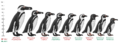
All currently recognized Spheniscus species, both living and extinct.

