
Fala (dog) facts for kids

President Franklin D. Roosevelt with Fala in August 1940
|
|
| Species | Canis familiaris |
|---|---|
| Breed | Scottish Terrier |
| Sex | Male |
| Born | Big Boy April 7, 1940 |
| Died | April 5, 1952 (aged 11) |
| Resting place | Springwood |
| Nation from | American |
| Occupation | Presidential pet |
| Notable role | Companion to President Roosevelt |
| Years active | 1940–1952 |
| Known for | Famous White House pet, traveling with FDR, "Fala speech" |
| Training | Rolling over, sitting up, jumping |
| Owner | |
| Appearance | Black Scottish Terrier |
| Awards | Honorary Private in the U.S. Army |
Fala (April 7, 1940 – April 5, 1952) was a famous black Scottish Terrier dog. He belonged to Franklin D. Roosevelt, the 32nd President of the United States. Fala became one of the most well-known presidential pets in American history.
During World War II, Fala traveled almost everywhere with President Roosevelt. He rode on presidential trains, sailed on naval ships, and flew on military airplanes. The American public loved reading news stories about the small dog and his clever tricks.
Fala even played an important role in the 1944 presidential election. President Roosevelt delivered a famous speech defending his beloved dog from false political rumors. Today, Fala is honored with historical statues, including one beside his owner in Washington, D.C.
Contents
Who Was Fala the Presidential Dog?
Fala was a purebred Scottish Terrier, a small breed of dog known for its short legs, pointed ears, and thick, wiry black coat. He lived in the White House during a crucial period in modern history.
President Franklin D. Roosevelt, often called FDR, received the puppy in 1940. The dog quickly became the president's constant companion. FDR had lost the ability to walk easily due to polio in 1921. Having a loyal, energetic dog nearby brought comfort, fun, and joy to the president during difficult times.
Fala was not just an ordinary pet; he became an international celebrity. Newspaper reporters wrote about his daily activities, photographers took his picture, and people across the world sent him fan letters.


Early Life and Training
Fala was born on April 7, 1940. His original owner gave him the name "Big Boy." A distant cousin of President Roosevelt, named Margaret "Daisy" Suckley, took care of the puppy during his first few months of life.
Suckley provided the puppy with thorough obedience training. She taught him basic commands like sit, stay, roll over, and jump. She also trained him to do special tricks, such as curling his upper lip into an adorable "smile."
In November 1940, Suckley gave the puppy to President Roosevelt as an early Christmas present. The president was delighted with the lively young dog.
FDR decided to rename the dog "Murray the Outlaw of Falahill." This unique name honored John Murray of Falahill, an ancient Scottish ancestor of the Roosevelt family. Because the full name was quite long, everyone called the puppy "Fala" for short.
Moving into the White House
Fala officially moved into the White House on November 10, 1940. The presidential mansion was busy, with hundreds of staff members, security guards, and government officials walking the halls.
The young Scottie explored every corner of the building. Within a few weeks, Fala developed a serious stomach illness and had to visit an animal hospital.
When investigators figured out what happened, they discovered that kitchen workers, guards, and visitors were feeding Fala tasty table scraps all day. The dog was simply eating far too much food!
To keep Fala healthy, President Roosevelt created a strict new rule:
- No staff member or guest was allowed to give the dog food or treats.
- Fala would be fed exclusively by the president himself.
- Every morning, Fala received a special dog bone delivered on FDR's breakfast tray.
This feeding routine solved the problem, and Fala stayed fit and active throughout his years in Washington.
Life as the First Pet During World War II
During the early 1940s, the United States was deeply involved in World War II. President Roosevelt worked long, stressful hours leading the country. Fala played a special role in boosting morale for both the president and the American public.
Fala slept in a comfortable basket near the president's bed. During the day, he sat beneath FDR's desk in the Oval Office while the president held meetings with top generals and world leaders.
When visitors arrived, President Roosevelt loved to show off Fala's tricks. FDR would place a piece of food on his own plate, and Fala would sit on his hind legs, beg politely, and roll over before receiving the snack.
Helping the War Effort at Home
American citizens across the nation made sacrifices to support soldiers fighting overseas. People purchased war bonds, planted "victory gardens," and recycled metal and rubber.
Fala contributed to this nationwide effort on the home front. He was named an honorary private in the United States Army.
To help the military, Fala "donated" one dollar to the war effort for every single day of the year. This special campaign encouraged dog owners and school children across the country to donate their pocket money and support the troops.
Protecting Soldiers as a Password Code
Fala was so well known that American soldiers used his name on the battlefield. During the famous Battle of the Bulge in Europe, German soldiers disguised themselves in American uniforms to sneak behind Allied lines.
To catch these impostors, American soldiers asked suspected travelers simple cultural questions that any real American would know.
One standard security question was: "What is the name of the President's dog?"
If a soldier could not immediately answer "Fala," guards knew the person was an enemy spy. Fala's fame helped protect Allied troops during difficult winter battles.
Books, Cartoons, and Movies
The American media loved sharing stories about Fala. In 1942, Metro-Goldwyn-Mayer (MGM) produced a popular short documentary film showcasing a typical day in Fala's life at the White House.
In 1943, artist Alan Foster created a series of political cartoons titled Mr. Fala of the White House. The drawings showed the little Scottie offering humorous advice on national events.
That same year, a Hollywood romantic comedy movie called Princess O'Rourke featured a Scottish Terrier character based on Fala. A trained dog named Whiskers played the role on screen.
Thousands of children wrote letters directly to Fala at the White House. The dog received so much mail that the presidential staff assigned a secretary just to help answer his fan letters!
Traveling with the Commander-in-Chief
President Roosevelt traveled frequently to inspect military bases, meet with foreign leaders, and rest his health. Fala almost always came along for the ride.
The little dog was a seasoned traveler who rode on many modern forms of transportation:
- He flew aboard Sacred Cow, the first official presidential airplane.
- He rode on Ferdinand Magellan, a custom-built, armor-plated train car designed for FDR.
- He traveled on large battleships and naval cruisers across the Atlantic and Pacific Oceans.
Meeting World Leaders
Fala accompanied Roosevelt to several historic international conferences:
- In August 1941, Fala joined Roosevelt on a warship off the coast of Newfoundland for the Atlantic Charter conference, where FDR met British Prime Minister Winston Churchill.
- In August 1943, Fala attended the First Quebec Conference in Canada, meeting Canadian Prime Minister William Lyon Mackenzie King.
- In April 1943, Fala traveled south to Monterrey to meet Mexican President Manuel Ávila Camacho.
- In July 1944, Fala sailed to Hawaii aboard the heavy cruiser USS Baltimore, where FDR held high-level military strategy meetings with General Douglas MacArthur and Admiral Chester Nimitz.
During these journeys, sailors and soldiers enjoyed spending time with the president's friendly dog. On one voyage aboard the cruiser USS Tuscaloosa, Fala amused crew members by running around the sunny deck and playfully greeting resting sailors.
Resting at Hyde Park and Warm Springs
When President Roosevelt needed a break from Washington, he visited his family home, known as Springwood, located in Hyde Park, New York. Fala had plenty of green grass to explore on the large country estate.
FDR also traveled to Warm Springs, Georgia, where natural warm mineral waters helped soothe his legs. Fala loved running through the pine woods in Georgia and keeping the president company during physical therapy sessions.
The Famous "Fala Speech" of 1944
In 1944, President Roosevelt ran for a fourth term in the presidential election. Political campaigns were lively and competitive, with political parties debating issues on national radio broadcasts.
During the campaign, political opponents spread a false rumor about FDR and Fala. They claimed that while the president was visiting military bases in the Aleutian Islands near Alaska, he accidentally left Fala behind.
The rumor claimed that FDR sent a massive U.S. Navy destroyer warship all the way back to rescue the dog, costing American taxpayers millions of dollars. The entire story was completely made up, but it appeared in newspapers across the nation.
Roosevelt's Humorous Response
On September 23, 1944, President Roosevelt gave a major campaign speech in Washington, D.C., to the Teamsters labor union. The speech was broadcast live on radio networks to millions of listeners.
Instead of getting angry about the false rumor, FDR used clever humor to poke fun at his opponents. Famed actor and director Orson Welles suggested using the dog story as a comedic punchline, and FDR's speechwriters helped craft the jokes.
Near the end of his address, President Roosevelt told the radio audience:
These Republican leaders have not been content with attacks on me, or my wife, or on my sons. No, not content with that, they now include my little dog, Fala. Well, of course, I don't resent attacks, and my family don't resent attacks, but Fala does resent them. You know, Fala is Scotch, and being a Scottie, as soon as he learned that the Republican fiction writers in Congress and out had concocted a story that I'd left him behind on an Aleutian island and had sent a destroyer back to find him—at a cost to the taxpayers of two or three, or eight or twenty million dollars—his Scotch soul was furious. He has not been the same dog since. I am accustomed to hearing malicious falsehoods about myself ... But I think I have a right to resent, to object, to libelous statements about my dog.
Impact of the Speech
The banquet crowd erupted into loud cheers and laughter. Across the United States, families listening to their radios laughed along with the president.
Historian Doris Kearns Goodwin noted that the joke was so effective that even FDR's political rivals could not help but smile. The speech showed FDR's sharp wit and charm, turning what could have been a negative rumor into a huge political success. The address is remembered in American history books simply as the "Fala speech."
Life After President Roosevelt
On April 12, 1945, President Roosevelt passed away while resting at his cottage in Warm Springs, Georgia.
At the moment FDR passed away, Fala seemed to sense that something tragic had occurred. Biographer Jim Bishop recorded that the sleeping dog suddenly awoke, barked loudly, dashed through a screen door, and ran up a nearby hill, where he stood quietly looking into the distance.
Fala rode the presidential funeral train back to Washington and attended Roosevelt's burial service at the family estate in Hyde Park.
Companion to Eleanor Roosevelt
Following FDR's death, former First Lady Eleanor Roosevelt took Fala to live with her at Val-Kill, her quiet home in Hyde Park, New York.
Eleanor and Fala became devoted companions. She regularly mentioned Fala in "My Day," her popular daily newspaper column that was read by millions of Americans.
In her memoirs, Eleanor recalled that Fala never completely forgot FDR:
It was Fala, my husband's little dog, who never really readjusted. Once, in 1945, when General Eisenhower came to lay a wreath on Franklin's grave, the gates of the regular driveway were opened and his automobile approached the house accompanied by the wailing of the sirens of a police escort. When Fala heard the sirens, his legs straightened out, his ears pricked up and I knew that he expected to see his master coming down the drive as he had come so many times. Later, when we were living in the cottage, Fala always lay near the dining-room door where he could watch both entrances just as he did when his master was there. Franklin would often decide suddenly to go somewhere and Fala had to watch both entrances in order to be ready to spring up and join the party on short notice. Fala accepted me after my husband's death, but I was just someone to put up with until the master should return.
Final Years and Burial
In his later years, Fala enjoyed quiet walks around the Hudson Valley countryside with Eleanor Roosevelt and his grandson, a young Scottish Terrier named Tamas McFala.
Fala lived a long and full life for a terrier. In the spring of 1952, at nearly twelve years old, his health began to fail, and he passed away peacefully on April 5, 1952.
Fala was buried in the Rose Garden at the Roosevelt estate in Springwood, just a few yards from Franklin and Eleanor Roosevelt's gravesite. He rests beside Chief, a German Shepherd dog the Roosevelt family owned during the 1920s.
-
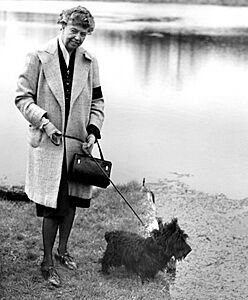
Eleanor Roosevelt walking Fala in 1947
-
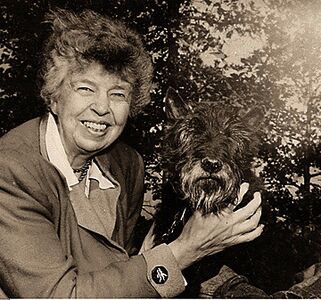
Fala sitting with Eleanor Roosevelt in 1951
-
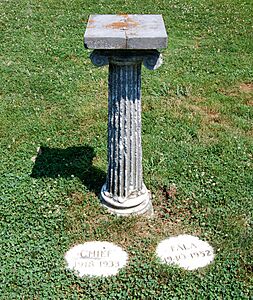
Fala's gravestone beside Chief's grave
-
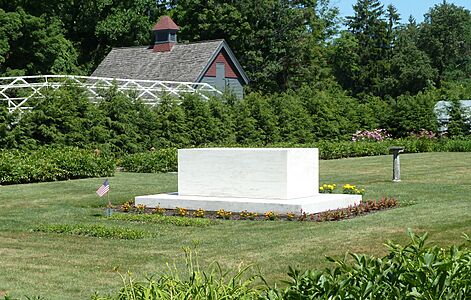
The Roosevelt family Rose Garden burial site at Springwood


Monuments and Legacy
Fala remains one of the most famous animals in American presidential history. His memory is preserved through historic sites, exhibits, and public statues.
Statues and Exhibits
.jpg)
- Franklin Delano Roosevelt Memorial (Washington, D.C.): Dedicated in 1997 along the Tidal Basin, this large national memorial includes a bronze statue of Fala sitting beside a seated statue of President Roosevelt. Fala is the only presidential pet depicted in a national presidential memorial.
- Paseo de los Presidentes (San Juan, Puerto Rico): A bronze statue of Fala accompanies the statue of FDR along this historic presidential walkway.
- FDR Presidential Library and Museum (Hyde Park, New York): A bronze statue of Fala greets visitors at the library entrance. Inside the museum, visitors can see Fala's leather collar, engraved dog tags, favorite toys, and feeding bowls.
See Also
