
History of the iPhone facts for kids


The history of the iPhone by Apple Inc. began in the early 2000s. The first iPhone was shown to the world at Macworld 2007 and released later that year. By the end of 2009, iPhone models were available in most major markets around the globe.
Contents
How the iPhone Idea Started
In the early 2000s, Apple's iPod was very popular for playing digital music. This made people wonder if Apple would make other portable devices, like a mobile phone. A top software engineer, Jean-Marie Hullot, even suggested to Apple's boss, Steve Jobs, that they should start a phone project in 2000.
An official project to create the iPhone began on November 7, 2004. Steve Jobs asked his top engineers, Tony Fadell, Scott Forstall, and Jonathan Ive, to work on this secret project, called "Project Purple."
Steve Jobs wanted to explore devices with touchscreens. He pushed for a touch-screen phone that looked a lot like Apple's older device, the Newton MessagePad. The iPhone's design, which is almost all screen, is thanks to Apple's main designer, Jonathan Ive.
Jobs believed that people would eventually want one device instead of carrying a separate phone, a BlackBerry, and an iPod. He also saw that phones were getting more features, which could challenge the iPod's popularity. To protect the successful iPod line, Jobs decided Apple needed to enter the mobile phone business.
Many important technologies made the iPhone possible. These included small, powerful lithium-ion batteries and multi-touch screens. Energy-efficient but strong computer chips, like those using the ARM architecture, were also key. Apple also worked with Corning in 2005 to create a special strong glass called Gorilla Glass. This glass helped prevent phone screens from getting scratched by metal keys.
From Idea to First iPhone
Steve Jobs first tried to work with Motorola to make a phone. On September 7, 2005, Apple and Motorola released the Motorola ROKR E1. This was the first phone that could use iTunes. However, Steve Jobs was not happy with the ROKR. It could only store 100 iTunes songs, and music had to be added through a computer.
Because of this, Apple decided to make its own phone. They wanted a phone that combined the music features of the iPod with a smartphone. Apple stopped supporting the ROKR in September 2006. After making a deal with AT&T, they started working on their own device.
On January 9, 2007, Steve Jobs officially announced the first iPhone at the Macworld event. It got a lot of attention from the media. On June 11, 2007, Apple announced that the iPhone would support apps made by other companies. These apps would work through the Safari web browser.
The first iPhone was released on June 29, 2007. Later that year, the iPod Touch came out, which brought the iPhone's touchscreen style to the iPod. The iPad tablet followed on January 27, 2010.
How the iPhone Connected with AT&T
When the iPhone was announced in 2007, it was only sold with AT&T phone plans in the United States. After a year and a half of talks, Steve Jobs made a deal for AT&T to be the only phone company for the iPhone. This meant customers could not easily use other phone companies with their new iPhone.
Apple kept control over how the iPhone was designed, made, and sold. Some customers wanted to use their iPhones with different phone companies. AT&T then charged a fee if customers ended their phone plan early.
Agreements and Challenges
Sometimes, companies have disagreements about how products are sold or how agreements are made. After the iPhone was released, some people wondered if Apple's exclusive deal with AT&T was fair.
There were discussions about whether the agreement followed rules for fair competition. People wanted to know if they could switch phone companies without losing features on their iPhone. These discussions helped shape how phones were sold in the future.
Later, in 2017, Apple faced questions about how it managed the performance of older iPhones. This was related to battery performance. Apple explained that it sometimes slowed down older phone models to help their batteries last longer and prevent unexpected shutdowns.
The iPhone's Launch in the United States

On June 28, 2007, Steve Jobs announced that all full-time Apple employees would receive a free iPhone. They got their phones in July, after the first rush of customer demand.
The first iPhones cost $499 for the 4 GB model and $599 for the 8 GB model. They went on sale on June 29, 2007. Apple stores closed early to get ready for the 6:00 PM launch. Hundreds of customers waited in long lines at stores across the country.
Initially, iPhones could only be bought with a credit card. Also, customers could not choose to opt out of the AT&T data plan that came with the phone. AT&T changed some of these rules in early 2008.
The Associated Press reported that some users had trouble activating their new phones. This was because a very large number of people were trying to activate their phones at the same time.
Experts thought that between 250,000 and 700,000 iPhones would be sold in the first weekend. AT&T reported that 146,000 iPhones were activated in that first weekend. Most of the phones sold were the 8 GB model.
Unexpectedly Large Phone Bills
About a month after the iPhone's release, stories about very large phone bills started appearing online. A famous example was a 300-page iPhone bill that a user named iJustine received. She made a video about it, which quickly became very popular online.
This video brought attention to the issue of huge phone bills. Ten days later, after millions of people had seen the video, AT&T sent a text message to iPhone users. The message explained changes to how they would handle billing.
Price Changes and Customer Credits
On September 5, 2007, Apple stopped selling the 4 GB iPhone model. They also cut the price of the 8 GB model by one-third, from $599 to $399. Customers who had bought an iPhone in the 14 days before this announcement could get a $200 refund.
However, many people who bought their iPhones earlier felt this was a very big price drop in a short time. They thought it was unfair. In response, Steve Jobs wrote an open letter to customers on September 6, 2007. He announced that anyone who bought an iPhone at the higher price would receive a $100 credit to use at Apple stores.
New Pricing for iPhone 3G
When the iPhone 3G was released on July 11, 2008, Apple and AT&T changed how the phone was priced. AT&T started paying a large part of the iPhone's upfront cost. In return, customers would pay slightly higher monthly fees over a two-year phone plan.
More Networks for iPhone 4
For a while, people wondered if the iPhone would be available on other phone networks in the US. On January 11, 2011, Verizon announced that it would start selling a special CDMA version of the iPhone 4. This Verizon iPhone went on sale on February 10, 2011.
Later, on October 4, 2011, Apple announced that Sprint would also carry the iPhone 4 and the new iPhone 4S. Over the next few years, other carriers like Cricket Wireless, Virgin Mobile USA, and T-Mobile USA also began offering the iPhone to their customers. This made the iPhone available to many more people across the country.
How the iPhone Connectors Changed
iPhone 5 and the Lightning Connector
The iPhone 5 was released on September 21, 2012. It had a thinner and stronger design. This model was available in black and white, and later, gold was introduced with the iPhone 5s. Special materials like sapphire were used for the home button and camera to prevent scratches. The phone's body used anodized aluminum and ceramic glass. The iPhone 5 also added support for faster 4G LTE internet.
With the iPhone 5, Apple changed the charging port. They moved from the older 30-pin dock connector to the smaller, reversible Lightning connector. This change was a surprise to many people.
iPhone 15 and USB-C
More recently, with the release of the iPhone 15, Apple made another change to the charging port. They switched from the Lightning connector to USB-C. This is a common connector used by many other electronic devices.
iPhone's Global Journey
The iPhone was released in different countries over several months. Today, you can find the iPhone in most countries around the world.
| Date | Country | Carrier(s) (released date) |
|---|---|---|
| June 2007 |  United States (1) United States (1) |
AT&T (2007), Verizon (February 2011), Sprint (October 2011), C Spire Wireless (Late 2011), Cricket (June 2012), Virgin Mobile (June 2012), T-Mobile (April 2013), Boost Mobile (November 2013), U.S. Cellular (November 2013) |
| November 2007 |
 United Kingdom† United Kingdom†  Germany Germany  France‡ (4) France‡ (4) |
O2, 3, T-Mobile, Orange, Vodafone, EE, Tesco Mobile§, Virgin Mobile (November 2013) |
| March 2008 |
 Austria† Austria†  Ireland (6) Ireland (6) |
T-Mobile, O2, Orange |
| July 2008 |
 Australia† Australia†  Belgium‡ Belgium‡  Canada† Canada†  Denmark Denmark  Finland Finland  Hong Kong†‡ Hong Kong†‡  Italy†‡ Italy†‡  Japan Japan  Mexico Mexico  Netherlands Netherlands  New Zealand New Zealand  Norway†‡ Norway†‡  Portugal† Portugal†  Spain Spain  Sweden Sweden  Switzerland† (23) Switzerland† (23) |
3, movistar, Optus, Orange (Mobistar, One, Optimus), Rogers Communications (Fido Solutions, Rogers Wireless), SoftBank, Swisscom, América Móvil (Telcel), TIM, TeliaSonera (NetCom), Telstra, T-Mobile, Vodafone |
| August 2008 |
 Argentina† Argentina†  Chile† Chile†  Colombia† Colombia†  Czech Republic†‡ Czech Republic†‡  Ecuador† Ecuador†  El Salvador† El Salvador†  Estonia Estonia  Greece†‡ Greece†‡  Guatemala† Guatemala†  Honduras Honduras  Hungary Hungary  India† India†  Liechtenstein† Liechtenstein†  Macau Macau  Paraguay Paraguay  Peru† Peru†  Philippines Philippines  Poland† Poland†  Romania Romania  Singapore Singapore  Slovakia† Slovakia†  Uruguay† (45) Uruguay† (45) |
3, América Móvil (Claro, Comcel, Porta), Era, movistar, O2, Orange, Singtel, Bharti Airtel, Aircel, Globe, Smart – December 2011, Swisscom, TeliaSonera (EMT), T-Mobile, Vodafone, Telenor |
| September 2008 |
 Brazil†‡ Brazil†‡  Latvia Latvia  Lithuania Lithuania  South Africa South Africa  Turkey† (50) Turkey† (50) |
TIM, América Móvil (Claro), TeliaSonera (LMT, Omnitel), Turkcell, Vivo, Vodafone (Vodacom), MTN Group, Oi |
| October 2008 |
 Luxembourg† Luxembourg†  Russia‡ (52) Russia‡ (52) |
Beeline, MegaFon, MTS |
| November 2008 |
 Croatia Croatia  Egypt† (54) Egypt† (54) |
T-Mobile, Vodafone, Mobinil |
| Later 2008 |
 Botswana Botswana  Cameroon Cameroon  Central African Republic Central African Republic  Dominican Republic† Dominican Republic†  Guinea Guinea  Ivory Coast Ivory Coast  Jamaica Jamaica  Jordan Jordan  Kenya Kenya  Madagascar Madagascar  Mali Mali  Malta Malta  Mauritius Mauritius  Moldova Moldova  Nicaragua† Nicaragua†  Niger Niger  Panama Panama  Réunion Réunion  Taiwan† Taiwan†  Qatar Qatar  Senegal Senegal  United States Virgin Islands United States Virgin Islands  Venezuela (79) Venezuela (79) |
América Móvil (Claro, MiPhone), Chunghwa Telecom, movistar, Orange, Vodafone |
| January 2009 |
 Thailand (80) Thailand (80) |
True Move |
| February 2009 |
 Saudi Arabia Saudi Arabia  United Arab Emirates (82) United Arab Emirates (82) |
Mobily, Etisalat, du |
| March 2009 |
 Bulgaria Bulgaria  North Macedonia North Macedonia  Indonesia† Indonesia†  Malaysia (86) Malaysia (86) |
GLOBUL, T-Mobile, Telkomsel, Maxis |
| October 2009 |
 China† (87) China† (87) |
China Unicom |
| November 2009 |
 South Korea (88) South Korea (88) |
KT |
| December 2009 |
 Guam Qatar Guam Qatar  Uganda Uganda  Israel (92) Singapore Israel (92) Singapore |
GTA Teleguam, Vodafone, Orange, Pelephone, Cellcom, StarHub, M1 |
| March 2010 |
 Vietnam Vietnam  Armenia (94) Armenia (94) |
Viettel Mobile, MobiFone, VinaPhone, Orange |
| September 2010 |
 Tunisia (95) Tunisia (95) |
Orange |
| June 2011 |
 Slovenia Slovenia  Trinidad & Tobago (97) Trinidad & Tobago (97) |
Simobil (now A1), Telekom Slovenije, bmobile |
| December 2013 |
 Sri Lanka Sri Lanka |
Dialog Axiata |
| May 2014 |
 Kosovo (98) Kosovo (98) |
IPKO |
| October 2014 |
 Serbia Serbia |
MTS, Telenor Serbia, Vip Mobile |
† iPhone offered by multiple carriers under contract from Apple (country not carrier-exclusive)
‡ iPhone offered without contract and without carrier lock
§ MVNO with O2
| Timeline of iPhone models |
|---|
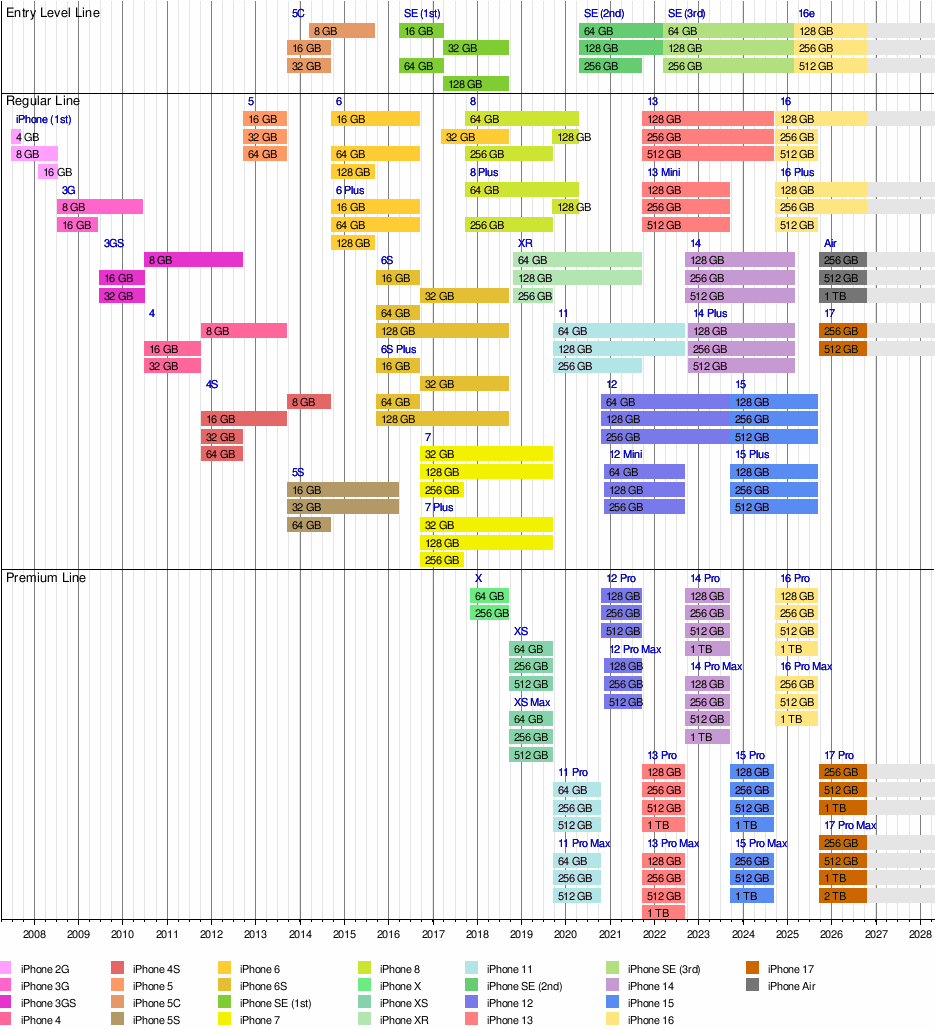 |
Source: Apple Newsroom Archive
| Timeline of iOS devices: iPhone, iPod Touch, iPad, Apple TV, and Apple Watch models |
|---|
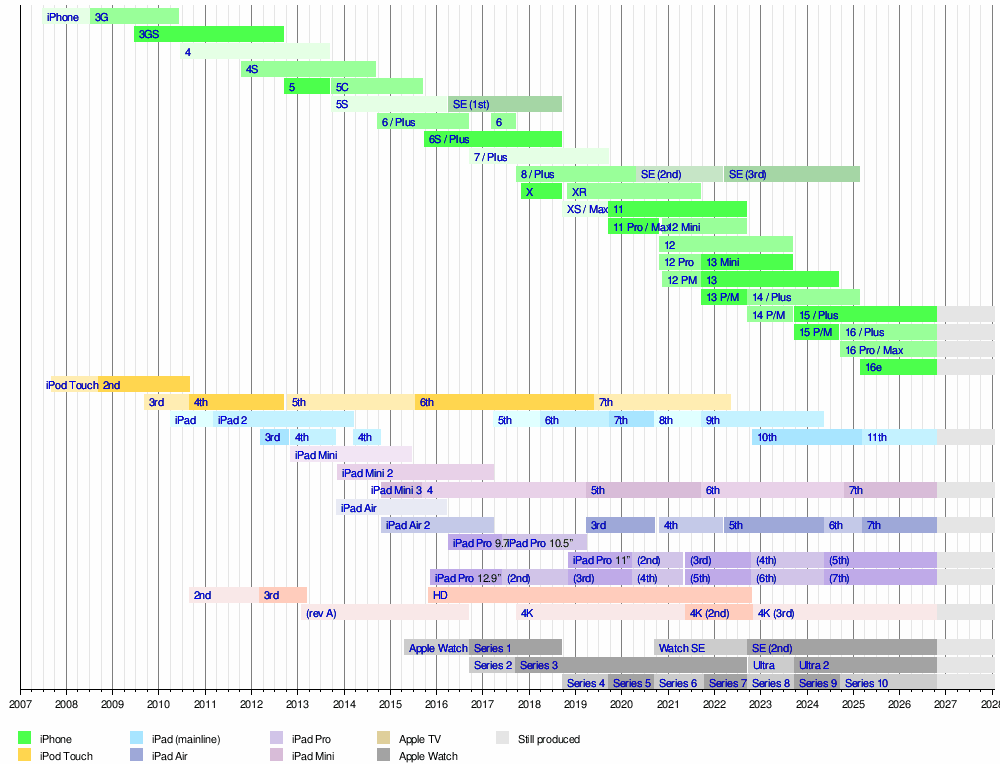 Sources: Apple Inc. Newsroom Archive, Mactracker Apple Inc. model database
|
Protecting iPhone Ideas and Names
Companies like Apple work hard to create new inventions and designs. They use things called patents to protect their new ideas and trademarks to protect their brand names. This stops other companies from simply copying their work.
Sometimes, other companies claim that Apple copied their designs. For example, LG Electronics once said the iPhone looked like their LG Prada phone. Also, Apple sometimes found that another company already had a similar name registered.
For instance, a company called Infogear had registered "I PHONE" and "IPhone" trademarks years before Apple's iPhone. Later, Cisco Systems bought Infogear and its trademarks. When Apple announced its iPhone, Cisco filed a lawsuit. However, Apple and Cisco quickly reached an agreement. They both decided they could use the "iPhone" name and would work together on their products.
Brand Name Challenges Around the World
Apple also faced challenges with the "iPhone" name in other countries. In Mexico, a company called iFone had registered its brand name in 2003. Apple tried to get control of the name, but a Mexican court decided that iFone was the rightful owner. This meant Apple had to respect iFone's existing trademark.
In Brazil, a company called Gradiente Eletrônica S.A. (now IGB Eletrônica S.A.) had registered the "IPHONE" brand in 2000. This was seven years before Apple released its first iPhone. In 2013, the Brazilian Patent and Trademark Office ruled that Gradiente owned the "iPhone" mark in Brazil. However, after further legal discussions, Apple won the right to use the brand name in Brazil in 2014. The court decided that Gradiente's registration did not give them exclusive rights to the name.
In the Philippines, a company called Solid Group launched its "MyPhone" brand in 2007. Apple argued that "MyPhone" was too similar to "iPhone." Apple filed a case, but the Intellectual Property Office of the Philippines ruled against Apple in 2015. They said it was unlikely that customers would confuse the two brands. The director noted that it was a case of a large company trying to claim too much territory from a local business.
Images for kids
-
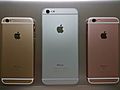
An iPhone 6 Plus alongside two models of the iPhone 6S (back)

See also
 In Spanish: Historia del iPhone para niños
- History of Apple Inc.
- History of mobile phones
- Timeline of Apple Inc. products
