
Hurricane Harvey facts for kids

Harvey at its peak intensity prior to landfall in Southern Texas late on August 25
|
|
| Meteorological history | |
|---|---|
| Formed | August 17, 2017 |
| Extratropical | September 1, 2017 |
| Dissipated | September 2, 2017 |
| Category 4 tropical cyclone | |
| 1-minute sustained (SSHWS/NWS) | |
| Highest winds | 130 mph (215 km/h) |
| Lowest pressure | 937 mbar (hPa); 27.67 inHg |
| Overall effects | |
| Fatalities | 107 |
| Damage | $125 billion (2017 USD) (Tied as the costliest tropical cyclone on record) |
| Areas affected | Windward Islands, Suriname, Guyana, Nicaragua, Honduras, Belize, Cayman Islands, Yucatán Peninsula, Southern and Eastern United States (especially Texas and Louisiana) |
|
Part of the 2017 Atlantic hurricane season |
|
|
History • Meteorological history Effects • Commons: Harvey images |
|
Hurricane Harvey was a huge and destructive tropical cyclone that hit the Southern United States in August 2017. It made landfall as a powerful Category 4 hurricane in Texas. The storm moved very slowly and poured record amounts of rain over cities like Houston. Harvey is famous for being the wettest tropical cyclone on record in the United States. It tied with 2005's Hurricane Katrina as one of the costliest tropical cyclones ever known.
The Journey and Path of Hurricane Harvey

A storm starts when warm ocean water evaporates into the air. Harvey began as a tropical wave that moved away from the coast of Africa. On August 17, it organized into a tropical storm near the Windward Islands. It passed over Barbados and Saint Vincent with breezy winds.
How Harvey Grew Stronger in the Gulf
Harvey weakened while crossing the warm Caribbean Sea because of rough winds called wind shear. The system crossed over the Yucatán Peninsula and entered the Bay of Campeche in the Gulf of Mexico. Here, the water was very warm and calm.
The storm quickly went through rapid intensification, forming a clear central eye. Its atmospheric pressure dropped fast, and its winds gained immense speed. On August 25, Harvey strengthened into a major Category 4 hurricane.
Landfall on the Texas Coast
Harvey crashed ashore near Rockport, Texas and San José Island on August 26. Winds reached an incredible 130 mph (210 km/h). It was the first major hurricane to hit the nation since Hurricane Wilma in 2005.
Instead of rushing across the continent, Harvey stopped moving forward. A weather system acting like a giant wall trapped the hurricane near the shoreline. For days, the swirling storm stayed in place and pumped moisture from the ocean right onto land.
Final Move to Louisiana
The center drifted back out over the water on August 28. It made a final landfall near Cameron, Louisiana, as a tropical storm on August 30. As it traveled inland toward Tennessee and Kentucky, it lost energy and became an extratropical cyclone.
Record Rainfall and Severe Flooding

The biggest danger from Harvey was not just high winds, but extreme rainfall. Because the storm did not move quickly, it poured continuous rain over towns for days.
Record Rainfall in Nederland
The city of Nederland, Texas measured 60.58 in (1,539 mm) of rain. That is more than 5 feet of water falling from the sky. This broke all national rainfall records for any single storm.
In many places across Southeast Texas, more than 40 in (1,000 mm) fell. Flat land and slow-moving rivers like Buffalo Bayou filled up quickly, causing huge flash floods.
Rescues in Greater Houston
In the Greater Houston area, water quickly covered streets, highways, and neighborhoods. Thousands of homes filled with water, forcing people to climb to safety on second floors or roofs.
More than 17,000 emergency rescues happened during the storm. Everyday heroes joined police and the Coast Guard. A group of boat owners called the Cajun Navy came from Louisiana to save neighbors trapped by high water.
Damage and Impact Across the Region

Hurricane Harvey was a destructive natural disaster. It damaged around 300,000 structures and half a million cars across Texas. It also triggered 53 tornadoes across multiple states, including Alabama, Louisiana, and North Carolina.
Large oil refineries closed along the coast, which caused a shortage in fuel and raised gas prices. High winds also knocked down trees and snapped power lines, leaving hundreds of thousands of people without electricity.
Rare Wildlife Impact
Wild animals were also affected by the flooding. Scientists worried about an endangered bird called the Attwater's prairie-chicken. Its grassland habitat flooded, but small wild populations managed to survive the harsh storm.
Communities Working Together to Rebuild

After the floodwaters went down, people worked hard to rebuild their towns. Schools gave out free meals, and community shelters like the George R. Brown Convention Center took in thousands of people who lost their homes.
Helping Hands and Donations
Athletes, musicians, and everyday citizens raised millions of dollars to help storm survivors. Football player J. J. Watt helped raise more than $37 million for relief. Baseball's Houston Astros wore special "Houston Strong" uniform patches and went on to win the 2017 World Series, bringing great joy to the city.
Because of the terrible damage it caused, the name was retired from the official list by the World Meteorological Organization. It was later replaced by the name Harold for the 2023 Atlantic hurricane season.
Images for kids
-
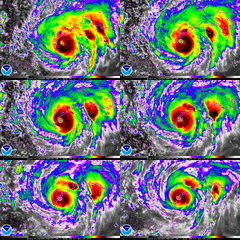
Satellite loop of Harvey making landfall in Texas on August 26
-

Infrared satellite loop of Harvey making landfall in Louisiana
-

Damage to a marina in Rockport, Texas
-

Satellite view of the flat land around Houston


See also
 In Spanish: Huracán Harvey para niños
