
International Commission for the Protection of the Danube River facts for kids

The International Commission for the Protection of the Danube River (ICPDR) is an international group. It has its main office in Vienna, Austria. This group was created by the Danube River Protection Convention. This agreement was signed by countries along the Danube River in Sofia, Bulgaria, in 1994.
The ICPDR started a system called the TransNational Monitoring Network (TNMN) in 1996. It also launched the Accident Emergency Warning System (AEWS) in 1997. Both of these systems are still used today. They help to protect the Danube River. Even though some ICPDR member countries are not part of the European Union (EU), they all work to follow the EU Water Framework Directive. In 2007, they also agreed to follow the EU Floods Directive. The ICPDR celebrated 25 years of the Danube River Protection Convention in 2019.
Contents
What is the ICPDR's Main Rulebook?
The ICPDR follows a special agreement called the Convention on Cooperation for the Protection and Sustainable use of the Danube River. People usually call it the Danube River Protection Convention, or DRPC. This agreement makes the countries promise to work together. They aim for good water management. This includes protecting water above and below ground. They also work to reduce pollution and prevent floods, accidents, and ice problems. The agreement was signed in Sofia, Bulgaria, in 1994. It officially started in October 1998.
What Does the ICPDR Do?
The ICPDR was set up to put the Danube River Protection Convention (DRPC) into action. It is a place where member countries can plan how to follow the agreement. It also helps them check their progress.
Here are the main goals of the ICPDR:
- Make sure water is managed in a way that can last a long time.
- Control pollution and reduce harmful substances in the water.
- Manage floods and problems caused by ice.
The ICPDR helps countries along the Danube and in the Black Sea region work together. They cooperate on issues that need joint effort. They also work with other international groups when new water challenges appear. Since 2000, all ICPDR members, including those not in the EU, have promised to follow the EU’s Water Framework Directive (WFD).
When the Water Framework Directive was adopted in October 2000, all countries working under the DRPC chose the ICPDR. They made it the main group for putting the WFD into practice across the entire river basin. They decided to work hard to follow the Directive everywhere. Countries not in the EU also agreed to follow the WFD through the DRPC. The ICPDR also helps coordinate how the EU Floods directive (EFD) is put into action across the basin.
How the ICPDR Works
The ICPDR is an international organization. It holds meetings twice a year. The main meeting is in Vienna in December. Another meeting, called the Standing Working Group, happens in June. This meeting is held in the country that is leading the ICPDR that year.
These meetings include representatives from member countries and other groups that observe the work. Each member country has one main representative. They try to agree on all decisions. The ICPDR President leads the meetings. The role of President changes each year, going to a different country in alphabetical order.
Most of the ICPDR's work is done by special Expert Groups (EGs). These groups are made of specialists from the member countries and observer groups. They are often government workers from relevant ministries. Sometimes, they are from non-profit groups or other agencies. As of 2020, there are seven permanent Expert Groups and one temporary one:
- Pressures and Measures
- Monitoring and Assessment
- Flood Protection
- River Basin Management
- Information Management and GIS
- Public Participation and Communication
- Accident Prevention and Control
- Strategic Expert Group (temporary)
These expert groups have clear rules and tasks set by the Commission. They usually meet two or three times a year. Smaller task groups can also be set up for specific jobs. These groups discuss issues and prepare reports. They also suggest ways for countries to work together.
The ICPDR has a Permanent Secretariat that helps with its work. An Executive Secretary supervises this office. Since 2013, Ivan Zavadsky has held this role. The secretariat is in Vienna. It manages and supports the ICPDR's activities. The office has nine permanent staff members. It also has extra staff for short-term projects. If you count all the national experts, observers, and consultants, over 300 people work with the ICPDR.
Fun Activities and Events
Every year on June 29, the 14 countries of the Danube River Basin celebrate Danube Day. This day honors their shared river system. They hold many events at schools and other public places. These events often focus on young people and education. They include challenges, quizzes, teaching events, folk dancing, and traditional music. The first Danube Day was held in 2004. This was the 10th anniversary of the Danube River Protection Convention.
Since 2004, the ICPDR has also helped run the Danube Art Master competition. They do this with the Global Water Partnership Central and Eastern Europe (GWP CEE). This art competition involves thousands of school children from all over the Danube River Basin. Children create original artworks. A group of judges chooses the winners each year.
Solving Problems Together
The ICPDR is a place for countries to work together and plan things. When countries signed the Convention, they agreed to certain actions and rules under international law. In the past, when there were disagreements, the ICPDR helped. It gave countries a place to talk and find solutions.
The Convention has a way to settle disagreements. However, this has not been needed so far. The countries involved have always worked to talk things through. They have found ways to agree on difficult issues.
Who Are the Members?

The ICPDR has fifteen member countries and organizations:


Who Are the Observers?
The ICPDR has 24 official observers. These groups can attend meetings and help with decisions:
- Black Sea Commission
- Carpathian Convention
- Central Dredging Association
- Danube Environmental Forum
- Danube Commission
- Danube Civil Society Forum
- Danube Competence Center
- Danube Parks
- Danube Sturgeon Task Force
- Danube Tourist Commission
- European Anglers Alliance
- European Barge Union
- European Water Association
- Friends of Nature International
- Global Water Partnership
- International Association for Danube Research
- International Association of Water Supply Companies in the Danube River Catchment Area
- International Hydrological Programme
- International Sava River Basin Commission
- Ramsar Convention on Wetlands
- Regional Environmental Center for Central and Eastern Europe
- via donau
- World Wide Fund for Nature — Central Eastern Europe
How the ICPDR is Funded
The ICPDR gets its money from the member countries. According to the Danube River Protection Convention, all members (except the EU) should pay an equal share. However, there are some exceptions for a short time. The ICPDR's total yearly budget is a little over one million Euros.
Much of the ICPDR's work is done directly by the member countries. They provide staff and materials. These contributions are very important, even if they don't show up in the ICPDR's official budget. The countries also pay for their own people to take part in the Commission's and Expert Groups' work.
Sometimes, the ICPDR works on projects that have other sources of money. These projects can be funded by the European Union, the United Nations Development Programme, GEF, and individual countries.
Images for kids
-
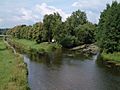
The place where the Breg and Brigach rivers join to form the Danube in Donaueschingen.
-
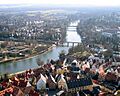
The Danube in Ulm, seen from the steeple of Ulm Minster.
-
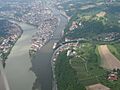
The meeting point of the Inn (left), Danube (center), and Ilz (right) rivers in Passau.
-
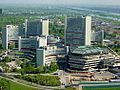
The Vienna International Centre, where the ICPDR's main office is located.
-
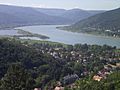
The Danube Bend is a curve of the Danube in Hungary, near Visegrád.
-
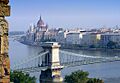
The Danube in Budapest.
-
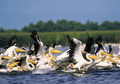
Pelicans in the Danube Delta, Romania.


See also
- Internationalization of the Danube River
- Commissions of the Danube River
- Danube River Conference of 1948
- Danube Commission
External links
- Danube River Protection Convention
- From Convention to Action: 25 Years of the ICPDR
- Implementation of the EU Strategy for the Danube Region, European Union, 17 February 2011
