
Lilium iridollae facts for kids
Quick facts for kids Lilium iridollae |
|
|---|---|
 |
|
| Scientific classification | |
| Kingdom: | |
| (unranked): | |
| (unranked): | |
| Order: | |
| Family: | |
| Genus: | |
| Species: |
L. iridollae
|
| Binomial name | |
| Lilium iridollae M.G.Henry
|
|
The Lilium iridollae is a special type of lily flower. It's a perennial plant, which means it lives for more than two years. This lily is one of only five kinds of lilies that grow naturally in certain parts of the southeastern United States. A woman named Mary Gibson Henry found this lily in 1940. She named it to remind people of a "pot of gold at the end of the rainbow."
The Lilium iridollae needs very specific conditions to grow well. This is why it has been hard for many plant lovers to find. The southeastern U.S. isn't usually known for growing lilies because it has warm winters and high humidity. These conditions are not good for many garden lilies.
Contents
Common Names for This Lily
The Lilium iridollae is known by two main common names:
- Pot-of-gold lily: People in North Carolina, South Carolina, and Virginia often call it this.
- Panhandle lily: In Florida and Alabama, it's known as the panhandle lily.
Where the Pot-of-Gold Lily Grows

The Lilium iridollae grows in wet pine woodlands, especially along streams. It also likes pitcher plant bogs in the southeastern United States. You can mostly find it in Florida, North Carolina, South Carolina, Alabama, and Virginia.
Sadly, this lily is now considered an endangered species in Florida. It is also a threatened species in North Carolina. This means its numbers are getting very low.
The health of this lily's habitat depends on natural fires caused by lightning. These fires help by clearing out other plants that compete with the lily. They also put important nutrients back into the soil from burned peat moss and leaves. The soil where these lilies grow is usually acidic and doesn't have many nutrients.
The Lilium iridollae is very sensitive to changes in water flow and water quality. This makes it easily harmed by things that disturb its ecosystem. For example, too much grazing by livestock or new buildings in nearby areas can hurt these plants.
What the Pot-of-Gold Lily Looks Like
The stem of the Lilium iridollae flower can grow up to 6 feet tall. However, it's often a foot or two shorter. Each stem usually has only one flower that hangs upside down. Each flower is about 3 to 4 inches wide.
The colors of the flowers can be anything from a light yellow to a bright orange. The petals of the flower curve backward so much that they touch each other behind the stem. The stamens (which hold pollen) and the stigma (which receives pollen) hang down in the open space. The petals also have many brownish-black spots. These flowers do not have a scent.
How the Pot-of-Gold Lily is Pollinated

The Lilium iridollae and many similar lilies are mostly pollinated by large swallowtail butterflies. This plant also attracts bees and birds. When pollination happens, a large seed pod grows. This pod can hold hundreds of tiny seeds.
Life Cycle of the Pot-of-Gold Lily
Lilium iridollae plants are deciduous. This means they lose their leaves and go back to being just a bulb in the ground in late fall. In early spring, new leaves start to grow. They form a flat circle of leaves close to the ground called a basal rosette.
In late spring, this rosette of leaves begins to grow taller. Then, by mid- to late-July, the plants start to flower. The seeds are light brown and can sprout in 1 to 2 months without needing a cold period.
Sometimes, these native lilies won't flower if the conditions aren't right. In these cases, they might just appear as a basal rosette of leaves each spring for several years. Also, young plants, even in perfect conditions, take more than two years to grow from a seed into a flowering plant because they grow slowly.
Similar Lily Species

The Lilium iridollae is closely related to Lilium superbum, which is also called the Turk’s Cap Lily, Turban Lily, Swamp Lily, or American Tiger Lily. The Lilium superbum has dark orange flowers with purple spots, and they don't have a scent. Its leaves grow in groups of 6 to 10 around a stem that can be 6 feet tall.

Another lily similar to Lilium iridollae is Lilium michauxii, or the Carolina Lily. Its flowers look like the Turk’s Cap Lily, but they are fragrant. Also, its stem is only 2 to 3 feet tall, and its leaves are wide and shaped like a spear.
Protecting the Pot-of-Gold Lily
Since Lilium iridollae is endangered and threatened, there are ways we can help protect it:
- Protect streams from siltation (mud and dirt washing into them) during logging and road construction.
- Avoid logging on sloped forests.
- Do not drain or fill in wetlands where these lilies grow.
- Wildfires are good for Lilium iridollae, so we should avoid putting firebreaks (areas cleared to stop fires) in places where different ecosystems meet. The wildfires should be allowed to burn into the edges of forests near streams.
- Finally, we should get rid of feral hogs (wild pigs) because they can harm the plants.
Images for kids
-
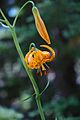
Lilium iridollae
-
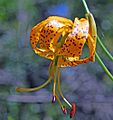
Lilium iridollae


