
List of New York State Historic Markers in Orange County, New York facts for kids
New York State Historic Markers are special signs that tell us about important places, people, and events in history. In Orange County, New York, there are many of these markers. They help us learn about the past, from early settlements and famous battles to important inventions and interesting local stories.
Contents
Exploring Orange County's History Through Markers
Orange County is full of history, and these markers help us discover it. Let's explore some of the fascinating stories these markers share.
Early Life and Inventions
Some markers show us how people lived and what they created long ago.
The First Butter Factory
Imagine a time when butter was made by hand! In Campbell Hall, New York, there's a marker for the BUTTER FACTORY. This was the very first butter factory in the United States, built in 1856. It was owned by H.W. Woodhull, and George Gouge was the buttermaker. This factory changed how butter was made and sold.

The Oldest Church
In Middletown, New York, the FIRST CONGREGATIONAL CHURCH marker tells us about a church organized on June 10, 1785. For 40 years, it was the only church in the area. The building you see today was built in 1872.

The First Mill
Before big factories, people used mills to grind grain. In Port Jervis, New York, near Beach Road, a marker points to the site of the FIRST MILL. This grist mill was built before 1713 by Stephen Tietsoort. It was an important place for early settlers to get their grain processed.

First Settler
Around 1690, a man named William Tietsoort became the FIRST SETTLER in an area of Deerpark, New York. He set up a blacksmith shop at the request of local Native Americans. They even gave him land west of their village.

Huguenot Settlement
The area known as HUGUENOT in Deerpark, New York was named after the Huguenot families, Cuddeback and Gumaer. They settled there around 1698. The Native American name for this place was Seneyaugnquan.

Huguenot School
The HUGUENOT SCHOOL marker in Deerpark, New York shows us a typical one-room schoolhouse built in 1863. It was made from bricks from the Neversink Valley and overlooked the D&H Canal.

Kaatsbaan (Dutch for Tennis Court)
In Deerpark, New York, the KAATSBAAN marker tells us about an old Indian football field. It was located in a bend of the river and was also the home of William Tietsoort from 1690 to 1713.

Border Disputes and Revolutionary War Stories
Orange County was a busy place during colonial times and the Revolutionary War.
The New Jersey Line War
For many years, there was a disagreement over the border between New York and New Jersey. This was called the N. J. LINE WAR. Markers in Deerpark, New York explain how New Jersey claimed land that New Yorkers also believed was theirs. This caused a 50-year border conflict!


Indian Raids and the Battle of Minisink
During the Revolutionary War, there were several attacks by Native American groups and Loyalists (people who supported the British). These events are often called the INDIAN RAIDs.
- Simon Westfall's House: In Port Jervis, New York, a marker tells us that Simon Westfall's house and barn were burned by Brant's Mohawks and Tories on July 20, 1779.

- Neversink Drive (Horn Road): This old road, marked by the NEVERSINK DRIVE (HORN ROAD) sign, saw many events during Joseph Brant's raid on July 20, 1779.

- Decker Fort: On Neversink Drive, the DECKER FORT marker shows where Major Decker's fortified house was burned by Brant's raiders on July 20, 1779. Militia gathered here while chasing Brant.

- Painted Aprons: A unique story is told by the PAINTED APRONS marker on Neversink Drive. In 1779, Black Rock school was attacked. Girls were spared because their aprons had a special emblem that told the raiders not to harm them.

- Indian Village: The INDIAN VILLAGE marker on Neversink Drive points to a plateau where the Indian village of Oquekumsey once stood. It was abandoned in 1730 and later excavated by the New York State Museum.

- Fort Van Auken: The marker for SITE OF Fort Van Auken on Neversink Drive tells us about a fort that was unsuccessfully attacked by Brant's Mohawks and Tories on July 20, 1779.

- Maghaghkamik Church: In Port Jervis, New York, the INDIAN RAID marker for Maghaghkamik Church notes that the church, built in 1743, was burned by Brant's raiders on July 20, 1779.

- Cole's Fort: The COLE'S FORT marker in Port Jervis, New York describes a fort built in 1755 during the French and Indian War. It was the home of Wilhelmus Coe, who settled there around 1730.

- Brant's Route: The INDIAN RAID marker on Peenpack Trail in Deerpark, New York shows the route taken by Colonel Brant and his raiders when they attacked the valley in 1778 and 1779.

Sullivan Expedition Camp Site
A marker for a CAMP SITE on Neversink Drive in Deerpark, New York tells us that the Second New York Regiment camped here on May 7, 1779. They were on their way to build a road for Sullivan's March against Native American groups.

Famous People and Local Landmarks
Orange County is also home to the birthplaces and homes of notable figures.
William H. Seward
In Florida, New York, a marker for WILLIAM H. SEWARD tells us that this important politician was born on this site between 1801 and 1872. He was a key figure in American history, serving as Secretary of State under President Abraham Lincoln.

The Crane House
In Port Jervis, New York, the THE CRANE HOUSE marker points to the home of Judge William Crane. His famous brother, writer Stephen Crane, visited this house from 1891 to 1896 and created some of his best works here.

Marion Rohner
A very special marker in Port Jervis, New York honors MARION ROHNER. Mrs. Rohner was a Den Mother for Cub Scouts for 43 years! In 2001, she earned a Guinness World Record for being the longest-serving Den Mother in the world. What an amazing dedication!

Hawk's Nest
The HAWK'S NEST marker on Route 97 in Deerpark, New York describes a famous scenic road. It started as a one-lane dirt road in 1859, was paved between 1931 and 1933, and officially dedicated in 1939. It's now part of the Upper Delaware Scenic Byway.

Images for kids
-
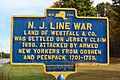
Another marker about the New Jersey Line War.
-
A marker for the New Jersey Line War on Neversink Drive.
-
The marker for the Indian Raid on the Van Etten house.
-
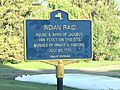
The marker for the Indian Raid on the Van Fleet house.
-
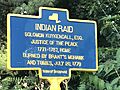
The marker for the Indian Raid on the Kuykendall house.
-
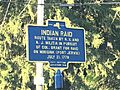
The marker showing the route taken by militia to the Battle of Minisink.
-
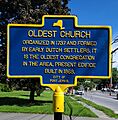
The marker for the Oldest Church in Port Jervis.


See also
