
Madge Networks facts for kids
Madge Networks NV was a company that made important computer networking technology. It was started by Robert Madge and was best known for its work with a type of network called Token Ring. In the mid-1990s, Madge Networks was a world leader in creating fast networking solutions. They also helped develop other technologies like Asynchronous Transfer Mode (ATM) and Ethernet.
The company went out of business in April 2003. Today, a company called Madge Ltd. in the UK continues some of its work. Another company, Ringdale, bought the rights to Madge's products and brand. This made Ringdale the biggest supplier of Token Ring technology in the world.
Contents
Building Network Technology

Madge Networks used to be one of the top companies making equipment for computer networks. Their main office was in Wexham, England. Madge Networks created products for Token Ring, Ethernet, ATM, and ISDN networks. These products helped connect computers and devices.
Their products included network adapters for personal computers (like those that fit into ISA or PCI slots). They also made larger equipment like hubs (which connect many devices), routers (which direct network traffic), and ISDN equipment for connecting to the internet. Madge wanted to combine different network technologies like Ethernet, Token Ring, ISDN, and the new ATM. Besides Wexham, Madge had big offices in New Jersey and California in the United States. They also had offices in over 25 other countries.
Madge Networks started in 1986. They were pioneers in the networking market, which changed how companies communicated. Madge Networks was a big supporter of Token Ring technology. They made many products for it, including network cards, switches, and other devices.
In the late 1990s, Madge Networks played a key role in developing High-Speed Token Ring (HSTR). This new technology made data transfer much faster. It also worked with the older Token Ring technology.
In 1998, Madge Networks sold its Ethernet technology (called LANNET) to Lucent Technologies. This reduced Madge's involvement in the Ethernet market. Ethernet was a rival to Token Ring. After this, Madge focused more on ATM technology, video conferencing, and ISDN uses. They made equipment that helped connect different types of networks for video conferencing. For ISDN, Madge developed products to use digital phone lines for faster data, voice, and video.
Company History
Robert Madge, who used to teach horseback riding, first worked in the computer industry designing chess games. In 1986, he decided to start his own business. He opened his first office on his family's farm in Buckinghamshire.
Early Years
By the mid-1980s, the Ethernet market already had many companies. Most of the money was made by companies like 3COM. Other companies avoided the Token Ring market because of IBM's strong presence. However, Madge found a way to succeed by working in IBM's shadow.
Madge Networks released its first Token Ring products in 1987. They quickly opened a second main office in San Jose, California. This put them closer to the center of the world's computer industry. It also had a clever benefit: customers in the United States thought Madge was a big British company, while UK customers saw it as a successful US company.
Robert Madge helped his company improve the technology. They introduced new products like the Smart Ringnode in 1989 and Fastmac technology in 1990. This put Madge at the forefront of Token Ring research. By the early 1990s, Madge was even ahead of IBM's development. IBM itself started recommending Madge's products to its own customers. A big boost came when Madge licensed its Fastmac technology to Cisco Systems in 1990.
Madge's income reached $18 million in 1990. Just one year later, it almost doubled to $34 million. Computer networking was just beginning to grow. By 1992, Madge's income was nearly $100 million. At the end of 1992, the company had seven percent of the Token Ring market. This was still small compared to IBM's 76 percent. Until the early 1990s, Madge mainly made adapter cards. These cards were put into individual computers to connect them to the network. Soon, the company's products also included the hubs and switches needed to send data and allow the adapter cards to communicate.
Madge Networks grew quickly in the 1990s. This was thanks to the boom in computer networking and their leading Token Ring technology. Madge successfully took market share from IBM in Token Ring. By the mid-1990s, Madge's share grew to over 16 percent. IBM's overall market share quickly dropped below 50 percent. Licensing deals between Madge and Cisco Systems helped this change.
Growing Bigger
In the 1990s, Madge continued to expand globally. They opened new offices in South Africa, Germany, Hong Kong, Japan, and France. Their San Jose office became a second main headquarters. To help the company grow, Madge Networks went public in 1993. They offered over six million shares on the NASDAQ stock exchange.
By 1994, Madge Networks' income reached over $213 million. This was impressive growth. However, it was still small compared to its main competitors like Cisco Systems and 3Com Corp. Also, many large companies wanted a wider range of networking products than Madge offered. Madge was strong in Token Ring, but its Ethernet products were not as good. This was a problem because Ethernet became the most popular networking technology in the mid-1990s.
In 1995, Madge Networks merged with Lannet Data Communications. Lannet was an Israel-based company that focused on LAN switches for Ethernet networks. The merger was valued at about $300 million. Lannet's operations became Madge's Ethernet division. Together, Madge and Lannet had combined revenues of $283 million. They were the smallest of the top five networking leaders. However, the combined company offered a full range of Token Ring and Ethernet products.
The merger allowed Madge to combine these different networking technologies. They could also connect their products to the newest networking technology, ATM. By the mid-1990s, existing networks were struggling to handle the amount of data. As more employees joined company networks, the networks ran out of bandwidth (capacity for data). New applications like video conferencing pushed bandwidth needs even higher. ATM used packet technology more efficiently, promising much faster data transfer. Adopting ATM meant companies would need to rebuild their networks. Madge Networks prepared its own ATM products. They also made hubs and switches to connect existing Token Ring and Ethernet equipment to the new ATM technology. The Lannet merger improved Madge's range of LAN switches. These were needed to connect Ethernet and Token Ring devices to corporate ATM systems.
Madge focused on ATM as a Local Area Network (LAN) technology. They did not see it as a backbone for Wide-Area Networks (WAN). Madge even bet that ATM would replace Token Ring, Ethernet, and even TCP/IP for desktop computers. This turned out to be a costly mistake. Companies chose switched Ethernet instead of ATM. Most of Madge's ATM products were not suitable for the larger carrier market. So, the company's big investment in future products did not pay off. This wrong focus on the market and technology was a major reason for Madge's eventual failure.
Another boost for Madge's growth was a 1995 agreement with Cisco Systems. Cisco was already a global networking leader. They agreed to use Madge's Token Ring switches in Cisco's products. They also licensed other parts of Madge's Token Ring technology for future Cisco designs. At the same time, Madge gained access to Cisco's LAN and WAN switching software. After the Cisco agreement, Madge also planned to increase its manufacturing. They built a new factory in Ireland.
By the end of 1995, the merged Madge-Lannet company had about 1,400 employees. Their income was over $400 million. Most of this (85 percent) came from outside the UK. In 1996, the company continued to expand. This included adding to its manufacturing in Israel with a new $10 million plant in Jerusalem. In February 1996, Madge bought Teleos Communications Inc. This company made ISDN and WAN access products. Teleos, based in Eatontown, had an income of $24 million in 1995. Madge paid $165 million for it. At the same time, Madge strengthened its relationship with Cisco Systems. They expanded their licensing agreements to include Cisco's IOS software.
At the end of 1996, Madge launched new products for a growing market: video conferencing. Madge's products helped connect data and video transmission technologies. The video conferencing market was still new, but Madge's move seemed to put them in a strong position to compete in what experts thought would be a huge future market.
Decline
After years of strong growth, the company's income for 1996 was only $482 million. In 1997, the company started losing money. Experts suggested that by trying to offer too many products, the company lost its focus. By August 1997, Madge had to reorganize. They laid off about 650 employees. In the mid-1990s, Madge tried to move most of its main operations to the United States, building up staff around its San Jose offices. However, the decline of ATM technology in the market made it hard for the company to recover. They decided to focus the company's activities in the England-Israel time zones. The company's U.S. offices were made much smaller.
Madge's reorganization continued into 1998. In late 1997, the company spun off its Ethernet division into a separate company, again named Lannet. After first denying reports, Madge agreed to sell Lannet to Lucent Technologies for $117 million in July 1998. During this time, Madge also decided to stop manufacturing. They sold their Ireland plant to Celestica, an electronics manufacturer. The total cost of Madge's reorganization was over $50 million. However, the company's renewed focus on Token Ring technology seemed to stabilize its finances. By mid-1998, Madge was profitable again, but with only about fifty employees.
In the late 1990s, Madge focused on developing the next generation of Token Ring technology, High-Speed Token Ring. This offered speeds from 16 Mbit/s to 100 Mbit/s, with plans for even faster gigabit speeds. They also became the only large producer of Token Ring technology besides IBM. This happened after they bought the Token Ring business from a competitor called Olicom. But abandoning Ethernet was the beginning of the end for Madge Networks. The big investment in ATM that didn't pay off was something they never recovered from. After 1998, they tried to get into wireless 802.11 technology, but without success.
Madge Networks eventually went out of business in 2003. It was then absorbed into Ringdale Limited through a management buyout.
Images for kids
-
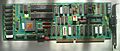
This is a Madge Token Ring network card for older computers.
