
Old Kingdom of Egypt facts for kids
Quick facts for kids
Old Kingdom of Egypt
|
|||||||||
|---|---|---|---|---|---|---|---|---|---|
| c. 2686 BC–c. 2181 BC | |||||||||

During the Old Kingdom of Egypt (circa 2700 BC – circa 2200 BC), Egypt consisted of the Nile River region south to Abu (also known as Elephantine), as well as Sinai and the oases in the western desert, with Egyptian control/rule over Nubia reaching to the area north of the third cataract.
|
|||||||||
| Capital | Memphis | ||||||||
| Common languages | Ancient Egyptian | ||||||||
| Religion | Ancient Egyptian religion | ||||||||
| Government | Theocratic absolute monarchy | ||||||||
| Pharaoh | |||||||||
|
• c. 2686 – c. 2649 BC
|
Djoser (first) | ||||||||
|
• c. 2184 – c. 2181 BC
|
Last king depends on the scholar, Neitiqerty Siptah (6th Dynasty) or Neferirkare (7th/8th Dynasty) | ||||||||
| History | |||||||||
|
• Began
|
c. 2686 BC | ||||||||
|
• Ended
|
c. 2181 BC | ||||||||
| Population | |||||||||
|
• 2500 BC
|
1.6 million | ||||||||
|
|||||||||


The Old Kingdom is a famous time in ancient Egyptian history. It lasted from around 2700 BC to 2200 BC. Many people call it the "Age of the Pyramids." During this time, workers built giant stone tombs for their rulers. The period includes the Third Dynasty through the Sixth Dynasty. The capital city was Ineb-Hedj, which is the Egyptian name for Memphis.
During this golden age, the King of Egypt was viewed as a living god. The ruler held complete power over the land. The Egyptians believed their king was connected to the god Horus. People thought the universe moved in cycles. The king worked to keep everything peaceful and balanced.
Contents
History of the Old Kingdom
How the Pyramid Age Began
The Old Kingdom started to rise under King Djoser. He ruled during the Third Dynasty. Djoser wanted a special tomb at Saqqara. His talented architect, Imhotep, figured out how to build using giant stone blocks. Together, they made the famous Step Pyramid. It looked like giant stairs reaching toward the sky.
Around this time, leaders divided Egypt into smaller provinces called nomes. Local governors looked after these areas and helped collect taxes. This helped the royal government run smoothly.
Building the Great Pyramids

The Fourth Dynasty was the most powerful time of the Old Kingdom. King Sneferu was an amazing builder. He built the Meidum Pyramid, the Bent Pyramid, and the Red Pyramid at Dahshur. He used more stone than any other ruler.
Sneferu's son was King Khufu. Khufu ordered the construction of the giant Great Pyramid of Giza. It is the largest pyramid ever built in Egypt. Later, King Khafre built another large tomb nearby. Khafre is also linked to the famous Great Sphinx of Giza. King Menkaure then built the third and smallest pyramid at the site. Egyptian power expanded south into Nubia and northeast into Canaan.


Sun Temples and Sailing Ships
During the Fifth Dynasty, kings focused on the sun god Ra. Rulers like Userkaf and Nyuserre Ini built special sun temples at Abusir. Pyramids became smaller, but people decorated the walls inside. King Unas was the first to carve the Pyramid Texts inside his burial chamber.
Trade grew quickly during this era. Egyptians needed wood, so they bought cedar from Lebanon. Egyptian sailors sailed down the Red Sea to the mysterious Kingdom of Punt. They brought back gold, ebony, and sweet-smelling resins like myrrh and frankincense. Builders made large wooden boats by tying planks tightly together with thick ropes.
Why the Kingdom Declined
During the Sixth Dynasty, central control began to break down. Local leaders called nomarchs became very rich and powerful. They passed their jobs down to their children. King Pepi II ruled for many decades. After his death, different groups argued over who should lead.
At the same time, the climate changed. A massive drought swept across the region. The Nile failed to flood regularly, which ruined crops. Food became scarce, causing widespread hardship. This difficult era after the collapse is known as the First Intermediate Period.
Art and Culture

Artists in ancient Egypt had very strict rules. Every piece of art served a religious purpose. Statues were designed to hold the human spirit.
Artists used special styles to show meaning:
- Frontality: Statues faced forward so they looked directly at visitors.
- Composite view: Paintings showed faces in profile, but the chest faced forward.
- Scale: Important people were drawn larger than others. Kings were always drawn larger than regular citizens.
Carvers used hard stones like granite to make lasting statues. They also gave special meanings to colors. Green meant new life, black meant rich soil, and red represented the sun.

Images for kids
-
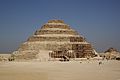
The Pyramid of Djoser at Saqqara.
-
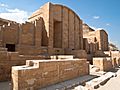
The Temple of Djoser at Saqqara
-
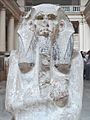
Limestone Ka statue of Djoser from his pyramid serdab at Saqqara, Egyptian Museum, Cairo
-
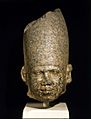
The head of a King, likely Huni c. 2650–2600 BC, Brooklyn Museum.
-
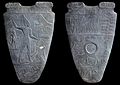
The Narmer Palette depicts the unification of the Two Lands.
-

Limestone head of an early Egyptian king, The Petrie Museum.
-
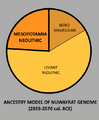
Ancestry model of Egyptian genome from Nuwayrat.
-
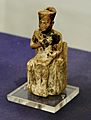
King khufu statue at Cairo museum
-
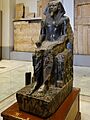
King khafre statue at Cairo museum
-
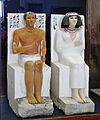
Rahotep and Nofret statues at Cairo museum
-
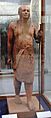
Kaaper around 2500 BC
-
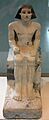
Majordomo Keki statue, 6th dynasty at Louvre museum


See also
 In Spanish: Imperio Antiguo de Egipto para niños
