
Papilio cresphontes facts for kids
Quick facts for kids Eastern giant swallowtail |
|
|---|---|
 |
|
| Conservation status | |
Scientific classification  |
|
| Kingdom: | Animalia |
| Phylum: | Arthropoda |
| Class: | Insecta |
| Order: | Lepidoptera |
| Family: | Papilionidae |
| Genus: | Papilio |
| Species: |
P. cresphontes
|
| Binomial name | |
| Papilio cresphontes Cramer, [1777]
|
|
| Script error: The function "autoWithCaption" does not exist. | |
| Synonyms | |
|
Heraclides oxilus Hübner, [1819] |
|

Script error: No such module "Check for conflicting parameters".
The eastern giant swallowtail (Papilio cresphontes) is the largest butterfly found in North America. This magnificent insect is famous for its massive size and striking colors. It lives across large parts of eastern North America. In the past, scientists thought it lived all the way to Panama. Today, western and southern populations belong to a separate species named Papilio rumiko.
Many gardeners love having this butterfly around because it is so beautiful. However, farmers sometimes view it differently. Its young larva stage can eat leaves on valuable citrus trees. Because of this habit, farmers often call the caterpillar the orange dog or orange puppy.
These caterpillars have a clever way to stay safe from hungry predators. They look almost identical to bird droppings. If an attacker gets too close, the larva uses an osmeterium. This special hidden organ shoots out a foul smell to keep the insect safe.
Contents
Geographic Range and Living Spaces
The eastern giant swallowtail makes its home in many regions across North America. It lives throughout the eastern half of the United States. Its range extends north into southern New England and parts of southern Canada.
Heading south of the United States border, the butterfly lives in regions of Mexico. It also flies across tropical islands, including Jamaica and Cuba. For many years, scientists grouped all giant swallowtails into one huge family. Recent studies using DNA showed that western butterflies are actually a separate species called Papilio rumiko.
Within these regions, the butterfly prefers places with plenty of sunlight and food. In the United States, Papilio cresphontes spends most of its time in deciduous forests and sunny fields. It also visits suburban flower gardens and citrus groves.
Winters can be very cold in the north. Because of this, giant swallowtails can only spend the winter safely in warm places like Florida and the deep South. In northern regions, adult butterflies often travel during warm summers before the cold autumn arrives.
Physical Appearance and Identification
One incredible feature of the eastern giant swallowtail is its massive size. Female butterflies have an average wingspan of 5.5 in (14 cm). The largest females can reach up to 6.9 in (18 cm) across.
Male butterflies are also giant insects. A male has an average wingspan of 5.8 in (15 cm). Some very large males reach an amazing wingspan of 7.4 in (19 cm). These giant wings allow them to glide gracefully through warm outdoor air.
The top surfaces of the wings show deep black colors. A bold yellow stripe runs horizontally across the top forewings. Another bright yellow band crosses diagonally down across the lower hindwings.
Underneath, the wings look completely different. The underside is mostly bright yellow with fine black markings. Near the base of the wing tails sits a tiny splash of bright red within a blue band. This red marking helps experts tell it apart from the rare Schaus' swallowtail.
Naturalist Pieter Cramer first named this butterfly in 1777. Later scientists placed it inside the Papilio thoas species group. While it looks similar to P. thoas, its wing spots and body structures are unique.
Food Resources and Feeding Habits
Eastern giant swallowtails need different types of food during their lives. Caterpillars eat leaves, while adults sip sweet nectar.
Food for Caterpillars
Caterpillars have hearty appetites and munch on plants from the Rutaceae citrus family. They love snacking on leaves of orange, lemon, and lime trees. They also eat wild native plants such as prickly ash and the common hoptree.
In backyards and gardens, caterpillars feed on exotic introduced species. These include garden plants like the fragrant gasplant, garden rue, and fruit trees like the sapote.
Special Diets in Local Areas
Scientists discovered that caterpillars develop special tastes based on where they hatch. Young larvae studied in Florida, Ohio, and Wisconsin grow best on local host plants. Caterpillars fed their home plants grew faster than those fed plants from elsewhere. This special adaptation helps local caterpillars thrive in their exact home habitats.
Food for Adults
Adult butterflies need lots of energy to power their giant wings. They visit many colorful flowers to drink sweet sugary nectar.
Favorite nectar flowers include bright garden blooms like Lantana and pink or purple azaleas. They also flutter around hanging flowers like bougainvillea, bouncing bet known as Saponaria officinalis, and sweet dame's rocket called Hesperis matronalis.
In wild meadows, they seek out goldenrod known as Solidago. They also drink from honeysuckle vines like Lonicera japonica and swamp milkweed called Asclepias incarnata. Adult butterflies will sometimes sip mineral-rich moisture from damp soil and animal droppings.
Life Cycle and Development
The life cycle of the eastern giant swallowtail includes four amazing stages. The insect changes completely from an egg to a flying adult.
Eggs
Mother butterflies search carefully for the best leaves before laying eggs. They lay small round eggs on the upper surfaces of healthy host leaves. The mother lays only one egg at a time instead of big clusters.
A single egg measures only 1 to 1.5 millimeters across. Each egg starts out with a brownish hue. It soon looks orange because the mother coats it in an orange liquid. Newly hatched caterpillars cannot crawl far, so choosing good leaves is very important.
Caterpillars
After hatching, the caterpillar enters a period of intense growth and feeding. The young larva passes through five different growth stages called instars. During these stages, it grows up to two inches long before transforming.
Most caterpillars are nocturnal animals that feed under the cover of night. Young instars have tiny bristles called setae on their skin. Older instars lose these bristles and have smooth, mottled skin. Throughout each stage, the larva uses clever camouflage to hide in plain sight.
Pupation
When fully grown, the larva looks for a safe vertical surface. It often chooses a sturdy stem on its host plant or nearby wood.
The caterpillar attaches itself using silk threads and sheds its skin. It transforms into a rough, brown chrysalis. The chrysalis looks just like a broken tree twig. Inside this protective shell, the butterfly develops for about 10 to 12 days before emerging.
Reproduction
Once adult butterflies emerge, they spread their wings to dry before flying. Male butterflies fly along set paths through woods and orchards looking for mates. Most mating takes place during sunny afternoons near leafy host plants.
Natural Enemies and Defense Tricks
Surviving in the wild is tough, so swallowtails use special tools to stay safe.
Parasites and Predators
Swallowtails face many dangers throughout their lives. They are especially vulnerable to parasites while resting inside the helpless chrysalis stage.
Tiny parasitic wasps and flies find chrysalises and lay their own eggs inside. Common insect parasites include wasps such as Brachymeria robusta, Pteromalus cassotis, and Pteromalus vanessae. Tachinid flies like Lespesia rileyi also attack resting pupae.
Camouflage and Disguises
To avoid being eaten by hungry birds, caterpillars rely heavily on protective patterns. Their brown, white, and cream blotches resemble slimy bird or lizard droppings. This clever disguise was favored by natural selection over thousands of years.
The bold markings break up the body shape through an effect called disruptive coloration. This trick confuses predators because the insect does not look like food. Older, larger caterpillars also stretch out their bodies to mimic small tree snakes.
The Smelly Osmeterium
If a predator discovers the caterpillar, the insect uses a secret weapon. It pushes out a bright red-orange organ called an osmeterium from behind its head.
This Y-shaped structure looks like the forked tongue of an angry snake. By the fourth instar, the organ produces a terrible, sour chemical smell. The caterpillar thrashes and rubs the smelly organ directly against small enemies. While this drives away ants and spiders, it does not stop large birds.
Senses and Flight Abilities
Giant swallowtails have powerful physical features that help them survive and travel.
Finding the Right Plants
Swallowtails must find exact host plants so their young can survive. They use their sensitive antennas to smell chemical scents called volatile compounds.
Female butterflies are especially good at detecting these unique plant odors. Their antennas sense subtle scent differences between native trees and garden citrus. This sharp sense ensures that eggs are laid only on healthy leaves.
Gliding Flight
With huge wings spanning up to seven inches, giant swallowtails fly effortlessly. They flap their broad wings slowly and glide smoothly across long distances. This gentle gliding style saves energy when migrating or searching for flowers.
Human Connections and Environmental Shifts
Humans and giant swallowtails have lived side-by-side for centuries. Sometimes they are garden friends, while other times they cause orchard problems.
Life on Citrus Farms
On commercial citrus farms, young caterpillars can be serious agricultural pests. Farmers dislike seeing them munching on young lemon and orange trees. Heavy feeding can strip small saplings bare of leaves. However, large adult trees rarely suffer serious harm from caterpillars.
Farmers protect young trees using biological solutions like Bacillus thuringiensis. This helpful bacterium stops leaf-eating caterpillars safely without harming helpful garden bugs. Scientists also discovered that an essential amino acid named methionine works as a safe spray.
Shifts in Cold Climates
In recent decades, eastern giant swallowtails have moved further north into Canada and New England. Warmer autumn weather without early September frosts allows larvae to survive longer. Because plants and insects respond to warmer conditions, these giant beauties continue exploring new northern territories.
Images for kids
-

A tiny orange egg laid on a green leaf
-
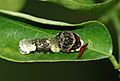
A caterpillar pushing out its red osmeterium to scare predators
-
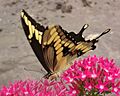
Underneath view showing the bright yellow wings of an adult butterfly


