
Phoenicia facts for kids
Quick facts for kids
Phoenicia
|
|||||||||||||
|---|---|---|---|---|---|---|---|---|---|---|---|---|---|
| c. 2500 – 64 BC | |||||||||||||

Approximate extent of Phoenician settlements and trade routes c. 800 BC.
|
|||||||||||||
| Capital | None; dominant cities were Byblos, Sidon, and Tyre | ||||||||||||
| Common languages | Phoenician | ||||||||||||
| Religion | Canaanite religion | ||||||||||||
| Demonym(s) | Phoenicians | ||||||||||||
| Government | City-states ruled by kings, with varying degrees of oligarchy or plutocracy; oligarchic republic in Carthage after c. 480 BC | ||||||||||||
| Major kings of Phoenician cities | |||||||||||||
|
• c. 1800 BC
|
Abishemu I | ||||||||||||
|
• 969–936 BC
|
Hiram I | ||||||||||||
|
• 820–774 BC
|
Pygmalion of Tyre | ||||||||||||
| Historical era | Archaic period to Classical antiquity | ||||||||||||
|
• Established
|
2500 BC | ||||||||||||
| 969 BC | |||||||||||||
| 814 BC | |||||||||||||
|
• Disestablished
|
64 BC | ||||||||||||
|
|||||||||||||

The Phoenicians were an amazing ancient people. They lived along the coast of what is now Lebanon and parts of Syria. They were famous for their incredible skills as sailors and traders. Their civilization grew and changed over many centuries. They spread their influence all across the Mediterranean Sea, from Cyprus to Spain. They left behind many writings and artifacts.
The Phoenicians came from the earlier Canaanites of the Bronze Age. They kept many of their old traditions. They called themselves "Canaanites" and their land "Canaan." The name Phoenicia was given to them by the ancient Greeks. It wasn't a name they used for themselves.
These skilled seafarers built one of the largest trade networks in the ancient world. This network helped connect great civilizations like Mesopotamia, Egypt, and Greece. They set up many trading posts and colonies. One of their most famous colonies was Carthage in North Africa. It became a very powerful city.
Phoenician society was made up of independent city-states. Important cities included Byblos, Sidon, and Tyre. Each city ruled itself. They didn't have a single, unified country. Kings often ruled these cities. However, powerful merchant families also had a lot of say. The Phoenician cities were strongest around 900 BC. Later, they faced challenges from big empires like the Assyrians and Persians. Their influence in the western Mediterranean lasted until the Romans destroyed Carthage around 150 BC.
For a long time, we didn't know much about the Phoenicians. This was because few of their own historical writings survived. But since the 1600s, and especially in the mid-1900s, discoveries of their inscriptions and archaeological sites have taught us a lot. Their greatest gift to the world was the alphabet. It was the first true alphabet and spread across the Mediterranean. It led to the Greek alphabet, and then to the Latin and Cyrillic alphabets we use today. They also made advances in shipbuilding, navigation, and trade. Their trade networks helped shape the economy and culture of the ancient Mediterranean.
Contents
Understanding the Name "Phoenicia"
The Phoenicians lived in many independent city-states. They didn't have one name for their entire land. People were often called by their city's name, like "Sidonian" for someone from Sidon. There is no clear proof that they called themselves "Phoenicians." They likely referred to themselves as "Canaanites."
The name Phoenicia comes from the ancient Greeks. It meant different things to them, like "Phoenician person," "Tyrian purple color," or "date palm tree." The Romans later used the name Poenī for them. This is where the word "Punic" comes from, which refers to Carthage.
Exploring Phoenician History
We know a lot about the Phoenicians from other ancient civilizations. We also learn from the artifacts found by archaeologists. Their most important period was from about 1200 BC to 332 BC.
Who Were the Phoenicians?
Historians and archaeologists often discuss if Phoenicians were different from other Canaanite people. Many experts believe that Phoenicians were a group of Canaanites. They lived in specific cities along the northern coast of the Levant. They shared a language and culture. They also developed a system of colonies in the western Mediterranean.
Early Beginnings and Growth
The early history of the Phoenicians is still being discovered. The Middle Bronze Age was a time of peace and growth for them. Their population, trade, and wealth increased. In the Late Bronze Age, big empires like Egypt and the Hittites competed for power. This affected the Phoenician cities.
Rising After the Bronze Age Collapse
Around 1200 to 1150 BC, many civilizations in the region faced a big crisis. This was called the Late Bronze Age collapse. It weakened or destroyed many empires, including the Egyptians and Hittites. The Phoenicians managed to survive this difficult time. By 1230 BC, cities like Tyre, Sidon, and Byblos were strong and independent. They focused on their sea trade and became very successful.
This period is sometimes called a "Phoenician renaissance." By the late 1000s BC, Tyre and Israel formed an alliance. This created a new balance of power in the Levant. Phoenician expansion into the Mediterranean began with trade and new settlements. They created a huge trade network.
Founding the Great City of Carthage
Carthage was founded by Phoenicians from Tyre. It was likely a stop for Tyrian merchants on their long voyages. The city's name in Punic, Qart-Ḥadašt, means 'New City'. Historians generally agree that Carthage was founded in 814 BC. Legend says Queen Dido founded the city. Carthage grew into a large empire across North Africa and islands like Sicily. However, it was eventually destroyed by Rome in the Punic Wars (264–146 BC).
Living Under Big Empires

The Phoenicians were city-states along a narrow coast. They didn't have a large army. So, as powerful empires grew nearby, the Phoenicians often came under their control. These foreign rulers allowed them some freedom but limited their independence.
The Assyrians began to dominate Phoenicia around 858 BC. Phoenician cities like Tyre, Sidon, Arwad, and Byblos paid tribute to the Assyrian kings. This meant giving them valuable goods like bronze, silver, gold, and ivory. Later, the Assyrians took direct control of most of northern Phoenicia.
The Phoenician cities sometimes rebelled against Assyrian rule. Sidon was destroyed by the Assyrians after a rebellion. After the Assyrian Empire fell, the Babylonians took over. Phoenician cities also revolted against the Babylonian kings. King Nebuchadnezzar II besieged Tyre for many years. However, the city was not destroyed.
The Persian Era

In 539 BC, Cyrus the Great of the Persian Empire conquered Babylon. The Phoenicians wisely chose to join the Persians. Most of the Levant became a Persian province. The Phoenician area was divided into four kingdoms: Sidon, Tyre, Arwad, and Byblos. These kingdoms had a lot of freedom. Local Phoenician kings stayed in power.
.jpg)
The Phoenicians were very important to the Persian Empire. They were skilled sailors and shipbuilders. They provided most of the Persian fleet during the Greco-Persian Wars. Phoenicians even helped build bridges for the Persian army to cross into Greece.
The Hellenistic Period
.jpg)
Phoenicia was one of the first areas conquered by Alexander the Great. Tyre, the most important city, resisted Alexander. After a long siege, Tyre fell. Alexander dealt harshly with the city. The rest of Phoenicia came under his control more easily.
Alexander's empire aimed to spread Greek culture. However, this wasn't strictly enforced in Phoenicia. Most Phoenician cities kept their original names. Greek settlement and administration were limited. The Phoenicians already had some connections with the Greeks.
After Alexander's death in 323 BC, his empire broke apart. Phoenicia came under the control of the Seleucids. Later, it was also ruled by the Ptolemaic Kingdom of Egypt. Under these rulers, the Phoenicians still had a good amount of freedom.
Who Were the Phoenician People?
The people we call Phoenicians were an ancient group who spoke a Semitic language. They first appeared in the Levant thousands of years ago. They didn't call themselves "Phoenicians." They likely called themselves "Kenaʿani," meaning 'Canaanites'. They identified strongly with their specific city, like being a "Sidonian" or a "Tyrian."
Genetic Studies and Ancestry
._2_sides._Paris,_1892.jpg)
Modern scientific studies have looked at the DNA of people in Lebanon. These studies show that today's Lebanese people get most of their ancestry from a population related to the ancient Canaanites. This means there's a strong connection between the people who lived in the Levant long ago and those who live there now.
Research in 2017 found that about 93 percent of the genetic ancestry of people in Lebanon comes from the Canaanites. Other studies have also found genetic links between ancient Phoenicians and people living in areas where Phoenicians settled, like the Spanish island of Ibiza and Sardinia. This suggests that Phoenicians mixed with local populations in their colonies.
The Phoenician Economy
.svg)
The Phoenicians were amazing traders. They connected different civilizations across the Mediterranean and Near East. They helped exchange goods, ideas, culture, and religious traditions. Their vast trade network helped create a strong economic and cultural bond in the Mediterranean. The Greeks and Romans later continued this.
What Did They Trade?

The Phoenicians had strong ties with the Greeks. They imported goods, art, and customs from the Near East to the Minoan and Mycenaean civilizations. They sold cedar logs to Egypt for a lot of money. They also traded wine with Egypt. From Egypt, they bought gold.

They got other important materials from far away. Silver came mostly from Sardinia and Spain. Tin, used for making bronze, might have come from Spain or even northern Europe. The Phoenicians were known for trading beer across their colonies.
Phoenician Industries

Phoenicia didn't have many natural resources besides its cedar wood. Since wood was limited, they became skilled manufacturers. They made many goods for everyday use and luxury. The Phoenicians developed or mastered techniques like glass-making, engraved metalwork (bronze, iron, gold), and ivory carving.
They were pioneers in making goods in large quantities. They sold glassware, like flasks and beads, all over the Mediterranean. They also used the potter's wheel. Their exposure to many cultures allowed them to create goods for different markets. The ancient Greeks highly valued Phoenician clothing and metal goods.
The Famous Tyrian Purple Dye
The most prized Phoenician goods were fabrics dyed with Tyrian purple. This dye was a major source of their wealth. It came from a special marine snail found in the eastern Mediterranean. The Phoenicians might have discovered this dye as early as 1750 BC.
Making Tyrian purple was difficult and required a lot of work. This, combined with the Phoenicians' control over its production, made it very expensive. Tyrian purple became a status symbol for the wealthy and powerful in many civilizations, especially among the Romans.
Mining for Metals
Phoenicia itself had limited mining, mostly for iron. The Phoenicians started large-scale mining in places like Cyprus for copper. Sardinia was likely colonized for its mineral resources, especially copper and lead. Spain was a very rich source of metals like gold, silver, copper, and tin. The Phoenicians and later the Carthaginians extracted huge amounts of silver from Spain.
Growing Grapes for Wine
Wine was a very important agricultural product that the Phoenicians helped spread across the Mediterranean. The common grape vine might have been first grown by the Phoenicians or Canaanites. Wine was exported to Egypt thousands of years ago. It also played a big part in Phoenician religion, used for offerings.
The Phoenicians set up vineyards and wineries in their colonies in North Africa, Sicily, France, and Spain. They likely taught winemaking to some of their trading partners.
Shipbuilding Innovations

The Phoenicians were master shipbuilders. As early as 1200 BC, their merchant ships could carry huge amounts of cargo. They invented a special way to join the planks of ship hulls underwater, called Phoenician joints. This method spread across the Mediterranean and influenced Greek and Roman shipbuilding.
The Phoenicians might have been the first to use the bireme, a ship with two rows of oars. Some scholars also believe they developed the trireme, a very advanced warship with three rows of oars. The trireme was considered the most advanced vessel in the ancient Mediterranean.


They also invented the amphora, a type of container for liquids and dry goods. This became a standard measurement for nearly two thousand years. They even built self-cleaning artificial harbors. In 2014, a 12-meter-long Phoenician trading ship from 700 BC was found near Gozo island in Malta. It is one of the oldest shipwrecks found in the Mediterranean.
Important Cities and Colonies

The Phoenicians were not a single country. They were independent city-states that shared a language and culture. The most important cities were Tyre, Sidon, and Byblos. These cities often competed but rarely fought each other.
Many other cities existed in the Levant, including Beirut, Sarepta, and Tripoli. From the late 1000s BC, the Phoenicians set up trading posts all over the Mediterranean. Tyre founded colonies in Cyprus, Sardinia, Spain, Sicily, Malta, and North Africa. They even explored beyond the Straits of Gibraltar.
Why Did Phoenicians Colonize?

The Phoenicians established many colonies and trading posts to help their trade. Their city-states usually didn't have enough people or the desire to conquer large territories overseas. Most colonies had fewer than 1,000 people. Only Carthage and some nearby settlements grew much larger.
A big reason for colonization was competition with the Greeks. The Greeks also started expanding across the Mediterranean at the same time. While usually peaceful, their settlements sometimes clashed.
The earliest Phoenician settlements outside their homeland were on Cyprus and Crete. They gradually moved westward to Corsica, Sardinia, and Sicily. They also settled on the European mainland in Spain. Tyre was a leader in establishing these coastal settlements.
Phoenician colonies were quite independent. They usually sent yearly tribute to their mother city, often as a religious offering. However, in the 600s BC, the western colonies came under the control of Carthage. Carthage continued to send tribute to Tyre for some time after it became independent.
Phoenician Society and Culture
We know about Phoenician culture from other ancient writings and archaeological finds. They shared many things with other Canaanites, like their language, religion, and a system of kings ruling city-states. Their daily life, economy, and culture were strongly focused on trade and seafaring. This brought them into contact with many other civilizations.
Politics and Government

Phoenician city-states were very independent and often competed. Formal alliances between them were rare. The power of each city changed over time. Sidon was powerful between the 12th and 11th centuries BC. By the 900s BC, Tyre became the strongest city.
Early Phoenician society had different social levels and was mostly ruled by kings. Kings usually had absolute power over city, business, and religious matters. They often relied on important officials from noble and merchant families. Priests were also a powerful group, often from royal or leading merchant families.
Phoenician kings didn't usually make sculptures or monuments to celebrate their rule. Their wealth and achievements were shown through fancy sarcophagi, like that of Ahiram of Byblos. Historians have learned about their rulers from tomb inscriptions.
Over time, councils or assemblies started to advise the kings and gained more power. In the 500s BC, Tyre briefly had a government with two judges, similar to Roman consuls. These judges were chosen from powerful noble families.

By the 300s BC, when Alexander the Great approached Tyre, he was met by representatives of the city's government, not just the king. This shows that citizens had a voice in their city's affairs.
Law and Order

The Phoenicians had a system of courts and judges. These courts helped solve disagreements and deal with crimes. Laws were put in place by the government. They were the responsibility of the ruler and special officials. Like other societies at the time, penalties for crimes could be strict. Fines, exile, and other punishments were common.
Military and Defense
The Phoenicians generally had little interest in conquering other lands. They were relatively peaceful. Their wealth came from foreign trade, which needed good relationships with others. They also didn't have enough land or people to support a large army for conquest. Each city had an army commander in charge of defending the city.
Language and the Alphabet

The Phoenician language was part of the Canaanite group of languages. A later version of their language, called Punic, was spoken in the Carthaginian Empire. Punic was still spoken as late as the 400s AD.
The Amazing Phoenician Alphabet
Around 1050 BC, the Phoenicians developed a writing system for their language. The Canaanite-Phoenician alphabet has 22 letters, all consonants. It is believed to have come from an earlier script. Through their sea trade, the Phoenicians spread this alphabet to other lands. Phoenician writings have been found in Lebanon, Syria, Israel, Cyprus, and other places.
The Greeks adopted and changed this alphabet around the 800s BC. This likely happened through long-term trade. The legendary Phoenician hero Cadmus is sometimes credited with bringing the alphabet to Greece. However, it's more likely that Phoenician traders brought it to Crete, and it slowly spread north.
Phoenician Art
Phoenician art mostly focused on decorative items. These included jewelry, pottery, glassware, and reliefs. Large sculptures were rare, but small figurines were common. Phoenician goods have been found across a wide area, from Spain to Iraq. This shows how far their trade reached.
Phoenician art was greatly influenced by other cultures, especially Egypt, Greece, and Assyria. Greek styles were seen in their pottery. Egyptian themes were often found in their bronze and ivory work. Phoenician artists were known for their skill with wood, ivory, bronze, and textiles. The Bible mentions a craftsman from Tyre who helped build and decorate Solomon's Temple. This suggests that Phoenician crafts were highly valued.
-
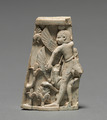
Decorative plaque showing a man fighting a griffin; 900–800 BC; Nimrud ivories; Cleveland Museum of Art (Ohio, US)
-
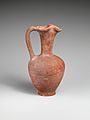
Oinochoe (a type of jug); 800–700 BC; terracotta; height: 24.1 cm; Metropolitan Museum of Art (New York City, US)
-
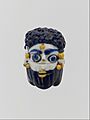
Face bead; mid-4th–3rd century BC; glass; height: 2.7 cm; Metropolitan Museum of Art
-
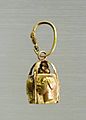
Earring from a pair, each with four relief faces; late fourth–3rd century BC; gold; overall: 3.5 x 0.6 cm; Metropolitan Museum of Art


Women in Phoenicia

Women in Phoenicia took part in public events and religious ceremonies. Pictures show them at banquets, dancing, and playing music. Women were generally expected to dress and behave more modestly than men.
While women rarely held political power, they were involved in community affairs. At least one woman, Unmiashtart, is recorded as ruling Sidon in the 400s BC. Two famous Phoenician women are Jezebel, a princess from Sidon mentioned in the Bible, and Dido, the legendary founder and first queen of Carthage.
Phoenician Religion

The religious practices of the Phoenicians were similar to those of their neighbors in Canaan. These beliefs were common throughout the ancient Semitic world. Religious ceremonies were mainly for the city-state. Paying taxes was even seen as a type of religious offering.
The supreme god in Canaan was called El, meaning 'god'. His son was Baal, meaning 'master' or 'lord'. Baal was a powerful thunder god. Other gods were known by royal titles, like Melqart, meaning 'king of the city', or Adonis for 'lord'. These might have been local names for the same gods.
The Phoenicians worshipped many gods. Which god was most important often depended on the specific city-state. Melqart was important throughout Phoenicia and its colonies. Astarte, a goddess of fertility, was also widely worshipped.
Religious groups in Tyre called marzeh helped build community and loyalty. These groups held banquets on festival days. Many became elite clubs. They shared ritual meals to honor their ancestors. The Phoenicians made offerings to their gods, like figurines and pottery. These have been found in special storage places in temples. Offerings were also cast into the sea to ensure safe travels.
The Phoenicians were known for building impressive temples. Some features of the First Temple in Jerusalem, like its design and decorations, were likely inspired by Phoenician architecture.
-
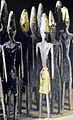
Votive deposit from the Temple of the Obelisks, a Bronze Age temple in the World Heritage Site of Byblos
-
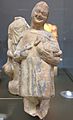
Fourth century BC votive figurine from the Phoenician sanctuary of Kharayeb
-
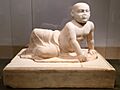
The Baalshillem Temple Boy, a 5th century BC royal votive gift from the Temple of Eshmun
-
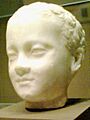
A head of a child, fifth century BC, from the Temple of Eshmun


See also
 In Spanish: Fenicia para niños
- Maronites
- Names of the Levant
- Phoenicianism
- Punic people
- Theory of Phoenician discovery of the Americas
