
Tasmanian devil facts for kids
Quick facts for kids Tasmanian devil |
|
|---|---|
 |
|
| Tasmanian devil | |
| Conservation status | |
| Scientific classification | |
| Kingdom: | |
| Class: | |
| Infraclass: | |
| Order: | |
| Family: | |
| Genus: |
Sarcophilus
|
| Binomial name | |
| Sarcophilus harrisii |
|

The Tasmanian devil (Sarcophilus harrisii) is a meat-eating mammal. In Australia, people sometimes call it the Tassie devil. It is also a marsupial, which means it has a small pouch to carry its babies. It is the largest meat-eating marsupial in the world.
Tasmanian devils are nocturnal. This means they sleep during the day and are awake at night. Today, they only live in Tasmania, an island state of Australia.
A devil is about the size of a small dog. It has a wide head and a short tail. Male devils can weigh up to 12 kg and be 30 cm tall. They have black fur and make a very loud, scary screeching noise. Devils hunt other animals and also eat dead animals. They have strong teeth and jaws. They can eat all of their prey, even bones and fur.
Tasmanian devils disappeared from the Australian mainland about 400 years before Europeans arrived in 1788. People used to hunt them in Tasmania. In the 1930s, a company even paid money for each devil killed. But in 1941, they became officially protected by law.
Contents
About the Tasmanian Devil

The Tasmanian devil is the biggest meat-eating marsupial still alive today. It has a strong, thick body with a large head. Its tail is about half as long as its body.
Unlike most marsupials, its front legs are a bit longer than its back legs. Devils can run up to 13 km/h for short times. Their fur is usually black. Many devils have white patches on their chest and bottom. These markings might help them blend in at dawn and dusk. About 16% of wild devils do not have these white patches.
Male devils are usually bigger than females.

Devils have five long toes on their front feet. Four point forward, and one comes out from the side. This helps them hold food. Their back feet have four toes. Devils have claws that they cannot pull back.
Devils are fully grown when they are two years old. Most devils in the wild live for less than five years. One devil named Coolah lived for more than seven years in a zoo.
Female devils have a pouch that opens backwards. They have this pouch their whole lives.

The Tasmanian devil has the strongest bite for its size of any living meat-eating mammal. It can bite with a force of 553 N. Its jaw can open very wide, up to 75–80 degrees. This allows the devil to tear meat and crush bones. It can even bite through thick metal wire.
Devils have long claws that help them dig burrows and find food underground. Their strong teeth and claws let them attack wombats that weigh up to 30 kg.
Devils have long whiskers on their face and on top of their head. These whiskers help them find prey when it is dark. They also help devils know when other devils are close during feeding time.
Hearing is their best sense. They also have a great sense of smell. They can smell things from up to 1 km away.
Habitat


Tasmanian devils are native to Tasmania, a large island off the southeastern coast of mainland Australia. While they used to live across mainland Australia thousands of years ago, they became extinct there about 3,500 years ago. Today, their home is exclusively Tasmania.
You can find Tasmanian devils in almost all types of environments on the island, from the edges of bustling towns to quiet, wild places. They especially love dry sclerophyll forests (forests with tough, leathery-leaved trees) and coastal woodlands. They also live in mixed forests and coastal heaths. They're not usually found in the highest mountains or the very wet, grassy plains, but they are very adaptable!
Devils are often found near roads, not because they like cars, but because roads can be a source of food – unfortunately, other animals often get hit by vehicles, and devils come to scavenge these "roadkill" meals. This can be dangerous for the devils themselves, as they can also become victims of road accidents.
Diet
Tasmanian devils are carnivores, which means they eat meat. They are also opportunistic feeders, which is a fancy way of saying they'll eat whatever food they can find, whether it's something they've hunted themselves or an animal that's already dead.
Their diet is very varied and depends on what's available. Here's a look at what's on a devil's menu:
- Scavenging: Devils are famous for being excellent scavengers. They love to eat carrion, which is the meat of dead animals. This is super helpful for the environment because they act like nature's clean-up crew, preventing the spread of diseases by quickly getting rid of carcasses. They can eat almost every part of an animal, including bones and fur, thanks to their incredibly strong jaws and teeth!
- Hunting: While they often scavenge, Tasmanian devils also hunt live prey. They can catch animals up to the size of a small kangaroo! However, they usually go for smaller, easier targets. Their favorite meals often include:
- Wombats: These are a favorite because they are relatively easy to catch and have a good amount of fat.
- Wallabies, bettongs, and potoroos: These are all native marsupials found in Tasmania.
- Birds
- Insects: Especially for younger devils.
They might even eat domestic animals like sheep or rabbits if they are sick or injured and easy to catch.
How Do They Live and Find Food?
Tasmanian devils are mostly nocturnal (active at night) and crepuscular (active at dawn and dusk). During the day, they usually hide away in dense bushes, hollow logs, or burrows to rest and stay safe.
They have an amazing sense of smell, which can detect food from up to a kilometer away, and excellent hearing, which helps them find prey and other devils in the dark. Their vision is strongest in black and white, making it easier to spot moving objects at night.
While devils are generally solitary animals, they often come together to share a large meal. These communal eating events can be very noisy, with lots of growls, screeches, and clicks as they establish who gets to eat first. This loud behavior might actually be a way to tell other devils that there's food available, so it doesn't go to waste.
Devils are surprisingly agile. Young devils are also good at climbing trees, which helps them escape from older devils (who might eat them if they're very hungry!) and find food like grubs and eggs. They can even swim across rivers!
They don't form permanent packs but have a "home range" where they live and search for food. They use several dens within their home range, often choosing old wombat burrows because they are safe and secure, especially for mothers with young.
Reproduction and Life Cycle

Female devils start to have babies when they are two years old. Male devils fight over females during the breeding season.
Pregnancy lasts for 21 days. Female devils give birth standing up. They have 20 to 30 tiny babies. Each baby weighs about 0.18 to 0.24 g.
Tasmanian devil babies are called "pups," "joeys," or "imps." Once inside the mother's pouch, they attach to a nipple for about 100 days.

Inside the pouch, the babies grow quickly. Their eyes open when they are about 87 to 93 days old. They can let go of the nipple at 100 days.
They leave the pouch about 105 days after birth. At this point, they look like small versions of their parents and weigh around 200 g. After leaving the pouch, the young devils stay in the den for about three more months. They start to go outside the den between October and December. They become independent in January.
Devil Genetics
.png)
Tasmanian devils have low genetic diversity. This means there is not much variety in their genes. This happened because a small number of devils came to Tasmania from Australia a long time ago. So, their genes were less varied than the original group.
Diseases, like the one they face now, might have happened before. These events can reduce the devil population to a very small number. This is called a 'population bottleneck'. A small population with less genetic variety is always at risk of extinction. This is because none of the animals might be able to fight off an infection.
Scientists studied the devil's genes in 2010. There is hope for their survival. Since 2005, three female devils have been found that are partly resistant to the disease.
In Popular Culture

The devil is a famous animal in Australia. It is especially linked to Tasmania. The animal is the symbol of the Tasmania Parks and Wildlife Service. A former Tasmanian football team was called the Devils. The Hobart Devils were once a basketball team. The devil has also been on many special coins in Australia. A ginger beer in Tasmania has a Tasmanian devil on its label. In 2015, the Tasmanian devil became Tasmania's state emblem.
Tasmanian devils are popular with tourists.
With its unique personality, the Tasmanian devil has been in many documentaries. It has also been in fiction and non-fiction books for children.

The Tasmanian devil is probably best known around the world because of the Looney Tunes cartoon character. This character is called the Tasmanian Devil, or "Taz." He first appeared in 1954. Taz is a loud, super active cartoon character. But he is not much like the real animal.
After a few short cartoons between 1957 and 1964, the character was not used for a while. Then in the 1990s, he got his own show, Taz-Mania, and became popular again. In 1997, a newspaper said that Warner Bros. had "trademarked the character and registered the name Tasmanian Devil." This trademark was protected. For example, there was an eight-year legal case about a Tasmanian company wanting to call a fishing lure "Tasmanian Devil."
Fun Facts About the Tasmanian Devil
- After the thylacine (another amazing marsupial) became extinct in 1936, the Tasmanian devil became the largest carnivorous marsupial in the world!
- Devils can eat about 15% of their body weight every day! If there's a lot of food, they can eat up to 40% of their body weight in just 30 minutes. After a big meal, they might become very full and slow, waddling away to rest.
- They have 42 teeth, just like dogs, but their teeth grow continuously throughout their lives.
- These incredible animals are known for their incredibly strong bite, which is one of the most powerful for any land mammal of its size. This super bite helps them crush bones and tear meat, making them excellent at cleaning up carcasses.
- Devils can eat all parts of a smaller animal's body, including bones and fur.
- Despite their stocky build, they can run quite fast for short distances (up to 25 km/h or 16 mph).
- Devils store body fat in their tails. Healthy devils have fat tails.
- They also have a scent gland at the base of their tail. They use this gland to mark the ground with a strong smell.
Images for kids
-
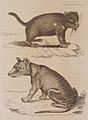
An 1808 drawing featuring the Tasmanian devil and a thylacine by George Harris
-
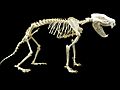
Tasmanian devil skeleton on display at the Museum of Osteology, Oklahoma City, Oklahoma
-
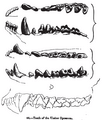
Drawings of a Tasmanian devil's teeth
-
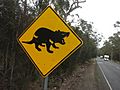
A road sign telling drivers that there may be devils nearby
-

The Devil Cat catamaran
-
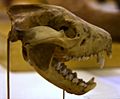
Tasmanian devil skull in The Museum of Zoology, St. Petersburg, Russia
-
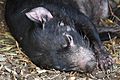
Tasmanian Devil
-
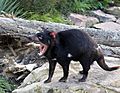
Tasmanian devil yawning
-
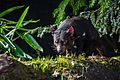
Tasmanian Devil in its natural home


Tasmanian_Devil.jpg)

.jpg)
See also
 In Spanish: Demonio de Tasmania para niños
