
Skirmish at Top Malo House facts for kids
Quick facts for kids Skirmish at Top Malo House |
|||||||
|---|---|---|---|---|---|---|---|
| Part of the Falklands War | |||||||
|
|||||||
| Belligerents | |||||||
 United Kingdom United Kingdom |
 Argentina Argentina |
||||||
| Commanders and leaders | |||||||
 Captain Rod Boswell Captain Rod Boswell |
 Captain Jose Vercesi Captain Jose Vercesi |
||||||
| Strength | |||||||
| 19 | 13 | ||||||
| Casualties and losses | |||||||
| 3 wounded |
|
||||||
The Skirmish at Top Malo House was a small but important battle during the Falklands War. It happened on May 31, 1982. This fight was between special soldiers from Argentina and Royal Marines from Britain.
The battle took place at a building called Top Malo House. It was unusual because it was the only planned fight during the day in the war. Most battles were planned for night-time. The Argentine soldiers were trying to set up hidden look-out spots. A British look-out team spotted them at Top Malo House. This battle was one of several problems for the Argentine side during the war.
Contents
Why the Fight Happened
The Falklands War was a conflict between Britain and Argentina. They both claimed ownership of the Falkland Islands. Argentina calls them Islas Malvinas.
Tensions grew when Argentine scrap metal workers and marines raised the Argentine flag on South Georgia Island in March 1982. On April 2, Argentine forces took control of the Falkland Islands. Britain then sent a large group of ships and soldiers to take the islands back. British forces landed near Port San Carlos on May 21.
The Falkland Islands Landscape
.jpg)
The Falkland Islands have wide open grasslands and heather. There are no native trees. The wind blows all the time, and the weather can change very quickly. A unique part of the land is called stone runs. These are areas covered with broken rocks.
Outside the main town of Stanley, there were small farms where people raised sheep. Fences were common. There were dirt tracks around the farms, but no proper roads between them. Moving across the country by vehicle meant avoiding stone runs and soft, wet areas called peat bogs. Small planes connected the settlements, and each had a landing strip. Heavy items were moved by boat along the coast.
Getting Ready for Battle
Argentine Plans
The Argentine Army did not have permanent special forces. Instead, they created them from soldiers with special training when needed. The Argentine 602 Commando Company was formed on May 21, 1982. It had 54 trained soldiers. They flew to the Falklands on May 27.
Two days later, a group of 13 soldiers from 602 Commando Company left Stanley. Their mission was to set up a look-out post on Bluff Cove Peak. This was part of a bigger plan by the Argentine commander, Mario Benjamín Menéndez. He wanted to create a line of look-out posts with special forces. These posts would watch British movements and try to capture British soldiers.
A group of 13 soldiers, led by Captain José Arnobio Vercesi, was assigned to Mount Simon. They took off from Stanley in two helicopters on May 29. Soon after, the weather got bad. A helicopter carrying another group crashed, killing many on board. Because of this, other special forces flights were delayed until the next day.
Vercesi and four of his men landed near Mount Simon. The other eight men from the second helicopter did not meet them at first. But Vercesi decided to continue the mission. His group set up a look-out post near the top of Mount Simon. They saw British aircraft activity there. Later, the missing eight men joined them. They stayed on Mount Simon overnight, and it snowed a lot.
In the morning, the radio operator, Sbert, tried to send a message. He wanted to report that British planes were flying from San Carlos to Mount Kent. His radio could hear messages but could not send them. He managed to send one short message before the radio stopped working completely.
Since they could not report back, Vercesi decided to go to Fitzroy. An engineer group there had a working radio. Moving was slow because of the peat and stone runs. It was raining and snowing, and they had to cross the Malo River. This river was fast-flowing and icy, reaching their waists.
Two soldiers, Brun and Helguero, had experience in cold places. They told Vercesi to find shelter. So, he led his group to Top Malo House. It was a building made of corrugated iron with a wooden frame. They approached the building carefully. No British soldiers were there, so they went inside for shelter.
British Preparations
The Mountain and Arctic Warfare Cadre was a special unit of the Royal Marines. They trained marines in climbing and attacking cliffs. When the Falklands War started, this unit formed a 36-man patrol group. It was led by Rod Boswell. This group included training staff and recently trained students.
The Mountain and Arctic Warfare Cadre left the UK on April 5. They arrived in the Falkland Islands on May 21.
On May 28, four groups from the Mountain and Arctic Warfare Cadre were sent near Top Malo House. Their job was to watch over the British forces moving out from San Carlos. They had landed behind another British unit, the 3rd Battalion, Parachute Regiment (3 Para). They then joined 3 Para on their march towards Teal Inlet.
About 2 kilometers (1.2 miles) south of Teal Inlet, they left 3 Para. They headed south and set up four look-out posts. Lieutenant Fraser Haddow's group set up their post on Evelyn Hill. On May 30, they saw the Argentine patrol moving towards Top Malo House.
At first, Haddow thought the Argentines had seen his group and were coming to attack. When they didn't, he realized this wasn't the case. He radioed his headquarters and asked for an air strike on Top Malo House.
When Boswell received this message, he went to the main British headquarters. An air strike could not happen right away. A British Harrier jet had been lost that day. Harriers usually flew in pairs, so another plane had to be prepared. It would not be ready until morning.
Also, artillery (large guns) could not be used. Top Malo House was 48 kilometers (30 miles) from the guns at San Carlos. This was too far. The guns were not scheduled to move closer until the next day. Even then, they would still be very far away.
Boswell then suggested a surprise attack on Top Malo House at dawn. The British commander, Brigadier Julian Thompson, approved this plan.
Boswell decided to take his headquarters and four of his groups (19 men in total). He left only one soldier behind in San Carlos. His plan was to take off from San Carlos at 6:00 AM on May 31. They aimed to land in the dark at 6:30 AM. Sunrise was around 7:00 AM.
They studied aerial photos and built a model of Top Malo House. A stream junction about 2 kilometers (1.2 miles) southwest of the house was chosen as the landing spot. Boswell held a meeting at 8:00 PM on May 30. He explained the mission to his soldiers, allowing them to get a good night's sleep.
The Battle Begins
The British soldiers arrived at the helicopter departure spot around 4:30 AM. After watching several helicopters land and take off without them, Boswell spoke to a pilot. This pilot was Lieutenant Commander Simon Thornewill. Boswell explained his mission. Thornewill assigned one of his helicopters to take them.
The next helicopter, a Westland Sea King, landed. Boswell quickly briefed the pilot, Lieutenant John Miller. The British soldiers loaded themselves and their gear onto the helicopter. Boswell was the last to board. He climbed on top of a pile of backpacks, with his feet against the open door. The helicopter was overloaded. It took off and flew for about 20 minutes at a low height. It dropped the soldiers at the chosen stream junction.
The soldiers left their heavy backpacks at the landing site. Boswell split his group into two parts. One was a seven-man "fire group" led by Lieutenant Callum Murray. The other was an "assault group" led by Boswell himself.
The soldiers followed the stream for about 1.5 kilometers (1 mile). Then they crossed a small hill and followed another stream for 600 meters (0.4 miles). They reached a fence line. The two groups then split up. The fire group went along the fence to find a good firing spot. The assault group followed the stream, going around a small hill to approach Top Malo House unseen. A peat cutting provided a hidden starting point for their attack.
It was now daylight. The soldiers were wearing dark camouflage uniforms. These stood out against the snow. This meant they could easily be seen by any lookouts. The British did not know that the Argentines had heard the helicopter.
Boswell ordered his men to fix their bayonets (knives attached to rifles). He started the attack by firing a green flare. This was the signal for the fire group to launch four rockets at Top Malo House.
Around the same time, Losito, the second-in-command of the Argentine patrol, said that Espinosa, who was on guard, shouted an alarm. Espinosa then fired at the attacking British soldiers. Groves, the British sniper, saw Espinosa. Groves was aiming his weapon at the top floor window where Espinosa was. Groves fired at Espinosa, who then disappeared.
The first four rockets missed the house. But a second group of three rockets all hit the building. Top Malo House burst into flames.
Boswell and his group charged forward about 50 meters (164 feet) towards the house. They stopped, fired two more rockets, and then charged again. The Argentinians ran from the burning house. They took cover in a stream bed about 200 meters (656 feet) away. They kept firing as they ran. Espinosa on the top floor was killed by a rocket. Sbert was shot dead while giving cover fire for the other Argentines leaving the house. As the British assault group moved forward, smoke from the burning building hid them from the Argentine soldiers' fire.
The gunfight lasted for about 45 minutes. The Argentine soldiers were running low on ammunition. Seven of their group were wounded. Captain Vercesi decided to surrender.
After the Battle
The attack on Top Malo House was the only planned daylight battle of the Falklands War. Two Argentine soldiers (Espinosa and Sbert) were killed. Seven were wounded, and five were taken as prisoners. Three British soldiers were also wounded.
After the battle, Boswell told Vercesi, "Never in a house." This meant it was dangerous to stay in a building during a fight.
Top Malo House was completely destroyed. A small building nearby only had dead sheep inside. An outhouse (small outdoor toilet) about 40 meters (131 feet) from the main house was checked by a British soldier, McGregor. He fired his weapon into it to make sure no one was hiding.
Soon after, a four-man British patrol waving a British flag was seen. This was another British group that had watched the fight and decided to join. Boswell radioed San Carlos to ask for helicopters to pick up the wounded and his soldiers. He got no answer. So, he contacted another soldier, Wright, who went to headquarters with the request.
The three British and seven Argentine wounded soldiers were flown to a hospital at Ajax Bay. Three unwounded British soldiers went with them. The prisoners and the other British soldiers were flown to Teal Inlet. The prisoners were then handed over for questioning.
Espinosa and Sbert were given Argentina's highest award for bravery after they died. Six other Argentine soldiers also received awards for their courage. On the British side, Chris Stone was mentioned for his bravery, and Tim Holleran received a special commendation.
According to Boswell, two other Argentine special forces groups saw the attack. He believed they surrendered the next day. This would have meant the 602 Commando Company almost stopped existing. However, the Argentines say that no special forces surrendered. They claim that two other groups from 602 Commando Company continued to fight British patrols for another week and a half.
The Argentines also say that 602 Commando Company kept British forces busy. This allowed another Argentine group to blow up part of a bridge near Bluff Cove and Fitzroy on June 2 without being bothered.
The fight at Top Malo House was one of several problems for Argentina's plan to create a special forces screen. Out of 170 soldiers who were supposed to take part, only 50 were sent. Of these, 32 became casualties (killed or wounded). The remaining special forces were used to protect areas around Stanley. They did not take much part in the later battles. Because this special forces screen failed, the British advance was not watched by the Argentines.
Images for kids
-
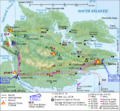
Land operations during the Falklands War

