
Sloop-of-war facts for kids
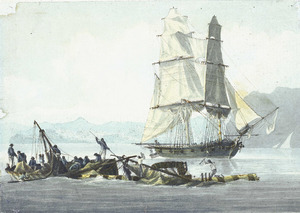
A sloop-of-war was a special kind of warship used by the Royal Navy in the 18th and 19th centuries. These ships had one deck for their guns and usually carried up to 18 cannons. They were smaller than larger warships like frigates.
The Royal Navy had a system for classifying ships based on their number of guns. Sloops-of-war were considered "unrated" because they had fewer than 20 guns. This group included different types of smaller warships, like gun-brigs and cutters.
Later, during World War I and World War II, the Royal Navy used the term "sloop" again. This time, it referred to ships built for specific tasks like protecting convoys. These modern sloops, such as the Flower class and Black Swan class classes, were good at defending against submarines and aircraft. They performed similar duties to destroyer escorts in the United States Navy and smaller corvettes.
Contents
How Sloops Sailed: Rigging Styles

A naval sloop-of-war was quite different from a regular civilian sloop. Civilian sloops usually had only one mast. Naval sloops, however, often had two or three masts, which made them more powerful and versatile.
In the early 18th century, most naval sloops had two masts. They might have a ketch rig (two masts, but no front mast) or a snow rig (a front mast and a main mast with a small extra mast behind it).
Ship-sloop: Three Masts for Speed
The first sloops with three masts, known as "ship-rigged" sloops, appeared in the 1740s. By the mid-1750s, most new sloops were built with this three-masted design. Having a third mast gave these sloops better speed and allowed them to maneuver more easily.
Brig-sloop: Two Masts and Powerful Guns
In the 1770s, a new type of two-masted sloop appeared, called the brig sloop. These ships had two masts, both with square sails. Ship sloops continued to have three masts.
During the time of the Napoleonic Wars, Britain built many brig-sloops. Famous examples include the Cruizer class (with 18 guns) and the Cherokee class (with 10 guns). The brig rig needed fewer sailors, which was helpful because Britain often had a shortage of trained seamen during wartime.
These brig-sloops were often armed with carronades. Carronades were powerful, short-range cannons that needed fewer crew members to operate than traditional long guns. This made brig-sloops very effective in close combat. They were sometimes used instead of larger frigates for shorter missions. However, they couldn't carry as much water or food, so they weren't ideal for very long voyages. Their shallower design made them excellent for attacking ships near the coast.
Bermuda Sloop: Fast and Versatile Ships

The Royal Navy also used Bermuda sloops a lot. These ships were fast and were used to chase down French privateers, slave ships, and smugglers. They also served as dispatch boats, carrying important messages, people, and supplies. Bermuda sloops were also great for reconnaissance, which means scouting ahead for the fleet.
Bermuda sloops could have one, two, or three masts. Single-masted versions had huge sails and were very fast, but they needed many experienced sailors. The Royal Navy preferred multi-masted versions because they required fewer sailors and could carry more guns on their longer decks.
How Ships Were Grouped: Classification
Originally, a sloop-of-war was smaller than a sailing frigate. It was not part of the official Rating system of the Royal Navy because it had too few guns. Generally, a sloop-of-war was commanded by a "master and commander" rather than a "post captain." However, at sea, the commanding officer of any naval ship was usually called "captain."
A ship sloop was similar to the smaller corvettes used by the French Navy. The term "corvette" was later used for British ships, but not until the 1830s. The United States Navy also used "sloop-of-war" for certain ship-rigged warships, sometimes with as many as 26 guns.
The Story of Sloops: History
.jpg)
In the Royal Navy, the sloop developed into an "unrated" vessel with one gun deck and three masts. Two masts had square sails, and the back-most mast had fore-and-aft sails.
Sloops in the War of 1812
During the War of 1812, sloops-of-war in the United States Navy performed very well against their British counterparts. American ships often had an advantage because they were "ship-rigged" (three masts) instead of "brig-rigged" (two masts), which made them more maneuverable. They were also generally larger and had more powerful weapons. British Cruizer-class brig-sloops, in particular, struggled in one-on-one battles with American sloops-of-war.
The End of Sailing Sloops
In the second half of the 19th century, naval guns became much larger and more powerful. Also, steam-powered sloops began to appear. By the 1880s, even the most powerful warships had fewer than a dozen large guns. This meant that the old rating system, which depended on the number of guns, no longer made sense. The classifications of sloops, corvettes, and frigates were eventually removed. Instead, ships were classified by their purpose, such as cruiser or battleship.
Sloops Return for World Wars
During the First World War, the British Royal Navy brought back the term "sloop" for smaller warships. These ships were not meant for large fleet battles. Examples include the Flower classes of "convoy sloops," designed to protect merchant ships, and the Hunt class "minesweeping sloops," used to clear underwater mines.
The Royal Navy continued to build sloops between the World Wars. These were small warships used for showing naval presence in colonies, surveying oceans, and acting as convoy escorts during wartime. They were not designed for high speed, usually traveling less than 20 knots. Classes like the Grimsby and Kingfisher were built during this time. Fleet minesweepers, such as the Algerine class, were also called "minesweeping sloops." The Royal Navy officially stopped using the term "sloop" in 1937, but people still used it commonly.

Sloops in World War II
During World War II, 37 ships of the Black Swan class class were built for convoy escort duties. However, these sloops were built to high warship standards, which made them difficult to mass-produce quickly in commercial shipyards. Because of this, the corvette and later the frigate became the main escort ships for the Royal Navy. These new ships, like the Flower and River classes, were built using simpler commercial standards and could be produced in large numbers for the Battle of the Atlantic. In 1948, the Royal Navy reclassified its remaining sloops and corvettes as frigates.
Modern Ideas: Uncrewed Sloops
In the 2010s, the Royal Navy thought about a new idea called the "Future Black Swan-class Sloop-of-war." This was an alternative to a larger ship program, but it did not move forward.
More recently, the British Government's 2026 Defence Investment Plan suggested creating a series of autonomous (uncrewed) vessels for the Royal Navy. One idea was the Type 92 "Uncrewed sense platform." This uncrewed vessel was imagined as a sloop that could "hunt enemy submarines across the North Atlantic, supporting our new frigates." The exact number of these vessels and when they would be introduced were not announced at that time.
Famous Sloop-of-War Ships
- Perhaps the most famous sloop was HMS Resolution. In this ship, Captain James Cook made his second and third voyages across the Pacific Ocean to explore. It was originally a merchant ship that the Royal Navy bought and changed for exploration.
- USS Independence was a sloop of the Continental Navy during the American Revolutionary War. It was the first ship bought by the Continental Congress and sailed on important missions to France.
- In 1780, HMS Vulture carried Major John Andre to a secret meeting with General Benedict Arnold to discuss plans for Arnold to surrender West Point to the British.
- HMS Beagle, a Cherokee-class brig-sloop, became famous because Charles Darwin sailed around the world on it between 1831 and 1836, studying nature.

- In 1805, HMS Pickle (a Bermuda sloop) brought the important news of the British victory at the Battle of Trafalgar.
- Between 1800 and 1801, Lord Cochrane commanded HMS Speedy, a brig-sloop, through many famous adventures in the Mediterranean Sea.
- USS Wasp was a U.S. Navy sloop that performed very well during the War of 1812. It sank or captured several British warships and merchant vessels before being lost in a storm.
- USS Kearsarge was an 1861 steam sloop-of-war. It is best known for defeating the Confederate ship CSS Alabama in a famous battle off the coast of Cherbourg, France in June 1864.
- HMS Egret, a 1938 sloop, was the first ship ever to be sunk by a guided missile. This happened on August 27, 1943, when it was hit by a Henschel Hs 293 glide bomb.

- On March 4, 1942, HMAS Yarra was sunk while bravely defending three ships from three Japanese cruisers and four destroyers. The actions of its crew are considered very heroic in the history of the Royal Australian Navy.
- HMS Starling, commanded by Captain Frederic John Walker, helped sink 14 U-boats between 1943 and 1944 as part of the 2nd Escort Group.
- In 1949, HMS Amethyst, a Black Swan-class sloop, became famous during the "Yangtse Incident" when it was trapped in the Yangtze River by Chinese shore batteries. The ship made a daring escape on July 30, 1949.
See also
- List of corvette and sloop classes of the Royal Navy
- List of sloops of war of the United States Navy
- Cruizer-class brig-sloop
- Rating system of the Royal Navy
- List of frigates of the Second World War
