
Humboldt penguin facts for kids
Quick facts for kids Humboldt penguin |
|
|---|---|
.jpg) |
|
| At Copenhagen Zoo, Denmark | |
| Conservation status | |
| Scientific classification | |
| Genus: |
Spheniscus
|
| Species: |
humboldti
|
 |
|
| Distribution of the Humboldt penguin. 80% of the world's population lives in the protected areas of the Northern Chilean regions Atacama and Coquimbo. | |


The Humboldt penguin (scientific name: Spheniscus humboldti) is a medium-sized bird that lives in the ocean. You can find it along the Pacific coast of Peru and Chile in South America. It's related to other penguins like the African penguin, Magellanic penguin, and Galápagos penguin. Both this penguin and the cool ocean current it swims in are named after a famous explorer, Alexander von Humboldt.
Sadly, the Humboldt penguin is considered a vulnerable animal. This means its population is shrinking, with about 23,800 adult penguins left in the wild. They also travel to different places during the year.
These penguins make their homes on islands and rocky shores. They dig burrows in guano (which is bird droppings) or sometimes use natural caves and rocky spots. They live only along the Pacific coast of South America. Sometimes, their homes overlap with Magellanic penguins in central Chile. Occasionally, they are seen in Ecuador and Colombia. They have even been seen living alongside Magellanic penguins in some places in southern Chile. Many people enjoy seeing Humboldt penguins in their natural homes through ecotourism.
Contents
What Do Humboldt Penguins Look Like?
Humboldt penguins are medium-sized. They grow to be about 56 to 70 centimeters (22 to 28 inches) tall. They usually weigh between 2.9 to 6 kilograms (6.4 to 13.2 pounds).
It's hard to tell males and females apart just by looking at their feathers. However, males are generally a bit heavier and larger than females. Scientists can tell them apart by measuring their head width and bill length.
Among their close penguin relatives, Humboldt penguins are the heaviest. Females weigh about 4.05 kg (8.9 lb) on average, and males average 4.7 kg (10.4 lb). They have a black head with a white stripe. This stripe goes from behind their eye, around their chin, and meets at their throat. Their backs are blackish-grey, and their bellies are white. A black band crosses their chest and goes down their sides. The base of their bill is a pinkish color. Young penguins have dark heads and no chest band. They even have small spines on their tongue to help them hold onto slippery fish!
Penguin Talk: How They Communicate
Humboldt penguins use many different sounds to talk to each other. These calls are similar to those used by their penguin relatives.
- Yell: If another penguin gets too close, they might give a loud 'Yell'. This is a warning. If the warning is ignored, they might peck or chase the intruder. When many penguins live close together, they tend to 'Yell' more often.
- Throb: This is a soft sound. Mates use it when they are at the nest, especially when one returns to the other.
- Haw: Young penguins in the water make a short 'Haw' sound. Mated pairs also use it when one is in the water and the other is on land. Each penguin's 'Haw' can sound a bit different.
- Bray: This is a long, loud call. Penguins use it to find a mate or to show other penguins where their home is. Each penguin's 'Bray' is unique, like a fingerprint! When they 'Bray', they point their head up and slowly flap their flippers.
- Courtship Bray: This is like the regular 'Bray'. But during courtship, both partners stand together. They point their heads and necks up, with flippers out to the side, and call at the same time.
- Peep: Baby penguins make a 'Peep' sound when they are hungry and want food.
Changing Feathers: Moulting
Most Humboldt penguins change their feathers, a process called moulting, between mid-January and mid-February. The exact timing can change based on where they live and how much food is available.
During moulting, penguins cannot go into the water. They must stay on land until their new feathers grow in. Before moulting, they eat a lot to build up energy. Their old feathers fall out and new ones grow back in about two weeks.
Where Does the Name Come From?
Both the Humboldt penguin and the cool ocean current it swims in are named after Alexander von Humboldt. He was a famous explorer.
In Peru, people sometimes call them pajaro-niño. This means 'baby-bird'. It's because of how they waddle and hold out their wings, like a toddler learning to walk.
Where Do Humboldt Penguins Live?
The Humboldt penguin is a special animal found only on the west coast of South America. It's a top hunter in its home.
They breed from southern Chile, through the dry Atacama Desert region, all the way to Isla Foca in northern Peru. They stick to coasts and islands where the cool Humboldt Current flows. This current brings lots of food, helping many seabirds thrive. One of their most important breeding spots in Chile is Isla Chañaral.
In July 2002, a Humboldt penguin was found far from home. It was caught in a fishing net near Prince of Wales Island in Alaska. Fishermen safely released it back into the water. This was the first time a penguin was seen in the wild in North America. No one knows if it was a wild penguin or one that escaped from a zoo or a home.
Humboldt Penguin Life and Habits

What Do Humboldt Penguins Eat?
Humboldt penguins mainly eat fish that swim in large groups in the open ocean. Sometimes they also eat cephalopods like squid or small crustaceans like shrimp.
Penguins in the north mostly eat Atlantic saury and garfish. Those in the south prefer anchovy, herring, silver-side, pilchard, and squid. Their diet changes with the seasons, depending on which fish are available.
How They Hunt for Food
Humboldt penguins hunt by sight. They leave their nests after the sun rises to find food. Different groups of penguins might travel different distances from their homes. They hunt more when there is good light. They spend more time hunting during trips that last overnight. They usually catch fish from below with quick, shallow dives.
From places like Pan de Azúcar National Park, they can hunt anywhere from 2 to 92 kilometers (1.2 to 57 miles) away. Most of their hunting happens within 35 km (22 mi) of the island. They can dive as deep as 54 meters (177 feet) to find food.
Penguins that don't have chicks might take longer trips to find food. They also dive deeper and for longer periods than penguins raising young.
Finding a Partner: Courtship
When looking for a partner, Humboldt penguins bow their heads to each other. They also look into each other's eyes, one at a time.
To attract a mate, a penguin might do an 'ecstatic display'. It stretches its head up, puffs out its chest, flaps its wings, and makes a loud call. This call sounds a bit like a donkey's bray! Once they are a pair, they stand side-by-side. They repeat these same actions together.
Life Cycle: Raising Young
Humboldt penguins build nests in groups, called colonies. Most pairs lay two eggs, usually four days apart. Both parents take turns keeping the eggs warm for about 41 days.
They time their breeding based on how much food is available. They often breed right after changing their feathers. This is when there's plenty of food and less strong sunlight.
Humboldt penguins lay eggs from March to December. They often have two main egg-laying times: April and August-September. This is because some pairs have a second set of eggs. About half of the females can successfully raise two sets of chicks in a year. If a pair loses their first eggs, they might lay new ones within 1 to 4 months.
Parents take turns sitting on the eggs for about 2.5 days at a time. Then, one parent goes to find food while the other stays with the eggs. Both male and female parents help equally in feeding their chicks.
Chicks usually hatch about two days apart. They are born quite helpless and stay in the nest. One parent guards them while the other hunts for food. Chicks are fed once a day. After they get a bit older, both parents leave the nest to hunt at the same time.
Where Do They Build Nests?
Historically, these penguins dug burrows in layers of guano to make their nests. Today, you can also find their nests in caves, hollows, on cliff tops, beaches, and in grassy areas. Some even nest on Peruvian islands where they can dig into the soil. Most penguins prefer to breed on cliff tops.
Penguin Journeys: Migration
During breeding season, Humboldt penguins usually stay close to their nests. They often return to the same nesting spots each year. However, they can travel long distances if food becomes scarce or if their environment changes. They truly migrate between Peru and Chile.
Challenges for Humboldt Penguins
The Impact of El Niño
The ocean where Humboldt penguins live is greatly affected by a natural event called El Niño. During El Niño, the ocean water gets warmer, and there is less nutrient-rich water rising from below. This means less food for the penguins. Many young penguins can die, and adult penguins might leave their nests or stop breeding. When this happens, penguins often travel south to find food, like anchovies. They have to spend more time and energy hunting when the water is warmer.
Fishing and Penguins
Humboldt penguins need a lot of fish to survive, especially during breeding season. They depend on fish like anchovies that are also caught by people for food. This means that if too many fish are caught, there might not be enough left for the penguins. Penguins can also get tangled in fishing nets, which is very dangerous for them.
People and Their Homes
Humboldt penguins are very shy around people. If someone gets too close to a nesting penguin (even 150 meters or about 490 feet away!), it can make the penguin stressed. This is one of the longest distances reported for any penguin species. It can take them up to half an hour to calm down after people come near. If people visit too often, the penguins might get too stressed and leave their nests. This can lead to fewer baby penguins surviving.
Habitat Changes and Other Animals
Sometimes, other animals that are not native to the islands can cause problems. For example, wild goats on the Puñihuil islands ate the plants that penguins use for nesting. They also caused burrows to collapse. When islands get connected to the mainland, other animals like rabbits, rats, cats, and dogs can move in. Rats can eat penguin eggs. Wild cats and dogs can hunt young and adult penguins.
Building and Industry
Some Humboldt penguin homes are threatened by new buildings and industries. For example, plans for power plants and mines in Chile can disturb their habitat. Peru's largest penguin colony at Punta San Juan faces the possibility of a new industrial port nearby.
Oil spills have also harmed penguin colonies. In 2015–16, a colony of 800 birds in Cachagua was affected by two oil spills. Oil spills from ships and ports have hurt many penguin species around the world.
In 2017, a company called Andes Iron wanted to build a port near the Humboldt Penguin National Reserve in Chile. This plan was first stopped because of worries about the environment. Many people who care about the environment were happy with this decision. However, the company challenged the decision, and the project was later approved. Groups like Oceana continue to work to protect this important area. If built, this project would include a large mine, a processing plant, a water plant, and a port.
History of Population Decline
.jpg)
Guano Harvesting
In the past, Humboldt penguins used to dig their nests in thick layers of guano on islands along the Peruvian and Chilean coasts. Guano, which is bird droppings, was very valuable as a fertilizer. People collected guano, which destroyed many penguin nesting sites. Fishermen and guano workers also sometimes killed penguins for their oil and skin. This harvesting of guano in the 1800s greatly harmed the Humboldt penguin population.
The 1982–83 El Niño
Before the strong 1982–83 El Niño event, there were about 20,000 Humboldt penguins. This El Niño caused a huge drop in their numbers. The warm waters and lack of food, combined with human changes to their habitat, meant many penguins could not have babies or survive. The population dropped by 65%. Many young penguins did not survive that year. By 1984, only about 2,100 to 3,000 adult penguins were left.
Protecting Humboldt Penguins
Humboldt penguins received legal protection in 1977 from the Peruvian Government. They are also listed in Appendix I of the Convention of International Trade of Endangered Species (CITES). Both Peru and Chile have laws to protect them. They are listed as vulnerable because their population changes a lot, they live in specific areas, and the threats they face have not gone away. In August 2010, Humboldt penguins in Chile and Peru were also protected under the U.S. Endangered Species Act. Most penguins now breed in protected areas.
Peruvian law says it's illegal to hunt, capture, or sell these birds. Chile also put a 30-year ban on hunting, transporting, owning, or selling penguins in 1995.
In 2017, a large mining project in Chile was initially stopped because of its possible harm to the penguins. However, that decision was later changed.
As of January 2026, the species is still listed as Vulnerable on the IUCN Red List. Their population of about 23,800 adult penguins is still declining. Climate change, too much fishing of their food sources, and getting caught in fishing nets are all reasons for this decline. Rats, wild cats, and dog attacks also threaten some colonies. In the past, removing guano from their nesting sites greatly reduced the places where they could dig and nest.
Humboldt Penguins in Zoos
.jpg)
Besides their natural homes in South America, Humboldt penguins live in zoos all over the world. You can find them in places like Spain, Germany, India, South Korea, Ireland, Japan, the United Kingdom, and the United States.
Mr. Sea
Mr. Sea was one of the oldest penguins at Woodland Park Zoo and in North America. He lived to be almost 32 years old, which is much older than the average Humboldt penguin lifespan of 17.6 years. He was a father, grandfather, and great-grandfather to many penguins.
Escape from Tokyo Zoo
In 2012, a Humboldt penguin known as "337" escaped from Tokyo Sea Life Park in Japan. It managed to climb a 4-meter (13-foot) wall and get through a fence. The penguin lived in Tokyo Bay for 82 days before zoo keepers safely recaptured it in late May 2012.
Same-sex Penguin Parents
In 2009, at the Bremerhaven Zoo in Germany, two male Humboldt penguins adopted an egg. The egg had been left by its biological parents. After the egg hatched, the two male penguins raised, protected, and fed the chick just like other penguin parents. Another example happened in 2014 at Wingham Wildlife Park. Two male Humboldt penguins, Jumbs and Kermit, successfully hatched and raised an egg given to them after its mother abandoned it.
Images for kids
-
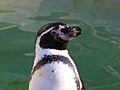
Upper body
-
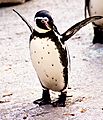
Humboldt penguin at Newquay Zoo
-
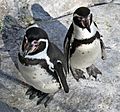
St Louis Zoo
-
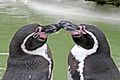
A pair "kissing" at Cotswold Wildlife Park
-
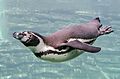
Swimming underwater
-
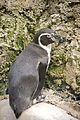
Back
-
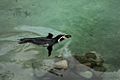
At the Dublin Zoo
-
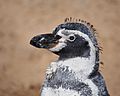
Humboldt penguin during moult at the Cornish Seal Sanctuary
-

At the Oregon Zoo
-

Humboldt penguins at Jijamata Udyaan, Mumbai, India
-

Humboldt penguins at Twycross Zoo
-
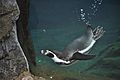
At the Woodland Park Zoo
-

In captivity at Brookfield Zoo
-
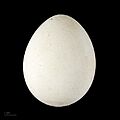
Spheniscus humboldti - MHNT
-
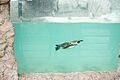
Swimming at the Parque de las Leyendas
-upper_body.jpg)

.jpg)


See also
 In Spanish: Pingüino de Humboldt para niños
