
Works of Jagadguru Rambhadracharya facts for kids
 Book covers of several works of Rambhadracharya |
||
| Releases | ||
|---|---|---|
| ↙Poems | 28 | |
| ↙Plays | 2 | |
| ↙Music | 5 | |
| ↙Commentaries | 19 | |
| ↙Critiques | 6 | |
| ↙Discourses | 9 | |
| References and footnotes | ||
 |
This article contains Indic text. Without the correct software, you may see question marks or boxes, misplaced vowels or missing conjuncts instead of Indic text. |
Jagadguru Ramanandacharya Swami Rambhadracharya, often called Jagadguru Rambhadracharya, is a famous Hindu guru (teacher) and a very talented person. He is a great Sanskrit scholar, writer, poet, and composer. He also performs Katha (religious storytelling). He lives in Chitrakoot, India.
Even though he is blind, he has created more than 90 works. These include published books and handwritten ones. He has written four long epic poems and many commentaries. A commentary is a book that explains another important book. He has written explanations for Tulsidas' Ramcharitmanas and for ancient Sanskrit texts like the Ashtadhyayi and the Prasthanatrayi.
Many of his talks and musical works have been recorded. He writes in several languages, including Sanskrit, Hindi, Awadhi, and Maithili. His most famous work is Śrībhārgavarāghavīyam. He won the Sahitya Akademi Award for Sanskrit for it, which is a very important award in India. He has also received other special titles like Mahakavi (Great Poet).
This article lists his important writings and musical works, grouped by their type.
Contents
Poems by Jagadguru Rambhadracharya
Jagadguru Rambhadracharya has written many different kinds of poems. These include long epic poems, shorter poems, and even poems written as letters or songs.
Epic Poems (Mahākāvyas)
Epic poems are very long stories told in verse. They often tell about heroes and important events.
- To arrange this table by year, name, or any other column, click on the
 icon right of the column name.
|
Year
|
Name
|
Language
|
Publisher
|
Details | Notes |
|---|---|---|---|---|---|
|
|
|
|
|
A long poem with 1,279 verses. It has 15 parts and tells the story of the rishi (sage) couple Vasishtha and Arundhati. | |
|
|
|
|
|
A long poem with 2,121 verses. It uses 40 different Sanskrit and Prakrit poem styles. It has 21 parts, each with 101 verses. The poet also wrote a Hindi explanation for it. This poem won several awards, including the Sahitya Akademi Award for Sanskrit. | |
|
|
|
|
|
A long poem with 864 verses, divided into 8 parts. It tells the story of the rishi Ashtavakra. The poem shows him as a hero for people with disabilities. | |
|
|
|
|
|
A rhythmic Sanskrit epic poem. It tells the story of the Ramayana in 1,008 Sanskrit songs. It has 28 parts, each with 36 songs. The songs are based on traditional village music. |
Shorter Poems (Khaṇḍakāvyas)
These are poems that are shorter than epic poems but still tell a story or describe a specific theme.
- To arrange this table by year, name, or any other column, click on the icon right of the column name.
|
Year
|
Name
|
Language
|
Publisher
|
Details | Notes |
|---|---|---|---|---|---|
|
|
|
|
|
A short poem about the character Vidura from the Mahabharata. | |
|
|
|
|
|
A short poem in two parts that praises the Hindu god Krishna. | |
|
|
|
|
|
A short poem about the character Shabari from the Ramayana. | |
|
|
|
|
|
A short poem about the life of the Indian freedom fighter Chandrashekhar Azad. It includes a Hindi explanation by Dr. Gita Devi Misra. | |
|
|
|
|
|
A short poem about the Sarayu river, which flows through Ayodhya. | |
|
|
|
|
|
A short poem about baby Rama. It is written using only short syllables in Sanskrit. | |
|
|
|
|
|
A short poem with 501 verses in two parts. It tells the story of Rama sending a message to Sita (who was captured by Ravana) through a bumblebee. |
Letter Poem (Patrakāvya)
This is a poem written in the form of a letter.
- To arrange this table by year, name, or any other column, click on the icon right of the column name.
|
Year
|
Name
|
Language
|
Publisher
|
Details | Notes |
|---|---|---|---|---|---|
|
|
|
|
|
A poem written as a letter to Krishna from a character named Kubja, who appears in the Bhagavata Purana. |
Rhythmic Poems (Gītakāvyas)
These poems are meant to be sung or have a strong musical rhythm.
- To arrange this table by year, name, or any other column, click on the icon right of the column name.
|
Year
|
Name
|
Language
|
Publisher
|
Details | Notes |
|---|---|---|---|---|---|
|
|
|
|
|
A rhythmic poem. | |
|
|
|
|
|
A rhythmic poem with 438 songs that praise Rama and Krishna. |
Procedure–era Hindi Poem (Rītikāvya)
This type of poem follows specific rules and styles from a certain period in Hindi poetry.
- To arrange this table by year, name, or any other column, click on the icon right of the column name.
|
Year
|
Name
|
Language
|
Publisher
|
Details | Notes |
|---|---|---|---|---|---|
|
|
|
|
|
A Rītikāvya with 327 verses, divided into three parts. It tells about the childhood activities of Sita and Rama. |
Poems of One Hundred Verses (Śatakakāvyas)
These are collections of exactly one hundred verses, usually on a single theme.
 |
Unpublished book written by hand. |
| * | Not marked with a date. |
- To arrange this table by year, name, or any other column, click on the icon right of the column name.
|
Year
|
Name
|
Language
|
Publisher
|
Details | Notes |
|---|---|---|---|---|---|
|
|
|
|
|
A poem with one hundred verses. | |
|
|
* |
|
|
A poem with one hundred verses written in the Arya metre style. | |
|
|
* |
|
|
A poem with one hundred verses that praises the goddess Chandi. | |
|
|
* |
|
|
A poem with one hundred verses that praises Rama. | |
|
|
* |
|
|
A poem with one hundred verses that praises Ganesha. | |
|
|
* |
|
|
A poem with one hundred verses that praises the special signs on Rama's feet. |
Praise Poems (Stotrakāvyas)
These poems are written to praise gods, goddesses, or important places.
- To arrange this table by year, name, or any other column, click on the icon right of the column name.
|
Year
|
Name
|
Language
|
Publisher
|
Details | Notes |
|---|---|---|---|---|---|
|
|
|
|
|
A poem praising the kind and graceful look of Sita. | |
|
|
|
|
|
A poem praising Sita. | |
|
|
|
|
|
A poem praising the greatness of the Ganges river. | |
|
|
|
|
|
A poem with eight verses praising Rama, especially his time in Chitrakoot. | |
|
|
|
|
|
A poem with eight verses that describe the birth of Rama. It compares baby Rama to things like the moon, a dark cloud, and an emerald. It includes an Awadhi poem translation and a Hindi explanation by the poet. |
Morning Worship Poems (Suprabhatam kāvya)
These are poems sung in the morning to wake up and worship deities.
- To arrange this table by year, name, or any other column, click on the icon right of the column name.
|
Year
|
Name
|
Language
|
Publisher
|
Details | Notes |
|---|---|---|---|---|---|
|
|
|
|
|
A suprabhatam (morning worship poem) for Sita and Rama. It has 40 verses and includes a Hindi translation by the poet. |
Commentary Poem (Bhāṣyakāvya)
This is a poem that also serves as a detailed explanation or commentary on another text.
- To arrange this table by year, name, or any other column, click on the icon right of the column name.
|
Year
|
Name
|
Language
|
Publisher
|
Details | Notes |
|---|---|---|---|---|---|
|
|
|
|
|
A detailed explanation of the Sutras (rules) of the Ashtadhyayi, which is a famous Sanskrit grammar book. This was part of his higher research. |
Plays by Jagadguru Rambhadracharya
Jagadguru Rambhadracharya has also written plays.
Play Poem (Nāṭakakāvya)
This is a play written in the form of a poem.
- To arrange this table by year, name, or any other column, click on the icon right of the column name.
|
Year
|
Name
|
Language
|
Publisher
|
Details | Notes |
|---|---|---|---|---|---|
|
|
|
|
|
A play with a single act about the success of Rama. |
Plays (Nāṭaka)
These are traditional plays.
| * | Not marked with a date. |
- To arrange this table by year, name, or any other column, click on the icon right of the column name.
|
Year
|
Name
|
Language
|
Publisher
|
Notes |
|---|---|---|---|---|
|
|
|
|
|
Written Works and Commentaries

Jagadguru Rambhadracharya has written many important commentaries and reviews on ancient texts.
Sanskrit Commentaries on the Prasthānatrayī
The Prasthanatrayi is a group of three very important Hindu sacred books: the Brahma Sutra, the Bhagavad Gita, and the Upanishads. Rambhadracharya wrote Sanskrit commentaries (explanations) for these books. He called his commentaries Śrīrāghavakṛpābhāṣyam. These were released in 1998 by the Prime Minister of India at that time, Atal Behari Vajpayee.
Rambhadracharya brought back the tradition of writing Sanskrit commentaries on the Prasthanatrayi after 500 years. His commentary was the first one written in almost 600 years for the Ramananda Sampradaya (a Hindu tradition).
- To arrange this table by year, name, or any other column, click on the icon right of the column name.
|
Year
|
Name
|
Commentary on
|
Publisher
|
Notes |
|---|---|---|---|---|
|
|
|
|
|
|
|
|
|
|
|
|
|
|
|
|
|
|
|
|
|
|
|
|
|
|
|
|
|
|
|
|
|
|
|
|
|
|
|
|
|
|
|
|
|
|
|
|
|
|
|
|
|
|
|
|
|
|
|
|
|
|
|
|
|
|
|
|
|
|
|
|
|
|
|
|
|
Other Sanskrit Commentaries
Besides the Prasthanatrayi, he has written other commentaries in Sanskrit.
- To arrange this table by year, name, or any other column, click on the icon right of the column name.
|
Year
|
Name
|
Commentary on
|
Publisher
|
Notes |
|---|---|---|---|---|
|
|
|
|
|
|
|
|
|
|
|
Hindi Commentaries
He has also written important commentaries in Hindi.
| # | Work is still being written. |
| * | Not marked with a date. |
- To arrange this table by year, name, or any other column, click on the icon right of the column name.
|
Year
|
Name
|
Commentary on
|
Publisher
|
Notes |
|---|---|---|---|---|
|
|
|
|
|
|
|
|
|
|
|
|
|
|
|
|
|
|
|
|
|
|
|
Reviews and Studies
These works involve looking closely at texts and ideas, offering new insights or discussions.
|
Unpublished book written by hand. |
- To arrange this table by year, name, or any other column, click on the icon right of the column name.
|
Year
|
Name
|
Language
|
Publisher
|
Details | Notes |
|---|---|---|---|---|---|
|
|
|
|
|
A study about certain language uses in the Adhyātma Rāmāyaṇa. | |
|
|
|
|
|
A study of a specific part in the Ayodhya Kand of Ramcharitmanas. | |
|
|
|
|
|
A study on the importance of cows in Hinduism. | |
|
|
|
|
|
A research paper about how Krishna is described in the works of Tulsidas. | |
|
|
|
|
|
A review that discusses the story of Sita's exile in the Ramayana. | |
|
|
|
|
|
A study on the Rāsapañcādhyāyī section of the Bhagavata Purana. |
Speeches and Discourses
Jagadguru Rambhadracharya is also known for his inspiring speeches, which are often published as books.
- To arrange this table by year, name, or any other column, click on the icon right of the column name.
|
Year
|
Name
|
Language
|
Book contains
|
Publisher
|
Notes |
|---|---|---|---|---|---|
|
|
|
|
|
|
|
|
|
|
|
|
|
|
|
|
|
|
|
|
|
|
|
|
|
|
|
|
|
|
|
|
|
|
|
|
|
|
|
|
|
|
|
|
|
|
|
|
|
|
|
|
|
|
|
|
|
|
|
|
|
|
Special Edition of Ramcharitmanas
Rambhadracharya created a special edition of the Ramcharitmanas, called the Tulsi Peeth edition. This edition was published in 2005 by Shri Tulsi Peeth Seva Nyas. It was a new way of presenting the epic, which led to some discussions. However, any concerns were resolved when Rambhadracharya addressed them.
Audio and Video Works
Many of Jagadguru Rambhadracharya's musical and spoken works are available as audio and video recordings.
- To arrange this table by year, name, or any other column, click on the icon right of the column name.
|
Year
|
Name
|
Language
|
Publisher
|
Details | Notes |
|---|---|---|---|---|---|
|
|
|
|
|
An audio CD with eight Bhajans (devotional songs) for Rama. Rambhadracharya composed, set the music, and sang these songs. | |
|
|
|
|
|
An audio CD with seven Bhajans for Krishna. Rambhadracharya composed, set the music, and sang these songs. | |
|
|
|
|
|
An audio CD with six Bhajans for Hanuman, originally written by Tulsidas. Rambhadracharya set the music and sang them. | |
|
|
|
|
|
An audio CD of Śrīsītārāmasuprabhātam, a morning worship poem. Rambhadracharya composed, set the music, and sang it in the Vairagi Raga (a musical scale). | |
|
|
|
|
|
A DVD with a musical performance and explanation of the Sundar Kand section of the Ramcharitmanas. Rambhadracharya spoke, set the music, and sang for this work. |
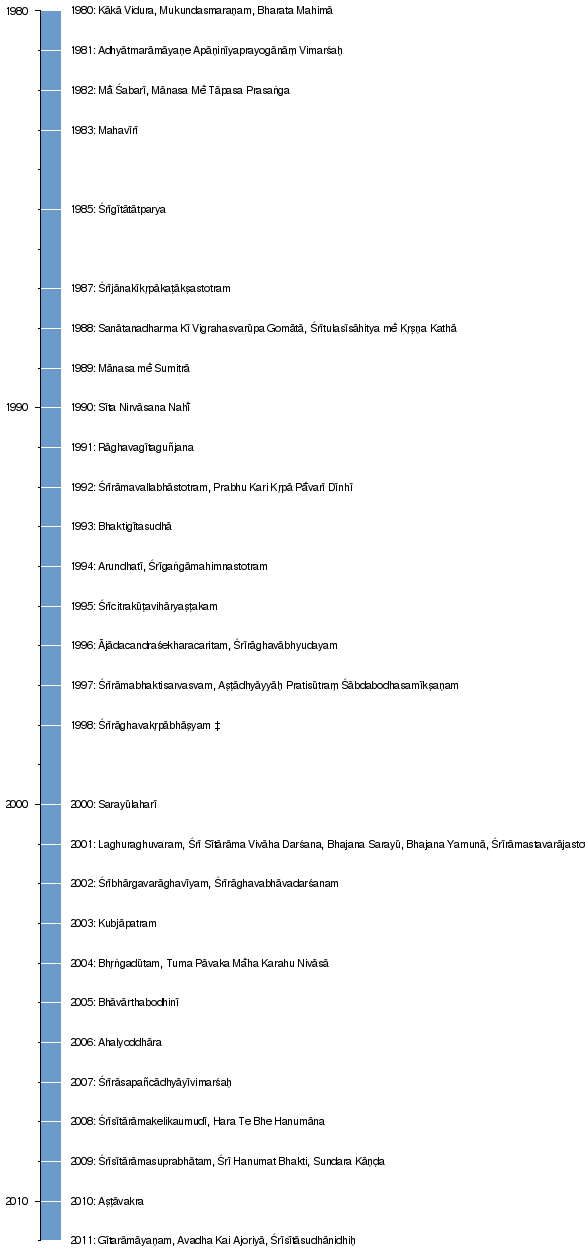
|
Includes all 13 Sanskrit commentaries on the Prasthānatrayī. |
