
Yellow-crested cockatoo facts for kids
Quick facts for kids Yellow-crested cockatoo |
|
|---|---|
 |
|
| In Hong Kong (feral population) | |
| Conservation status | |
Scientific classification  |
|
| Unrecognized taxon (fix): | Cacatua (Cacatua) |
| Species: |
C. sulphurea
|
| Binomial name | |
| Cacatua sulphurea (Gmelin, JF, 1788)
|
|
 |
|
| Native (blue) and introduced (red) ranges of C. sulphurea | |
| Script error: The function "autoWithCaption" does not exist. | |
Script error: No such module "Check for conflicting parameters".
The yellow-crested cockatoo (Cacatua sulphurea) is a bright white cockatoo known for its cheerful yellow crest. It is also called the lesser sulphur-crested cockatoo. This beautiful parrot comes from the tropical islands of Indonesia and East Timor. Today, it is famous for its intelligence, loud calls, and playful behavior. Because people love parrots, this species has been studied by scientists for hundreds of years. However, wild populations are in danger, making it one of the most protected birds in the world.
Contents
What Does the Yellow-Crested Cockatoo Look Like?

The yellow-crested cockatoo is a medium-sized bird, measuring about 34 centimeters (13 inches) long. It has snow-white plumage covering most of its body. On top of its head sits a bright yellow or orange-tinted crest. The bird can raise this feathery crest when it feels excited, curious, or alarmed. It can also fold the crest flat against its head when resting.
Its face features pale, bluish-white bare skin around each eye. The hooked bill is strong, curved, and deep black. Strong grey feet allow the bird to climb tree trunks easily and grip food. Male and female yellow-crested cockatoos look nearly identical. Scientists usually tell them apart by looking closely at their eye color.
Telling Cockatoo Species Apart
People often confuse this bird with its close relative, the sulphur-crested cockatoo. The sulphur-crested species is larger and lives further east in places like Australia. Yellow-crested cockatoos usually have a warmer yellow-orange crest and soft yellow patches on their cheeks. Another similar bird is the citron-crested cockatoo, which lives only on the island of Sumba. The citron-crested bird has a deep orange crest instead of a yellow one.
Habitat and Where They Live
In nature, yellow-crested cockatoos prefer open woodlands, forest edges, and cultivated farm fields. They are native to several Southeast Asian islands. You can find them on the large island of Sulawesi and across the Lesser Sundas.
These birds are social animals that enjoy living in noisy groups. During the morning, flocks fly across the forest canopy looking for food. At midday, they rest quietly in tall, shady trees to stay cool.
= Diet: What Do They Eat?
Yellow-crested cockatoos are plant eaters. Their strong black beak works like a nutcracker to open hard shells. Their daily meals consist of:
- Various tree seeds
- Soft plant buds
- Sweet tropical fruits
- Wild nuts
- Leaves from herbaceous plants
Reproduction and Life Cycle
Yellow-crested cockatoos form strong pairs that stay together for life. During breeding time, they look for hollow cavities inside old, tall trees. They use these safe natural holes as a nest to protect their family.
Raising the Chicks
The female usually lays two plain white eggs inside the hollow tree. Both mother and father share the duty of keeping the eggs warm. This incubation stage lasts about 28 days. Once the babies hatch, both parents gather food to feed the hungry chicks. Young birds grow their flight feathers rapidly and leave the nest around 75 days after hatching.
Discovery and Scientific History
European naturalists first learned about these cockatoos during the 18th century, when sailors brought pet birds home. In 1738, English naturalist Eleazar Albin drew a picture of one living at a tavern on Tower Hill in London. Later, in 1760, French zoologist Mathurin Jacques Brisson described a live cockatoo he met in Paris.
Other famous scientists soon wrote about the bird. George Edwards studied a pet cockatoo in Essex in 1764. The French scholar Comte de Buffon featured the bird in 1779. Finally, in 1788, German scientist Johann Friedrich Gmelin gave the bird its first scientific name, Psittacus sulphureus, while updating Carl Linnaeus's famous book Systema Naturae. He placed the bird in the parrot genus Psittacus. The original type locality was listed as Sulawesi. In 1817, French ornithologist Louis Pierre Vieillot moved the species into the modern cockatoo genus Cacatua.
Recognized Subspecies
Scientists recognize five distinct subspecies of this cockatoo across different islands:
- C. s. sulphurea: The nominate subspecies, found on Sulawesi, Muna, and Buton.
- C. s. abbotti (Abbott's cockatoo): Found only on the tiny island of Masakambing.
- C. s. djampeana: Lives on islands like Tanah Jampea and the Tukangbesi Islands.
- C. s. occidentalis: Inhabits western islands, including Lombok, Sumbawa, Komodo, Padar, Rinca, Flores, Pantar, and Alor.
- C. s. parvula (Timor yellow-crested cockatoo): Found on Rote, Semau, and Timor.
For a long time, researchers considered the citron-crested cockatoo a subspecies, but experts now classify it as its own species.
Status and Conservation Efforts
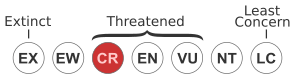
The yellow-crested cockatoo is categorized as critically endangered. This means it faces a very high risk of disappearing in the wild without help. Today, fewer than 2,500 wild individuals remain.
During the late 20th century, thousands of cockatoos were caught to be sold as pets. Habitat loss has also harmed the birds, as forests were cut down for timber and farming. Abbott's cockatoo on Masakambing suffered heavily when people cleared coastal mangroves and kapok trees. At one point, only 10 birds remained on that island.
To protect them, international trade rules under CITES placed the bird on Appendix I, making international commercial trade illegal. Many cockatoos now find shelter in protected preserves. These include Rawa Aopa Watumohai National Park on Sulawesi, Komodo National Park on Komodo Island, Manupeu Tanah Daru, Laiwangi Wanggameti National Park, and Nino Konis Santana National Park in East Timor.
Introduced City Birds in Hong Kong
Surprisingly, a thriving introduced population lives in the busy urban center of Hong Kong. Around 200 yellow-crested cockatoos make their home there, representing about 10 percent of all wild individuals on Earth.
These birds live happily in public parks and leafy residential areas. An old urban legend claimed that Governor Mark Aitchison Young released pet cockatoos right before the surrendering of Hong Kong in 1941. However, historical records show that the birds actually descend from escaped pets, with the earliest escape documented in 1959. Today, these clever birds nest safely in city trees, showing how adaptable cockatoos can be.
See Also
- Koki (cockatoo)
