
2013 Alberta floods facts for kids

The Downtown East Village neighbourhood of Calgary, Alberta, during the 2013 Alberta floods (June 21, 2013)
|
|
| Date | June 19 – July 12, 2013 |
|---|---|
| Location | Southern and central Alberta, including Calgary, High River, Canmore, and Medicine Hat |
| Deaths | 5 |
| Property damage | $5 billion (Estimated) |
The 2013 Alberta floods were a massive natural disaster that hit southern and central Alberta, Canada. Starting around June 19, 2013, very heavy rainfall caused several major rivers to overflow. Rivers like the Bow, Elbow, Highwood, and South Saskatchewan swelled rapidly. The provincial government called this the worst flooding in Alberta's history. Many communities declared emergencies, and thousands of people had to leave their homes for safety.
Sadly, five people lost their lives because of the floods. Over 100,000 people were forced to leave their homes across the region. About 2,200 Canadian soldiers were sent to help. The Royal Canadian Mounted Police and Alberta Sheriffs Branch also provided support. The total damage was estimated to be over $5 billion. This made the 2013 Alberta floods one of the most expensive disasters in Canadian history. After the waters went down, a huge cleanup effort began. Many volunteers helped strangers rebuild their homes and communities.
Contents
How the Weather Caused the Floods

Southern Alberta is usually a dry region and does not get much rain. However, from June 19 to 21, 2013, a special weather pattern changed everything. A high-pressure system in northern Alberta blocked a low-pressure system to the south. This trapped a lot of moisture over the Rocky Mountains foothills.
Heavy Rainfall and Swelling Rivers
This trapped moisture caused extremely heavy rain across the province. Many areas, especially west and southwest of Calgary, received over 200 millimeters (about 8 inches) of rain in less than two days. In Canmore, a mountain town, over 220 millimeters (about 8.7 inches) fell in just 36 hours. This was almost half of the town's average yearly rainfall. The town of High River recorded 325 millimeters (12.8 inches) in less than 48 hours.
The ground was already very wet, and there was still a lot of snow in the mountains. This combination caused rivers to rise and flow much faster. At the peak of the flooding, the Bow and Elbow rivers in Calgary flowed at three times their highest levels from a 2005 flood. Within a couple of days, the flow rate on the Bow River reached 1,458 cubic meters (51,489 cubic feet) per second. This was five times its normal rate for that time of year. The Elbow and Highwood rivers also reached flow rates ten times their usual averages.
Impact of the Floods

Government officials described the 2013 event as the worst flooding in Alberta's history. By June 24, 2013, about 2,200 Canadian soldiers were helping in the flooded areas. They used special military vehicles to move around and assist.
Community Spirit and Support
As communities flooded and people had to leave their homes, residents quickly came together. They offered support and help to those affected and to emergency workers. Some volunteers and police officers worked for up to 20 hours straight. They helped with evacuations, even if their own homes were damaged. Many people and businesses used social media like Facebook and Twitter. They offered their homes to neighbors and strangers who needed a place to stay. This showed an amazing spirit of community and kindness.
Calgary's Challenges

In Calgary, Alberta's largest city, 26 neighborhoods near the Bow and Elbow rivers were ordered to evacuate. This happened on June 20 and 21 as the rivers overflowed. About 75,000 people were affected, making it the largest evacuation in the city's history. The downtown area was also evacuated. City officials asked people to stay home, especially the 350,000 people who worked downtown. All schools were closed, and residents were asked to avoid unnecessary travel.
On June 21, the Bow River reached a record high water level of 4.09 meters (13.4 feet). Its flow rate also hit a record 1,750 cubic meters (61,790 cubic feet) per second. The city's largest indoor arena, the Scotiabank Saddledome, was badly damaged. Floodwaters filled up to the first ten rows of seats. The Calgary Stampede grounds, next to the arena, were also severely flooded. This happened less than two weeks before the annual event was scheduled to open. However, officials promised the Stampede would still go on.

Emergency officials began lifting some evacuation orders on June 22. However, Mayor Naheed Nenshi said it would take days to restore power downtown. City workers, with help from Canadian soldiers, worked to fix a large erosion of the riverbank. This protected several houses in the Inglewood neighborhood. Calgary's main business district, home to many oil companies, remained closed until June 26. Companies made plans for employees to work from other places.
As the water receded, the city allowed 65,000 residents to return home on June 23. They could then check for damage. However, parts of 14 communities remained off-limits. On June 27, the Bonnybrook Bridge collapsed under a Canadian Pacific Railway freight train. Floodwaters had weakened one of the bridge's supports. The train derailed, and because it carried special cargo, nearby areas were evacuated as a safety measure.
High River's Devastation


Southwest of Calgary, the town of High River faced extreme flooding. The Highwood River rose so high that water covered vehicles on main streets. Over 150 people had to be rescued from their rooftops. All 13,000 residents of High River were ordered to evacuate on June 20. The town was largely empty within three days. Local officials called the damage "unprecedented." Even "Maggie's Diner," a set from the TV show Heartland, was flooded.
During the emergency, authorities like the Royal Canadian Mounted Police (RCMP) and Alberta Sheriffs Branch were dispatched to help. They worked to secure the town and ensure public safety. This included entering homes to check for safety and secure items. Some residents later raised concerns about how these actions were carried out.
While other communities started cleaning up, High River remained closed for a week. Residents felt frustrated by the lack of information about when they could return. Officials explained that the town was still unsafe. Some homes were only reachable by divers, and dangerous bacteria like E. coli were found in the water. The province later decided to buy and demolish many luxury homes in flood-prone areas. This helped return the land to its natural state as a floodplain.
Flooding Across Southern Alberta


The mountain towns of Banff and Canmore, west of Calgary, were cut off. Flooding and mudslides closed the Trans-Canada Highway. In Canmore, some homes were swept away by the rising Cougar Creek.
Many other towns and municipal districts also declared states of emergency. These included Lethbridge, Black Diamond, Cochrane, Sundre, and Turner Valley. Several First Nation reserves were also affected. The Siksika First Nation, east of Calgary, evacuated 1,000 residents. The city of Medicine Hat, located downstream on the South Saskatchewan River, also faced significant flooding. About 10,000 residents were evacuated there as a precaution.
Impact on Neighboring Provinces
Officials in Saskatchewan and Manitoba also prepared for potential flooding. Many of Alberta's affected rivers flow into the South Saskatchewan and Saskatchewan rivers. The South Saskatchewan River reached record levels in Saskatoon. However, the city did not experience major flooding. About 2,200 people were evacuated from the Cumberland House area in eastern Saskatchewan. Flood warnings were also issued for The Pas in Manitoba.
Fatalities
Sadly, five people died as a direct result of the 2013 Alberta floods.
Cleanup and Recovery Efforts

The cleanup and recovery after the floods were enormous. On June 24, 2013, Alberta Premier Alison Redford predicted the damage would be very high. It was estimated to surpass the $700 million caused by the 2011 Slave Lake wildfire. Many costs were not covered by regular insurance. Early estimates suggested total damages could be between $3 billion and $5 billion. This made it one of the costliest natural disasters in Canadian history. The Province of Alberta later estimated the repair costs would exceed $5 billion. Insurable losses alone reached over $1.7 billion.
Community and Government Response
Alberta's Minister of Municipal Affairs announced a special task force. This group had successfully coordinated recovery efforts after the 2011 Slave Lake wildfire. They helped cities, towns, and villages affected by the flood. This included providing insurance for damaged public buildings, vehicles, and infrastructure. The cleanup was called the "biggest cleanup in provincial history."
Many people helped those whose homes were damaged. Calgary's first official call for 600 volunteers resulted in about 2,500 people showing up ready to work. The city hired contractors for larger repairs, but volunteers were crucial.
The Alberta Premier promised provincial help for recovery. The Alberta Treasury board approved a preliminary $1 billion emergency fund. This covered immediate cleanup and repair costs. The province also covered losses to homeowners and municipalities from overland flooding, which insurance often doesn't cover. Premier Redford cautioned that full recovery could take up to ten years.
Federal and International Support
Prince William and his wife sent a message of support on June 24. They expressed their best wishes to Alberta's leaders and to the brave emergency services and volunteers. Then Prince Charles also praised the "extraordinary efforts" of Canadians. Prime Minister Stephen Harper toured the flooded area and promised federal assistance. He discussed how the federal, provincial, and city governments would work together. In 2013, $2 billion was set aside from the government's Disaster Financial Assistance Arrangements for Alberta.
First Nations Recovery

The Siksika First Nation, east of Calgary, declared a state of emergency on June 20. About one thousand people were evacuated from their homes. By June 23, 200 homes were still underwater. Chief Fred Rabbitcarrier described a "feeling of hopelessness." However, news outlets covered their story, and a Facebook account helped coordinate relief efforts. Donations and volunteers quickly responded to their call for help. The Albertan government later granted the Siksika Nation $93 million to rebuild. This included $10 million for training people in construction skills.
Volunteer Power
As the floodwaters began to recede, many volunteers stepped up. Thousands of people went to heavily hit areas in Calgary to help neighbors and strangers clean up. Buses were organized to take volunteers to High River. Most residents there needed a lot of assistance. This widespread volunteering showed the strong community spirit in Alberta.
Preventing Future Floods
In November 2013, the Government of Alberta announced projects to help prevent future flooding. These included building a channel to divert water around High River. They also planned a dry dam for the Elbow River west of Bragg Creek, which is upstream of Calgary. Calgary also received a grant to study building a 5-kilometer (3.1-mile) tunnel. This tunnel would divert Elbow River floodwaters away from neighborhoods.
Gallery
Flooding in Calgary
-
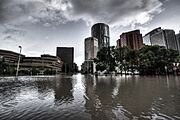
Looking toward Downtown Calgary from Riverfront Avenue during the 2013 Alberta floods (June 21, 2013)
-
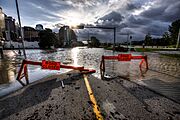
Riverfront Avenue in Calgary (June 21, 2013).
-
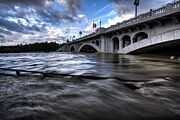
The Centre Street Bridge in Calgary (June 21, 2013).
-
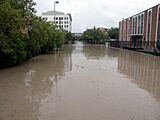
MacLeod Trail under water in Downtown Calgary (June 2013).


Flooding in Okotoks
-
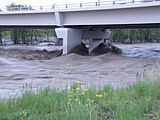
Flood waters rush by the Okotoks 32nd Street bridge on the evening of June 20, 2013.
-
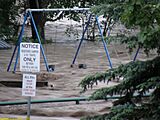
Flood waters rush in from the Sheep River into a local Okotoks campground (June 20, 2013).
-
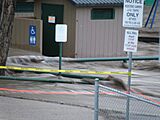
Flood waters from the Sheep River in Okotoks rush into the local campground (June 20, 2013).
-
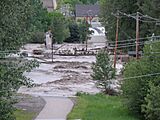
Viewpoint is on the south edge of the River Valley looking towards Okotoks library (June 20, 2013).
-
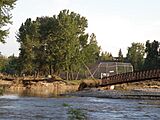
From the viewpoint of the north bank of the Sheep River, just east of the Okotoks library (June 23, 2013).
-
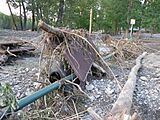
The picnic and day use area of an Okotoks campground, once a grassy meadow, now in some places buried several feet deep in silt and rocks (June 23, 2013)
-
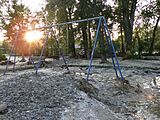
Swingset at Rich's Playground in Okotoks campground after flood waters receded (June 23, 2013)
-
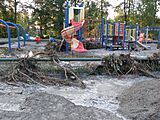
Rich's Playground at Okotoks campground after flood water receded (June 23, 2013)


See also
- 2011 Slave Lake wildfire
- 2016 Fort McMurray wildfire
