
Aleuts facts for kids
| унаӈан (unangan) унаӈас (unangas) |
|
|---|---|

Attu Aleut mother and child, 1941
|
|
| Regions with significant populations | |
| United States Alaska |
6,752 |
| Russia Kamchatka Krai |
482 |
| Languages | |
| English, Russian, Aleut | |
| Religion | |
| Eastern Orthodoxy, Animism | |
| Related ethnic groups | |
| Inuit, Yupik, Sirenik, Sadlermiut, Alaskan Creoles | |
The Aleuts are the Indigenous people of the Aleutian Islands. These rocky, windy islands sit between the North Pacific Ocean and the Bering Sea. In their own language, the people call themselves the Unangax̂. Today, their homeland is divided between the United States state of Alaska and Kamchatka Krai in Russia.
The Unangax̂ have thrived in a cold, stormy ocean home for thousands of years. They became brilliant sailors, inventors, and artists. They built special boats to hunt sea mammals and dug cozy homes underground to stay warm. Over many generations, they preserved a unique culture that continues today.
Contents
Who Are the Unangax̂ People?
Meaning of Their Names
In the Aleut language, the people call themselves Unangan in the eastern islands and Unangas in the western islands. Both words mean "original people." Today, many use the combined name Unangax̂ to include everyone.
The word "Aleut" was first given to them by Russian explorers and traders in the 1700s. Russian fur hunters used the word for local islanders and nearby neighbors, such as the Sugpiat on the Kodiak Archipelago. Today, both names are common, but many prefer their original Native title.
Where Do They Live?
Historically, the Unangax̂ lived across the curved chain of the Aleutian Islands, the Shumagin Islands, and the western tip of the Alaska Peninsula. Long ago, before Europeans arrived, around 25,000 Unangax̂ lived across these ocean islands.
During the 1800s, a Russian trading business called the Russian-American Company moved groups of families to help work in the maritime fur trade. They moved hunters and their households northward to the Pribilof Islands in Alaska and westward to the Commander Islands in Russia. Today, vibrant communities still live in both island groups.
The Unangam Tunuu Language
Language Family and Dialects
The traditional native tongue of the people is called Unangam Tunuu, or the Aleut language. This language belongs to the Eskaleut language family, which connects it to other far northern languages across the Arctic.
Unangam Tunuu developed three main regional dialects. The Eastern dialect was spoken on the eastern Aleutians, including the Fox Islands, Shumagin Islands, and Pribilof Islands. The western dialect, called Atkan, was spoken on Atka and Bering. A third dialect, the Attuan dialect, was spoken on the far western island of Attu.
Writing and Saving the Language
Long ago, knowledge and history were shared completely by spoken word and stories. Starting around 1829, an alphabet was made for the language using the Cyrillic script. Later, starting in 1870, writers also began using the Latin script.
Today, teachers, elders, and young learners work together to keep Unangam Tunuu alive. Many elders know the words and speak them proudly, especially on the Pribilof Islands. Schools, language camps, and online classes help young kids learn traditional stories, songs, and greetings.
Traditional Island Life and Survival
Earth-Sheltered Homes Called Barabaras

The Aleutian chain has very few trees because heavy winds blow across the subarctic ocean. To stay warm and dry, the Unangax̂ built clever houses that sat partly underground. This traditional home is known as a barabara.
To build a barabara, families dug a large pit about two to three feet deep into the soil. They created a strong frame using ocean driftwood and large whale bones. Then, they built a roof out of woven grasses and piled thick layers of sod and dirt on top. The earth kept the inside warm during winter freezes and fierce ocean storms. Inside, families used seal-oil lamps for warmth and soft illumination.
Thriving in an Active Earth Zone
The islands sit right where huge slabs of rock meet deep underground. The Pacific Plate moves slowly under the North American Plate. This movement causes regular earthquakes and creates smoking volcanoes.
Because their houses were built low into the ground with flexible wooden beams, they did not fall down easily when the earth shook. Villages were often placed high on coastal bluffs, like the ancient settlement on Anangula Island. This high position helped protect the homes from huge tidal waves and winter flooding.
Food from the Ocean and Land

Because farming was difficult on the stormy islands, the Unangax̂ gathered almost everything they needed from the wild sea. They caught salmon, cod, halibut, and shellfish like crabs and clams. They gathered tasty bird eggs from steep seaside cliffs.
Hunters went out into the open ocean to hunt seals, sea lions, and even whales. Food was preserved by air-drying, smoking, or roasting over fires. People also gathered summer berries and plants. One favorite meal was called alutiqqutigaq, which mixed sweet wild berries with fish and nutritious oils. Other rare treats included whale blubber and skin, as well as walrus meat.
Brilliant Tools and Inventions
Ocean Boats: Baidarkas and Baidaras

The Unangax̂ were famous across the world for their incredible boating skills. They designed two main kinds of skin-covered boats:
- Baidarka: This was a fast, narrow sea boat similar to a kayak. It had a light wooden frame covered with tough sea lion skins. It cut through crashing waves smoothly and was used by hunters.
- Baidara: This was a much bigger, open boat made with heavy walrus skins. It carried whole families, goods, supplies, and tools between the islands.
Hunters wore special waterproof jackets that tied tightly around the boat opening. This stopped freezing ocean water from splashing inside, keeping the paddler dry and safe.
Hunting Gear and Tools
To catch speedy ocean mammals, hunters invented smart gear. They created throwing boards that acted like an extra lever for the hunter's arm. This allowed them to fling light wooden harpoons much farther and with great accuracy.
These harpoons had bone tips carved with sharp barbs. Some tips detached from the wooden shaft when they struck, staying tied to a floating line so the animal could not get away. Toolmakers made sharp knives, needles, and scrapers using river stones, volcanic glass, and sturdy bird bones.
Art, Clothing, and Beautiful Traditions
Warm, Waterproof Clothing

In a land filled with icy rain and ocean spray, staying dry was a matter of life and death. The Unangax̂ were master clothing makers. Women created parkas from soft bird feathers, warm sea otter fur, and seal skins.
One of their most famous inventions was the Kamleika, an amazing waterproof jacket made from sea mammal intestines. The gut material was cleaned, stretched, and carefully sewn with tiny waterproof stitches. Rain and sea foam slid right off, acting just like modern plastic raincoats.
Bentwood Visors and Hats

Aleut hunters wore striking wooden hats called bentwood visors, or a chagudax. These hats were made from a single piece of wood, carefully steamed, bent into a cone, and stitched together.
The long visor shielded the hunter's eyes from blinding ocean sun glare and salty spray. Hats were decorated with colorful mineral paints, carved walrus ivory beads, feathers, and long sea lion whiskers. These magnificent hats honored the ocean animals and showed the hunter's great skill.
Grass Weaving and Fine Baskets

Unangax̂ women became famous for weaving some of the finest baskets on Earth. They gathered wild sea lyme grass along the shore, dried the blades, and split each piece into paper-thin threads using their fingernails.
Weavers spent months creating tightly wound baskets, mats, and small containers. The weave was so tiny and tight that some ancient baskets could even hold water without leaking. Skilled artists, including Anfesia Shapsnikoff, worked hard to teach this ancient art to younger generations.
Carving, Masks, and Adornments
Artists carved figures of puffins, seals, and people out of walrus ivory and washed-up driftwood. They also carved large wooden masks painted with colorful natural dyes. These masks were worn during winter ceremonies to honor spirits and remember village ancestors.
In earlier times, people decorated their bodies with neat tattoos and facial adornments. Both men and women wore ornaments made of bone, polished stone, or bird quills through their ears or lips. These decorations celebrated big achievements, family background, and personal bravery.
History Through the Ages
Early Settlements
Archaeologists studying island history have found stone tools showing that humans have lived on the eastern Aleutians for roughly 9,000 years. Over many centuries, families traveled westward, building villages across the entire chain. They learned every reef, current, and volcanic mountain in their homeland.
Arrival of Russian Traders
In the mid-1700s, Russian explorers and fur traders called promyshlenniki arrived on the islands. They wanted valuable sea otter furs to sell across Asia and Europe. The traders forced Native hunters to gather pelts, creating difficult and unfair conditions for the Unangax̂.
Traders also accidentally brought foreign infectious diseases, like smallpox and the flu, to which islanders had no natural immunity. Because of these illnesses and unfair treatment, the Native population dropped drastically during the 1800s. In 1794, church leaders arrived, and many people joined the Russian Orthodox Church. Today, many islanders still practice this faith alongside ancestral customs.
The World War II Years
During World War II, the Aleutian Islands became a battleground. In June 1942, Japanese troops landed on the far western islands of Attu and Kiska. The villagers of Attu were taken far away to Otaru in Japan as captive prisoners until the war ended.
Meanwhile, the United States military moved about 800 Unangax̂ from their island homes to temporary camps in southeast Alaska to protect them from fighting. Life in these camps was very difficult and crowded. After the war ended, survivors were finally allowed to go home, though several villages were never rebuilt. Decades later, the Aleut Restitution Act of 1988 helped repair some of this damage, and the government officially apologized for their treatment.
Unangax̂ Communities Today

Today, thousands of Unangax̂ live in traditional island villages and across larger cities in Alaska, Washington, and Russia. Modern communities keep their ancestral pride strong through dance groups, traditional food harvesting, and art workshops.
Tribal leaders protect the ocean waters, manage island resources, and teach kids how to paddle kayaks and speak the Native language. The resilient spirit of the Unangax̂ continues to shine brightly across the windswept northern seas.
Notable People
- John Hoover (1919–2011), a famous sculptor who shared Native culture through art.
- Carl E. Moses (1929–2014), a business owner and respected Alaska state lawmaker.
- Jacob Netsvetov (1802–1864), a teacher, priest, and saint who helped write down the Aleut language.
- Sergie Sovoroff (1901–1989), an honored teacher and builder of model sea kayaks.
- Eve Tuck, a modern university professor and researcher in Indigenous studies.
- Peter the Aleut (1800–1815), an early Native Alaskan historical figure and Christian saint.
Related Pages
Images for kids
-

Map showing the historic lands and dialects of the Unangax̂
-
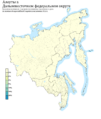
Map showing Aleut settlements in the Russian Far East
-
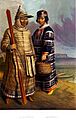
Historic drawing of Aleut islanders in the 1800s
-
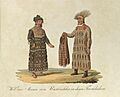
Traditional clothing and face adornments from Unalaska
-
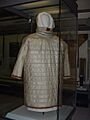
A waterproof Kamleika parka made from sea animal gut


See Also
 In Spanish: Aleutas para niños
- Adamagan
- Aleutian Islands
- Aleutian tradition
- Alutiiq
- Indigenous Amerindian genetics
- Maritime Fur Trade
- Sadlermiut
- Shamanism among Alaska Natives
- Unangan Aleut
- List of Native American peoples in the United States
