
American flamingo facts for kids
Quick facts for kids American flamingo |
|
|---|---|
.JPG) |
|
| Galapagos Islands | |
| Conservation status | |
Scientific classification  |
|
| Kingdom: | Animalia |
| Phylum: | Chordata |
| Class: | Aves |
| Order: | Phoenicopteriformes |
| Family: | Phoenicopteridae |
| Genus: | Phoenicopterus |
| Species: |
P. ruber
|
| Binomial name | |
| Phoenicopterus ruber Linnaeus, 1758
|
|
 |
|
| Distribution of the American flamingo | |
| Script error: The function "autoWithCaption" does not exist. | |

Script error: No such module "Check for conflicting parameters".

The American flamingo (Phoenicopterus ruber) is a large flamingo species. It is also known as the Caribbean flamingo. This bird is closely related to the greater flamingo and Chilean flamingo. Scientists used to think it was the same species as the greater flamingo. But now, most agree they are different. The American flamingo is the only flamingo that naturally lives in North America. You can also find it in the Galápagos Islands.
Contents
Where they live

American flamingos breed in many places. These include the Galápagos Islands and coastal Colombia. They also live in Venezuela and nearby islands. You can find them in northern Brazil and Trinidad and Tobago. Other homes are the northern Yucatán Peninsula, Cuba, and Jamaica. They are also in Hispaniola (which is Dominican Republic and Haiti). The Bahamas, Virgin Islands, and Turks and Caicos Islands are also home. A few live in Louisiana and extreme southern Florida.
Flamingos from the Galápagos Islands are a bit different. They are smaller than those in the Caribbean. They also lay smaller eggs.
These flamingos like specific places to live. They prefer salty lagoons and mudflats. They also like shallow, slightly salty (brackish) coastal or inland lakes. For example, they live in the Petenes mangroves in the Yucatán.
In Florida

American flamingos are also found in South Florida and the Florida Keys. These areas were likely the northernmost part of their natural range. Old museum records show flamingo eggs collected in Florida. This means they probably nested there a long time ago.
What they look like

The American flamingo is a large wading bird. It has beautiful reddish-pink feathers. Like all flamingos, it lays one chalky-white egg. They build their nests on a mud mound. This happens between May and August. The egg hatches after 28 to 32 days. Both parents take turns sitting on the egg. They also care for the young birds for up to 6 years. That's when the young flamingos become adults. Flamingos can live for about 40 years. This is one of the longest lifespans for birds.
Adult American flamingos are smaller than greater flamingos. But they are the biggest flamingos in the Americas. They stand about 120 to 145 cm (47 to 57 in) tall. Males weigh about 2.8 kg (6.2 lb). Females are a bit lighter, around 2.2 kg (4.9 lb). Most of their feathers are pink. This is why they were once called "rosy flamingos." This pink color helps tell them apart from the paler greater flamingo. Their wing feathers are red. Their long flight feathers are black. The beak is pink and white with a large black tip. Their legs are completely pink. When they call, it sounds like a goose honking.


Mating and family life
Scientists have studied how American flamingos find partners. They also watch how they raise their young.
Males usually start the courtship dance. But females decide if they are interested. If both birds like each other, the female walks by the male. If he is interested, he walks with her. They make synchronized movements together. This continues until one bird stops. For a simple courtship, they walk together with their heads held high. For a more serious courtship, they walk quickly. Their heads are lowered, as if they are feeding. This intense courtship stops if one bird turns away. It also stops if they raise their heads. Or if they slow down. Pairs that have been together a long time don't do these dances often. But they often stand, sleep, and eat close to each other.
Both parents take turns caring for the egg. They do this equally. After the chicks hatch, parents also take turns caring for them. They do this until the chicks are about 7–11 days old. Parents can sit on the nest for 21–60 hours at a time. The 'off-duty' parent might stay nearby to eat. Or they might fly to other lagoons if food is scarce. Parents usually switch places in the late afternoon or early morning.


Chicks get food from their parents less often as they grow. This decrease is biggest after they leave the nest. Chicks leave the nest at 7–11 days old. Then they join groups called "crèches." Male and female parents feed their chicks about the same amount. After chicks leave the nest, they are mostly fed at night.
How they are special
The American flamingo has special features for its shallow-water home. It has long legs and large webbed feet. These help it wade in the water. They also help stir up the bottom to find food. Flamingos have a unique beak that curves downward. It has special filters inside. These filters help them strain different sizes of food from the water.
What they eat depends on their beak shape. They dip their heads underwater to find food. They can hold their breath for a long time while feeding.
Flamingos choose their homes based on several things. These include water temperature and depth. They also look for food sources. How easy it is to reach an area matters too. They also check for plants in feeding areas. If there isn't enough food, or the temperature isn't right, they move. They will find a better place to feed or a warmer spot.
Moving around
Like other flamingos, American flamingos travel short distances. They do this to find enough food. Or if their current home is disturbed. For example, if water levels get too high, they might leave. High water makes it hard for them to wade and find food. So, they will leave to find food somewhere else. These flights are not as long as those of other migratory birds. But flamingos still fly for periods without eating.
Threats
Habitats Lost
- Development: As human populations grow, more land is needed for homes, cities, and businesses. Sometimes, these developments are built right where flamingos live, draining wetlands or filling in shallow waters.
- Agriculture: Farmers need land to grow crops and raise animals. This can lead to wetlands being converted into farmland, taking away vital feeding and nesting grounds for flamingos.
- Infrastructure: Building roads, airports, and other structures can also destroy or cut through flamingo habitats, making it harder for them to move between different areas they need.
- Habitat Degradation: Even if a habitat isn't completely destroyed, it can become "degraded," meaning it's not as healthy or useful as it once was.
- Changes in Water Flow: Dams and canals built for human use can change how water flows into wetlands. If the water becomes too deep, too shallow, or too fresh, it can affect the tiny organisms flamingos eat, making it harder for them to find food.
- Erosion: Sometimes, human activities can lead to soil washing away, which can change the shape of mudflats and make them less suitable for flamingos.
Water Pollution
Just like we need clean food and water to stay healthy, flamingos do too! Pollution is when harmful substances get into the environment, making it unsafe for animals.
- Chemicals from Farms: When rain washes over farms, it can carry chemicals like pesticides (used to kill insects) and fertilizers (used to help plants grow) into nearby wetlands. These chemicals can harm the tiny plants and animals that flamingos eat, or even directly sicken the flamingos themselves.
- Industrial Waste: Factories can sometimes release harmful chemicals into rivers and oceans if not properly managed. These pollutants can spread to flamingo habitats, making the water toxic.
- Oil Spills: Accidents involving oil tankers or drilling operations can release oil into the ocean. Oil is extremely dangerous for birds, coating their feathers and making it impossible for them to fly or stay warm. It can also poison them if ingested.
- Plastic Pollution: Plastic bags, bottles, and other trash often end up in oceans and wetlands. Flamingos might accidentally try to eat small pieces of plastic, thinking it's food, which can make them very sick or block their digestive systems. Sometimes, birds can get tangled in larger pieces of plastic debris, like fishing lines or plastic rings, which can injure them or prevent them from moving or flying.
Human Disturbance
Flamingos are wild animals, and like many wild creatures, they need their space. Human disturbance happens when people get too close or make too much noise, scaring the birds and disrupting their natural behaviors.
People enjoying activities like boating, jet-skiing, or even kayaking too close to flamingo feeding or nesting areas can cause the birds to fly away. If this happens too often, especially during nesting season, it can cause parents to abandon their nests, leaving their eggs or chicks vulnerable.
Tourism and photography can also stress the birds. They might stop feeding, waste energy flying away, or even leave a good feeding spot.
Loud noises from construction, vehicles, or even loud conversations can startle flamingos, especially when they are resting or nesting.
Changing Weather Patterns
Our planet's weather patterns are always changing, and sometimes these changes can affect flamingo habitats.
More intense storms, like hurricanes or tropical storms, can directly damage flamingo nests and habitats. Strong winds and heavy rains can flood nesting sites or destroy the delicate balance of their wetland homes.
Some areas might experience longer periods of drought (not enough rain), causing wetlands to dry up. Other areas might get too much rain, making their shallow feeding grounds too deep. Both scenarios make it difficult for flamingos to find food and suitable nesting sites.
Flamingos rely on very shallow water. If sea levels rise in some coastal areas, their preferred shallow feeding grounds could become too deep, or their nesting islands could be submerged.
Images for kids
-
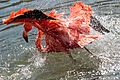
Individual at SeaWorld San Diego cleaning its feathers
-
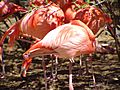
P. ruber stands on one leg in order to retain body heat


See also
 In Spanish: Flamenco del Caribe para niños
