
Spiral galaxy facts for kids

Spiral galaxies are a common type of galaxy. They were first described by Edwin Hubble in 1936. These galaxies are known for their beautiful spiral shapes.
Most spiral galaxies have a flat, spinning disk. This disk contains stars, gas, and dust. At the center is a bright, round group of stars called a bulge. Around these parts, there's often a fainter halo of stars. Many of these stars are found in groups called globular clusters.
Spiral galaxies get their name from the bright arms that swirl out from their center. These spiral arms are busy places where new stars are constantly forming. They look brighter than the rest of the disk because they contain many young, hot, and very luminous stars.
About two-thirds of all spiral galaxies also have a bar-shaped structure in their center. The spiral arms often begin at the ends of this bar. The number of barred spirals has grown over time. Today, more than two-thirds of the galaxies we can see have these bars.
Our own galaxy, the Milky Way, is a barred spiral galaxy. It's hard to see the bar from Earth because we are inside the galactic disk. However, telescopes like the Spitzer Space Telescope have helped scientists confirm its presence.
Spiral galaxies, along with irregular galaxies, make up about 60% of all galaxies in the universe. They are usually found in areas where galaxies are not too crowded.
Contents
What Makes Up a Spiral Galaxy?

Spiral galaxies are made of several distinct parts:
- A spinning disk of stars, gas, and dust. The spiral arms are a key feature of this disk.
- A central group of stars called a bulge. These stars are mostly older.
- A bar-shaped group of stars in the center of many spirals.
- A nearly spherical halo of stars surrounding the main galaxy. Many globular clusters are found here.
- A supermassive black hole at the very center of the bulge.
- A large, invisible dark matter halo that surrounds the entire galaxy.
The size, brightness, and mass of these parts can be different for each galaxy.
The Swirling Spiral Arms

The spiral arms are long, thin regions of stars that stretch out from the center of spiral galaxies. They give these galaxies their famous spiral look. Different types of spiral galaxies have arms that are more tightly or loosely wound. For example, some galaxies have very "loose" arms, while others have arms that are wrapped tightly. These arms are bright because they contain many young, blue stars. These stars form in the arms due to the high density of gas and dust there.
The Central Bulge
A bulge is a large, tightly packed group of stars at the center of most spiral galaxies. It often looks like a small, fuzzy ball of light.

Bulges can vary in size and type of stars. Some bulges are made of older, redder stars. Others are smaller and contain younger, bluer stars. Many bulges are believed to have a supermassive black hole at their very center. For instance, our Milky Way galaxy has a supermassive black hole called Sagittarius A* at its core.
The Galactic Bar
About two-thirds of all spiral galaxies have a bar-shaped structure made of stars. This bar extends from the central bulge. The spiral arms often begin at the ends of this bar. These bars can be strong or weak. Sometimes, in galaxies seen from the side, the bar can look like an X-shape or a peanut shell.
The Galactic Halo

Most stars in a spiral galaxy are in the flat disk or the central bulge. However, some stars live in a faint, nearly spherical region called the galactic halo. These halo stars orbit the galaxy's center in different ways. They might move in unusual paths compared to the stars in the disk.
Scientists believe that some halo stars come from smaller galaxies that merged with the spiral galaxy. For example, the Sagittarius Dwarf Spheroidal Galaxy is currently merging with the Milky Way. Observations show that some stars in our galaxy's halo came from it.
Unlike the galactic disk, the halo has very little dust. The stars in the halo are generally much older and have fewer heavy elements than the younger stars in the disk. The galactic halo is also home to many globular clusters.
The Oldest Spiral Galaxies
Scientists are always looking for the oldest galaxies. As of 2026, BRI 1335-0417 is considered one of the oldest and most distant known spiral galaxies. Its light took about 12.4 billion years to reach Earth. Another very old galaxy is Zhúlóng.
The oldest known "grand design" spiral galaxy is BX442. It is about 11 billion years old. Researchers think its spiral shape is due to the gravity of a nearby dwarf galaxy. The oldest multi-arm spiral galaxy discovered so far is A2744-DSG-z3. Its light has traveled for about 11.5 billion years to reach us. Another ancient spiral is A1689B11, which formed about 2.6 billion years after the Big Bang.
Learning More About Galaxies
In June 2019, citizen scientists working with Galaxy Zoo suggested that the way we classify spiral galaxies might need updates. This shows that our understanding of the universe is always growing!
How Do Spiral Arms Form?


Scientists have studied how spiral arms form for a long time. In 1925, Bertil Lindblad realized that spiral arms couldn't be made of stars that just stayed in a fixed spiral shape. This is because different parts of a galaxy rotate at different speeds. If the arms were fixed, they would quickly get wound up and disappear. This is known as the winding problem.
Since the 1970s, two main ideas explain how spiral structures form:
- Density Wave Theory: This idea suggests that spiral arms are regions where gas and stars are packed more closely together. These "density waves" move through the galaxy's disk.
- Star Formation Chains: This model suggests that new stars form in chains. The shock waves from these new stars and supernovae trigger even more star formation nearby. The galaxy's rotation then stretches these chains into spiral shapes.
These ideas might both be true, explaining different kinds of spiral arms.
The Density Wave Model Explained
Bertil Lindblad proposed that spiral arms are like cosmic traffic jams. In these "traffic jams," gas and dust get squeezed together. This squeezing causes new stars to form. Many of these new stars are short-lived and very bright, making the arms glow.
In 1964, C. C. Lin and Frank Shu developed this idea further. They suggested that stars in a galaxy travel in slightly oval-shaped orbits. The way these oval orbits line up creates the appearance of spiral arms. So, stars don't stay in the arms forever. Instead, they pass through these denser regions as they orbit the galaxy.

When gas clouds enter a density wave, they become denser. This higher density makes it easier for the clouds to collapse and form new stars. The compression wave acts like a trigger for star formation.
Why Spiral Arms Are Brighter
Spiral arms look brighter because they contain many young, massive, and very luminous stars. These stars don't live very long. After they die, the area behind the density wave becomes darker with fainter, older stars. This contrast makes the bright spiral arms stand out even more.
Stars move through the spiral arms as they orbit the galaxy. Their speed changes slightly due to the extra gravity in the denser arm. After passing through an arm, the stars return to their normal speed.
Gravity's Role in Spiral Arms
Scientists have observed that stars do move along spiral arms. The mutual gravity between stars helps to align their orbits into these spiral patterns. When gas clouds collide due to gravity, they form molecular clouds. These are the birthplaces of new stars. This process helps explain how large, well-defined spiral patterns can form.
The History of "Spiral Nebulae"

Before we knew that spiral galaxies were separate islands of stars, they were often called spiral nebulae. This name came from Lord Rosse. In 1845, his powerful telescope, the Leviathan, was the first to show the spiral structure of a galaxy. He drew the Whirlpool Galaxy (M51), and his drawings look much like today's photographs. He found similar patterns in other galaxies like Messier 99 and Messier 33 soon after.
For a long time, scientists debated whether these "spiral nebulae" were part of our own Milky Way galaxy or if they were separate galaxies far away. This was called the Great Debate of 1920. Starting in 1923, Edwin Hubble used special stars called Cepheid variables to measure distances to several spiral nebulae, including the famous Andromeda Galaxy. He proved that they were, in fact, entire galaxies far beyond our own. After this discovery, the term spiral nebula was no longer used.
Our Home: The Milky Way Galaxy

For a while, the Milky Way was thought to be a regular spiral galaxy. However, astronomers began to suspect it was a barred spiral galaxy in the 1960s. These suspicions were confirmed in 2005 by observations from the Spitzer Space Telescope. These observations showed that the Milky Way's central bar is larger than scientists first thought.
Famous Examples of Spiral Galaxies
- Alaknanda Galaxy
- Andromeda Galaxy
- Black Eye Galaxy
- Malin 1
- Milky Way
- Pinwheel Galaxy
- Sunflower Galaxy
- Triangulum Galaxy
- Whirlpool Galaxy
Images for kids
-
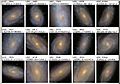
The similar distribution of stars in spirals

See also
 In Spanish: Galaxia espiral para niños
Classification
- Disc galaxy
- Dwarf elliptical galaxy
- Dwarf spheroidal galaxy
- Flocculent spiral galaxy
- Galaxy color–magnitude diagram
- Grand design spiral galaxy
- Intermediate spiral galaxy
- Lenticular galaxy
- Ring galaxy
- Starburst galaxy
- Seyfert galaxy
Other Topics
- Galactic coordinate system
- Galactic corona
- Galaxy formation and evolution
- Galaxy rotation curve
- Groups and clusters of galaxies
- List of galaxies
- List of nearest galaxies
- List of spiral galaxies
- Stellar halo
- Timeline of knowledge about galaxies, clusters of galaxies, and large-scale structure
- Tully–Fisher relation
