
Eickelberg Peak facts for kids
Quick facts for kids Eickelberg Peak |
|
|---|---|

Aerial view of east aspect
|
|
| Highest point | |
| Elevation | 3,648 ft (1,112 m) |
| Prominence | 3,298 ft (1,005 m) |
| Isolation | 9.72 mi (15.64 km) |
| Parent peak | Westdahl Volcano (5,426 ft) |
| Geography | |

 Eickelberg Peak
Location in Alaska
|
|
| Country | United States |
| State | Alaska |
| Borough | Aleutians East |
| Parent range | Aleutian Range |
| Protected area | Aleutian Islands Wilderness |
| Topo map | USGS Unimak C-2 |
| Geology | |
| Formed by | Subduction zone volcanism |
| Age of rock | Late Pleistocene |
| Mountain type | Stratovolcano |
| Type of rock | Andesitic |
| Volcanic arc | Aleutian Arc |
Eickelberg Peak is a tall mountain in Alaska, United States. It stands 3,648 feet (1,112 meters) high. This peak is part of the Aleutian Range.
Contents
Exploring Eickelberg Peak's Features
Eickelberg Peak is a type of volcano called a stratovolcano. Stratovolcanoes are cone-shaped mountains. They are built up over time by many layers of hardened lava, ash, and rocks. This peak is found on Unimak Island in the Aleutian Islands. It sits along the western edge of a large bowl-shaped area called Fisher Caldera. A caldera is a big crater formed when a volcano collapses.
Water from the mountain's eastern side flows into the caldera. Water from other slopes feeds into streams that join the Pogromni River. The mountain rises very steeply. It climbs about 3,050 feet (930 meters) above a lake inside the caldera. This happens in less than one mile (1.6 kilometers). The closest town is False Pass, which is about 44 miles (71 kilometers) to the east.
How Eickelberg Peak Got Its Name
The mountain was named after Ernest Werner Eickelberg. He was a Lieutenant Commander. He worked with the United States Coast and Geodetic Survey. His job was to help map Alaska. The name was first shown on a map in 1951. This map was made by the United States Geological Survey. The United States Board on Geographic Names officially approved the name.
Understanding Eickelberg Peak's Climate
Eickelberg Peak has a subpolar oceanic climate. This means it has cold, snowy winters. Its summers are cool. Weather systems often come from the North Pacific. When these systems hit the mountains, they are forced upwards. This process is called orographic lift. It causes a lot of rain and snow to fall. In winter, temperatures can drop to 0°F (-18°C). With wind, it can feel even colder, below -10°F (-23°C).
Gallery
-
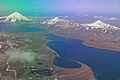
Aerial view of Fisher Caldera, with Eickelberg Peak in upper left corner

See also
