
Hot spring facts for kids

A hot spring is a natural pool of water heated by the Earth. It forms when warm groundwater bubbles up from underground. Some springs are pleasantly warm like a bath, while others are scalding hot. People love visiting them to soak, relax, and enjoy nature.
Contents
What Is a Hot Spring?

There are different ways to describe a hot spring. Usually, it is any natural spring warmed by geothermal energy. Some scientists define it as water warmer than normal human body temperature, which is about 37 °C (99 °F). Others say it is any spring that feels warmer than the surrounding air. When a pool is just slightly heated, people often call it a warm spring.
How Does the Earth Heat the Water?
The water in hot springs gets its heat from deep inside our planet. In volcanic areas, molten rock called magma sits close to the surface. Groundwater flows near this magma, warms up quickly, and rises through cracks.
Heat can also rise without volcanoes. Deep rock layers are naturally hotter than surface rocks due to the geothermal gradient. Deep down, radioactive decay of elements like uranium-238 and thorium-232 generates continuous warmth. Rainwater trickles down through deep breaks called faults. The heated water becomes lighter and floats back up to form a pool.
Geysers and Fumaroles
Sometimes superheated water gets trapped under heavy pressure underground. When steam builds up enough force, it blasts out as a geyser. A famous example is found in Yellowstone National Park. If the water boils entirely into steam before reaching daylight, it forms a vent called a fumarole. When the hot liquid mixes with dirt, it bubbles as a muddy pool called a mud pot.
Minerals and Bright Colors

Hot water can hold many dissolved rocks and mineral solids. As the water cools at the surface, these minerals harden into stone platforms.
- Silica: This mineral builds glassy rock called geyserite, which is a kind of opal.
- Carbonate: Springs with dissolved carbon dioxide create a white or tan limestone called travertine.
- Iron: Springs rich in iron leave behind bright orange, yellow, or reddish crusts.
Tiny Living Creatures

Hot springs look hostile, but they are full of fascinating life. Creatures that love high temperatures are called thermophiles. They are a type of extremophile, meaning they thrive in extreme habitats.
Right near the boiling vents, tough microscopic bacteria and primitive archaea thrive. As the water flows outward and cools, colorful mats of cyanobacteria appear. These tiny cells use sunlight to make food through photosynthesis. In the outer rings, single-celled diatoms and small plants join the mix. Some scientists believe that early cellular life on Earth began billions of years ago in volcanic pools just like these.
How People Use Hot Springs

Humans have used hot mineral waters for thousands of years. Wild snow monkeys in Japan even bathe in hot pools to stay warm during freezing winters. In Japan, traditional thermal baths are known as an onsen.
Many people visit these waters for health and rehabilitation. For example, President Franklin D. Roosevelt visited Warm Springs, Georgia to exercise his muscles. In places like Hammam Maskhoutine and across Asia, people use hot spring water for geothermal cooking. They gently cook eggs directly in the bubbling stream.
Staying Safe
Hot springs can be dangerous if visitors do not follow rules. Many natural pools are hot enough to cause severe burns. Some pools also carry dangerous microscopic bugs, such as Naegleria fowleri or Legionella bacteria. Swimmers should only enter tested, designated bathing areas.
Famous Hot Springs Around the World

Hot springs exist on every continent on Earth:
- Iceland: The spring Deildartunguhver has one of the highest water flows in Europe.
- Japan: The coastal city of Beppu is famous for thousands of bubbling vents and steaming springs.
- United States: The Excelsior Geyser crater in Wyoming pumps thousands of gallons of boiling water.
- Argentina: Travelers visit the historic baths at Termas de Rio Hondo for relaxation.
- France: The town of Chaudes-Aigues has used natural underground hot water to warm houses since the 1300s.
Images for kids
-
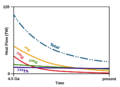
Chart showing radioactive heat inside the Earth.
-

The red iron-filled spring in Beppu, Japan.
-

A clear jungle spring in Thailand.
-

Map showing geothermal areas across the United States.


See Also
 In Spanish: Aguas termales para niños
- Geothermal energy
- Hydrothermal vent
- List of hot springs
- Mineral spring
